Source: CIA-RDP90G00152R000600770012-7
UNITED STATES ARMS CONTROL AND DISARMAMENT
AGENCY
Washington, D.C. 20451
Executive Registry
87-3109x
OFFICE OF THE DIRECTOR
August 14, 1987
MEMORANDUM FOR:
Grant S. Green, Jr.
Executive Secretary, National Security
Council
Melvyn Levitsky
Executive Secretary, Department of State
Colonel William M. Matz, Jr.
Executive Secretary, Department of
Defense
RADM Joseph C. Strasser
Executive Assistant to Chairman,Joint
Chiefs of Staff
[REDACTED]
Executive
Secretary, Central Intelligence Agency
Subject: Response to Senator Helms' Soviet ABM Compliance Questions
Request comments on attached draft response by COB, August 18.
Comments should be given to Paula DeSutter (647-8091).
/S/
William B. Staples
Executive Secretary
Attachment:
As stated.
– – – – – – – – – – – – – – – – – – – – – – – – – – – – – –
QUESTIONS TO THE PRESIDENT FROM SENATOR HELMS
QUESTION #1:
a. Because the Reagan Administration agrees with the Carter Administration that the Pechora-Krasnoyarsk Class Radars are ABM Battle management Radars, does the integrated designed pattern of redundancy, overlapping coverage, and internetting of these 9 radars provide a prohibited base for a nationwide defense?
Answer:
The Reagan Administration stated in the 1987 Report to Congress on Soviet Noncompliance that:
All LPARs, such as the Krasnoyarsk radar, have the inherent capability to track large numbers of objects accurately. Thus, they not only could perform as ballistic missile detection and tracking radars, but also have the inherent capability, depending on location and orientation, of contributing to ABM battle management. (U)
This does not constitute a USG determination that all such radars are ABM Battle management radars. However, the Administration is concerned about the relationship between these radars and other Soviet activities that could constitute preparing the base for a prohibited territorial defense. The 1987 Noncompliance Report highlighted this concern:
LPARs have always been considered to be the long lead time elements of a possible territorial defense. Taken together, the Krasnoyarsk radar and other Soviet ABM-related activities give us concern that the Soviet Union may be preparing an ABM defense of its national territory. (U)
– – – – – – – – – – – – – – – – – – – – –
QUESTION #2:
Do each of the 9 Pechora-Krasnoyarsk ABM Battle Management Radars violate Article I.2 of the ABM Treaty, by helping to provide a prohibited base for a nationwide ABM defense, and also in some cases providing a prohibited regional ABM defense?
ANSWER:
Soviet LPARs, with the exception of the LPAR at Krasnoyarsk are located on the periphery and oriented outward consistent with the ABM Treaty's provision on ballistic missile early warning radars. Thus, if the LPARs are to be early warning radars, they would be considered legal. If, however, they are not for early warning, spacetrack, or NTM, they are prohibited. (U)
– – – – – – – – – – – – – – – – – – – – –
QUESTION #3:
a. Do the 3 newly detected ABM Battle Management Radars violate Articles I, III, Agreed Statement (C), and Protocol Article I (2) of the ABM Treaty, by being near ICBM silo complexes but less than the required 1,300 kilometer separation distance from the Moscow ABM system?
ANSWER:
Such a determination has not been made. If, however, it is determined that these radars are not for early warning, spacetrack, or NTM, they would be prohibited. (U)
These radars will provide a much improved capability for ballistic missile early warning, attack assessment and accurate target tracking. The radars will be technically capable of providing support to a widespread ABM system, but there are uncertainties and differences of view about their suitability to support a widespread deployment. (S/NF)
b. Are these ABM radars within 1300 kilometers of each other?
ANSWER:
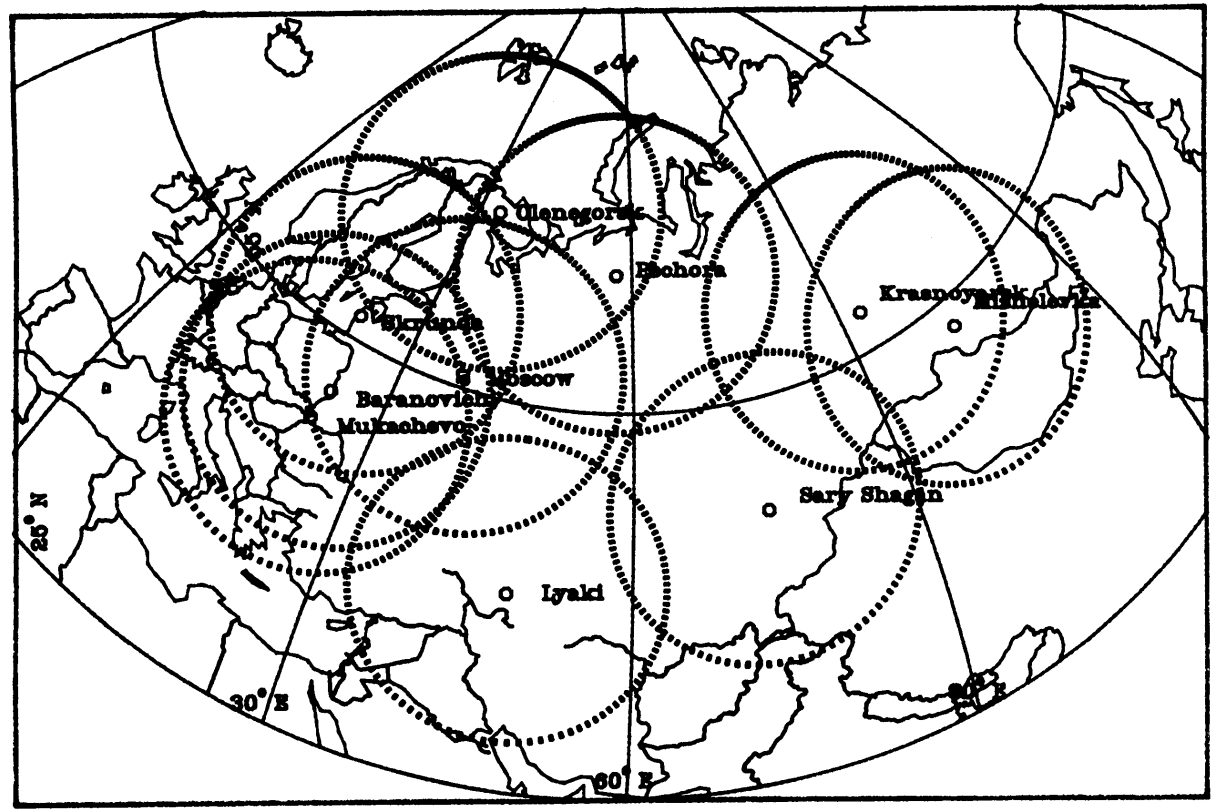
The new LPARS are within 1300 kilometers of each other: (S)
Mukachevo – Skrunda 900
KM
Mukachevo - Baranovichi 575
KM
Baranovichi - Skrunda 520
KM
– – – – – – – – – – – – – – – – – – – – –
QUESTION #4:
a. Are any of the other 9 Pechora-Krasnoyarsk Class Battle Management Radars located near ICBM silos and near ABM-capable defenses and within 1300 kilometers of the Moscow ABM system?
ANSWER:
To Be Supplied.
b. Are any within 1300 kilometers of each other? Are any of the two additional Pechora-Krasnoyarsk Class ABM Battle Management Radars predicted but as yet undetected probably going to be near ICBM silos and less than 1,300 kilometers from Moscow? (S/NF)
ANSWER:
The attacked graphic depicts all nine LPARs and Moscow, with circles 1300 KM in radius for each. (U)
One additional LPAR may be built near Sevastopol to complete the overlapping coverage of potential attack vectors. (S/WN)
– – – – – – – – – – – – – – – – – – – – –
– – – – – – – – – – – – – – – – – – – – –
QUESTION #5:
Do the Skrunda, Baranovichi, and Mukachevo ABM Battle Management Radars, near ICBM silos and less than the required 1,300 kilometer separation distance from Moscow, constitute a prohibited regional ABM defense?
ANSWER:
Such a determination has not been made. (U)
– – – – – – – – – – – – – – – – – – – – –
QUESTION #6:
a. Is the Moscow ABM system, as modernized with the longer range SH-04 and SH-08 Galosh and Gazelle interceptors, capable of defending any of the large number of Soviet ICBM silo launchers located around Moscow?
ANSWER:
The Moscow ABM system is being modernized with 68 launchers for the Gazelle short-range interceptor and 32 above ground and silo-launchers for Galosh long-range interceptors. Of these, only the 32 Galosh are potentially capable of defending silos near Moscow. This represents a reduction in any silo defense capability the Soviets may have had, since the previous Moscow system had 64 Galosh launchers. (S/WN)
b. Was the 150 kilometer radius (300 kilometer diameter) of each of the two ABM complexes allowed in 1972 designed to prevent the Moscow or a second then-allowed ABM site from defending nearby ICBM silos?
c. If so, how many ICBM silos can be defended by the modernized long range Moscow ABM site?
d. Is this capability consistent with the ABM Treaty?
– – – – – – – – – – – – – – – – – – – – –
QUESTION #7:
a. Are SAM-5s, which have also been improved to have longer range, and SAM-10s, and SAM-12s all deployed or about to be deployed around Moscow, also capable of defending ICBM silos adjacent to Moscow?
ANSWER:
The surface-to-air missile systems deployed around Moscow are not judged to be capable of defending ICBM silos closest to Moscow. No SA-12 launchers are deployed in the Moscow area. (S/NF)
b. Is this long range capability consistent with the ABM Treaty?
ANSWER:
Increased range per se is not inconsistent with the ABM treaty. The Treaty does not prohibit co-location of air defense systems and ICBMs, and the SAMs listed above could legally defend ICBMs from threats other than strategic ballistic missiles or their elements. The Treaty does, however, prohibit giving air defense systems capabilities to counter strategic ballistic missiles or their elements in flight trajectory, and it is this point that has proven difficult to determine. (S)
The 1987 President's Report to Congress on Soviet Noncompliance highlighted some of the disturbing factors regarding Soviet SAM systems and the SA-12 system in particular:
Even with as much as we know about the SA-12 system, there are disagreements about its upgrade potential. Different assumptions about the system lead to different views. At present, we are not able to judge what the actual or potential capabilities and roles of the SA-12 system might be for ballistic missile defense. (S/NF/WN)
c. Are there now reportedly 3,000 SAM-10 ABM-capable launchers deployed nationwide in the USSR?
ANSWER:
There are about 1,100 SA-10 launchers deployed nation-wide in the Soviet Union. The President's Report to Congress on Soviet Noncompliance stated that:
...concern has also existed for some time about the possibility of a ballistic missile defense capability with the SA-10 air defense system. The inherent technology in this system, and the association of some of its components with ABM/SAM operations, are also continuing causes for concern about a potential role for the SA-10 in ballistic missile defenses. (S/NF/WN)
d. Are mobile SAM-12 ABM-capable launchers now deployed close to the new Skrunda, Baranovichi and Mukachevo ABM Battle Management Radars?
ANSWER:
The only SA-12a GLADIATOR launcher unit (brigade) now deployed is at Stryy, 125 km from the Mukachevo LPAR. The SA-12 can engage conventional aircraft, cruise missiles and tactical ballistic missiles. We remain uncertain about its potential capabilities against strategic ballistic missiles. Any capabilities are based on assumptions made about design features which the system could have but which we cannot determine. (S/NF)
– – – – – – – – – – – – – – – – – – – – –
QUESTION #8:
At the time the ABM Treaty was signed in 1972, the only kind of ICBM launchers which were assumed to be deployed were silos. Soviet SS-24 railmobile ICBMs are reportedly now being deployed at the Kostroma ICBM complex near Moscow. Now that over 100 of the Soviet SS-25 roadmobile ICBM launchers have been operational for almost two years, and roadmobile SAM-12 radars and interceptors have reportedly been associated with mobile SS-25 ICBMs, are radar siting constraints in the ABM Treaty tied only to ICBM silos now completely ineffective?
ANSWER:
While this question raises a number of issues, it does not seem that the word "silo launcher" would eliminate consideration of the effect of radar siting constraints on ICBM launcher deployments -- whether these launchers be silo or mobile based. (U)
– – – – – – – – – – – – – – – – – – – – –
QUESTION #9:
a. According to press reports, the Flat Twin and Pawn Shop ABM-3 prototype radars have disappeared from the Sary Shagan ABM test range. Because the ABM-3 system is about to become operational around Moscow and is already in mass production is the best explanation for the disappearance the possibility that the prototype radars may have been covertly deployed along with many others mass produced as part of the emerging nationwide ABM defense?
ANSWER:
We have no evidence that the Soviets are mass producing or covertly deploying the Flat Twin or Pawn Shop. We judge it unlikely that the Soviets would undertake such a widespread ABM deployment in the late 1980s or early 1990s (roughly 10% chance). (S/NF)
Recent evidence indicates that one FLAT TWIN and one PAWN SHOP previously located at Sary Shagan were sent to an electronics plant near Gomel. We do not know what use the Soviets will make of these systems at the Gomel facility. (S/WN)
b. Are Flat Twin and Pawn Shop mobile ABM radars now deployed illegally, either in the field of at a new test range?
ANSWER:
The issue of whether the movement of this equipment front the test range to Gomel is contrary to the ABM Treaty is under study (S)
– – – – – – – – – – – – – – – – – – – – –
QUESTION #10:
How much warning time does the US now have before we can detect either the base for a Soviet ABM defense, or a Soviet nationwide ABM defense itself?
ANSWER:
At present, at least 3-5 years would be required to construct a new ABM radar facility and bring it into operation. An ABM launch complex requires 2-5 years to complete. We would expect that the establishment of a Soviet nationwide ABM defense would require extensive additional construction. (S/NF)
– – – – – – – – – – – – – – – – – – – – –
QUESTION #11:
How does the pattern of Soviet nationwide ABM radar coverage compare to the pattern of nationwide radar coverage of the 12-site US Safeguard ABM system planned in 1969?
ANSWER:
TBD
– – – – – – – – – – – – – – – – – – – – –
QUESTION #12:
Have the Soviets recently tested a laser from space from their "MIR" Space Station against a Soviet ICBM in flight?
ANSWER:
We have never detected a Soviet laser test from the MIR against a Soviet ICBM in flight. (S/WN/NF)