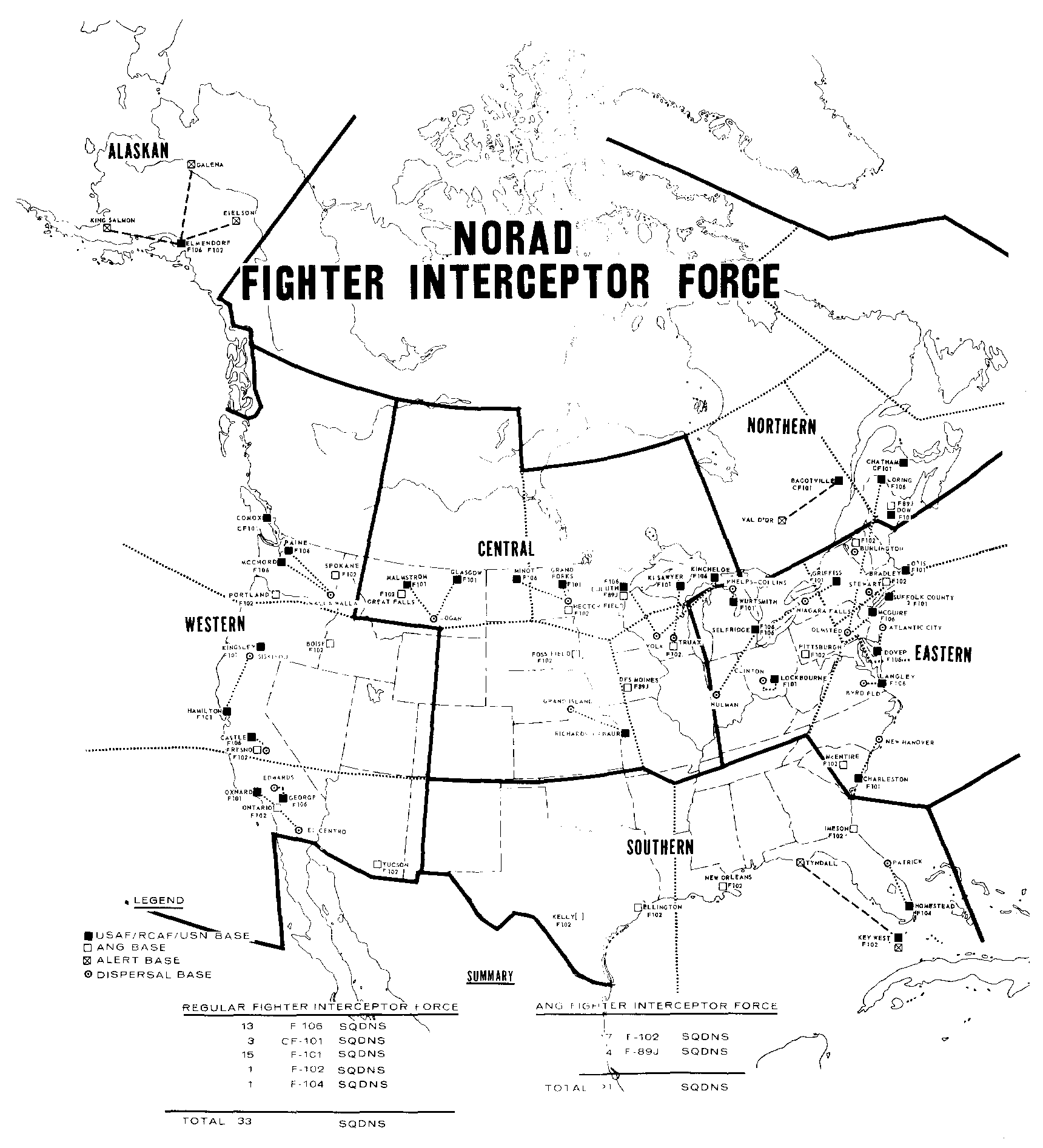
NORAD FIGHTER INTERCEPTOR FORCE
This page contains excerpted passages from the official NORAD/CONAD history that are of interest; because the full document (200+ pages) is too long to OCR exhaustively.
If you wish to see the original document, its available at this link: 6.18 MB PDF
- - - - - - - - - - - - - - - - - - - - - - - - - - - - - - - - - - - - - - - - - - - - - - - - - - - - - - - - - - - - - - - - - - - - - - - -
- - - - - - - - - - - - - - - - - - - - - - - - - - - - - - - - - - - - - - - - - - - - - - - - - - - - - - - - - - - - - - - - - - - - - - - -
(S) INTERCEPTOR FORCE
Regular: 33 Squadrons, 562 Aircraft
|
Type |
F-101 |
F-102 |
F-104 |
F-106 |
CF-101 |
|---|---|---|---|---|---|
|
No. |
15 |
1 |
1 |
13 |
3 |
Augmentation (Category I): 21 ANG Squadrons, 382 Aircraft
|
Type |
F-89 |
F-102 |
|---|---|---|
|
No. |
3 |
18 |
(S) MISSILE FORCE
8 x Bomarc B Squadrons – 230 x B Missiles, 230 Launchers
73 x RA Hercules Fire Units, 48 ARNG Fire Units – 1953 Missiles, 1198 Launchers
8 x RA Hawk Fire Units – 288 Missiles, 48 Launchers
(S) SURVEILLANCE AND CONTROL
Surveillance:
Long Range Radars: 170
Gap Filler Radars: 88
ALRI Stations: 4 off East Coast (EC-121H acft.)
AEW&C Stations: 1 off Key West (EC-121Q acft.), 5 off West Coast (EC-121D acft.)
DEW Line:
Continental Segment: 29 Stations
Aleutian Segment: 6 Stations
Greenland Segment: 4 Stations
G-I-UK Barrier (Under operational control of CINCLANT):
2 Iceland-based radars report through DYE Main
BMEWS:
3 Stations
SPADATS:
Space Defense Center
USN Space Surveillance System
USAF Spacetrack System
Canada – Baker-Nunn Camera (Cold Lake, Alta.)
NASA, Eastern Test Range, Western Test Range, and Pacific Missile Range data as available and/or upon request
NBC Systems:
Bomb Alarm System:
99 Instrumented Areas
12 Display Facilities
6 Master Control Centers
Nuclear Biological Chemical Warning and Reporting System (NBCWRS): Manual System
Control:
1 Combat Operations Center
1 Primary and 1 Secondary ALCOP
6 Region Combat Centers
16 Division Direction Centers
1 Division without a direction center (Hudson Bay)
31 NORAD Control Centers
2 Missile Masters
10 BIRDIE
2 FSQ-34
1 TSQ-38
5 TSQ-51
(S) MANPOWER AUTHORIZATION
NORAD Headquarters: 937
NORAD Region and Division Headquarters: 990
NIKE X SYSTEM
(U) NORAD issued Policy Memorandum No.6, 16 August 1965, to establish the general principles and objectives for command and control of ballistic missile defense. It was to give guidance to all concerned and was to be used as a reference for NORAD review of integration and interface requirements of all service component ballistic missile defense command and control systems during development, acquisition, and operation.
(C) On 8 September 1965, the first participation letter was sent by CONAD to the Army Chief of Staff. This letter concerned the Nike X Ballistic Missile Defense System and covered the degree of participation desired by CONAD. It also pointed out that NORAD interest extended to deployment and operation.
(U) Following an exchange of correspondence between the Army and CONAD, a meeting was held on 8 March 1966 at Redstone Arsenal, Ala., to discuss CONAD's participation in the development and acquisition of the command and control portion of Nike X. Representation at this meeting included CONAD, the Army, ARADCOM, and Nike X Project Office. It was agreed that CONAD could communicate directly with the NXPO on participation in development and acquisition matters. It was also agreed that a CONAD representative should be assigned as a working member of the NXPO at Redstone Arsenal. It was felt this would ensure proper CONAD participation. [*]
[* – (U) Lt. Col. Hubert S. Stees, Jr., USAF, after completing work with CONAD's Nike X Impact Study, was to be assigned to the NXPO.]
BALLISTIC MISSILE EARLY WARNING SYSTEM
SITE II TRACKING RADAR
(S) One of the improvements that NORAD wanted for BMEWS was to fill the low-angle gaps for detecting missiles with re-entry angles of less than 15 degrees. To fill the gap between Site I (Thule) and Site II (Clear), NORAD wanted a tracking radar at Site II. To fill the gap between Site I and Site III (Fylingdales), NORAD wanted a radar either in Iceland or Greenland.
(S) Finally, after the problem was studied and then re-studied, the Secretary of Defense approved in September 1963 a DDR&E recommendation to cancel the requirement for a gap filler between sites I and III. However, he approved the installation of a tracker at Site II.
(S) Requests for bids were sent to industry in May 1964. Specifications called for an FPS-92 radar -- an improved version of the FPS-49 – that would, in addition to filling the gap between sites I and II, provide credibility and serve as a backup to the detection radars at Site II and furnish information on satellites. At that time, the FPS-92 was expected to be operational in mid-1966.
(S) The Radio Corporation of America installed the radar and on 1 July 1966 it reached initial operational capability (IOC). On 15 September, the radar was put in full operational capability (FOC) status.
NUCLEAR BIOLOGICAL CHEMICAL WARNING AND REPORTING SYSTEM
BACKGROUND
(S) The NORAD Nuclear Biological Chemical (NBC) Warning and Reporting System, established on 1 January 1966, was created by combining two separate manual systems that had originally been set up on an interim basis until automated systems were ready. The first of these manual systems was the Nuclear Detonation and Radioactive Fall-out Reporting System. NORAD had taken over responsibility for this system from CONAD on 1 September 1959. The second system was the Biological/Chemical Interim Warning System, which became operational on 1 July 1964. The follow-on automated systems encountered technological and cost problems, however.
(S) An automated Nuclear Detonation Detection and Reporting System (NUDETS 477L) was planned to be implemented in two phases. Phase I, the prototype system, operated in the Baltimore-Washington, D.C. area and reported data to the NORAD COC for about 20 months (1 July 1964 to 27 February 1966). Ultimately, a nationwide system (Phase II) was intended to detect a nuclear detonation and provide burst data (height, yield, location) needed for attack assessment, fall-out warning, and damage assessment. However, planning for a nationwide system was canceled in the first quarter of 1965. One main reason for dropping the system was the belief that current technology would not provide an acceptable ratio between the effectiveness of the system and the cost involved. Additionally, testing of the prototype Phase I system showed that the data it provided was not reliable.
(S) Although the JCS had approved NORAD's requirement in 1961 for an automated biological and chemical rapid warning system, the main issues were that BC sensors were not sufficiently advanced to meet NORAD's needs, and there was insufficient guidance for an overall continental system. The Army, responsible for developing the system, recommended in 1964 suspending the program until suitable sensors and proper guidance were developed, and a complete evaluation of the CONUS BC warning problem was conducted. NORAD generally agreed with this approach but maintained its desire for an automated system.
(S) In March 1965, the JCS directed the Army to conduct an updated reappraisal of the requirement for a BC system through 1975. The JCS stated that this action was necessary due to changes in technical, operational, and intelligence factors since the requirement was established. NORAD and the Defense Intelligence Agency assisted in this reappraisal. As part of this analysis, NORAD updated its requirement and published it as the NORAD Qualitative Requirement for an Improved Biological and Chemical Detection Warning System (NQR 7-65) on 25 October 1965.
(S) In the NQR, NORAD affirmed the need for a rapid warning system but acknowledged that, due to the state of sensor development over the next 10 years, such a system could not be established at present. The NQR noted that while all elements of the system might not be developed before 1975, an improved system could be achieved by upgrading the interim manual system incrementally as development allowed. The NQR emphasized the need for research and development on sensors and research on design parameters for an automated system. NORAD stated that the automated system would not be needed until the threat from strategic BC weapons justified it and the cost-effectiveness ratio was acceptable.
(S) On 15 December 1965, the JCS forwarded the Army's reappraisal to DDR&E. In January 1966, the JCS informed NORAD that guidance had been issued on developing the system. The JCS stated that, due to the limited strategic threat, there was no need for a nationwide system to warn of a chemical attack. However, there was a need to develop a system to rapidly detect a biological attack. The Army was directed to establish a development program for biological sensors to support NORAD's requirement when research indicated that such sensors were technically feasible. The JCS stated that NQR 7-65 was to be used as broad guidance in the development effort. Additionally, CINCNORAD was to inform the JCS of any significant change in the BC threat to North America.
STATUS
(U) As noted above, the NBC Warning and Reporting System was established on 1 January 1966. The operation orders for the two manual systems that were combined to create the NBCWR System were replaced by a single document: NORAD Operation Order 303N-66, dated 26 November 1965. This order stated that the system was to detect, identify, and report all nuclear detonations (excluding tests) and enemy use of biological/chemical weapons, as well as resulting contamination in or adjacent to the CONUS, Alaska, the DEW Line, and its extensions. The system was to evaluate the reported data and issue appropriate warning reports.
(U) Procedures and techniques for collecting and reporting data were published in NORAD Manual 55-10, dated 17 January 1966. Detection and warning teams were to make observations and report data on NBC activity to reporting stations. These reports were then relayed through the NORAD communications system to the NORAD COC. Data from these reports would be evaluated, and if appropriate, warning reports would be verbally communicated to the JCS and other headquarters.
BOMB ALARM SYSTEM
RECONFIGURATION STUDY
(U) Another system for detecting nuclear detonations, developed by the Western Union Telegraph Company, was the Bomb Alarm System. This system was designed to automatically report nuclear explosions to the NORAD COC and other key military and civilian agencies. The BAS became operational on 1 September 1962 with sensors at 97 locations in the CONUS and at the BMEWS sites at Thule and Clear.
(U) In September 1964, USAF ADC asked NORAD to review the BAS coverage and advise whether any changes were needed. ADC believed that due to changes in both military structure and urban/industrial areas, there might be areas requiring coverage, as well as areas that no longer needed it.
(S) NORAD expressed a desire to add Eielson AFB and Elmendorf AFB, both in Alaska, to the BAS. In April 1965, USAF stated it would not approve NORAD's requirement because a JCS study group had already prepared a list of sites that would utilize the entire capacity of the BAS (120 sites). The purpose behind this planning, according to USAF, was for the system to indicate the ratio of an attack among urban, industrial, and military targets, rather than simply notifying that an attack had occurred.
(S) NORAD referred the issue to the JCS on 2 June 1965, reminding them that operational control of the BAS had been given to CINCNORAD. NORAD inquired whether it was compatible with current concepts to include the Alaska bases in the BAS and if action should continue on the matter. On 8 June, the JCS responded that a study was being conducted on all attack assessment systems, including the BAS. They noted that the study group was considering expanding the system but that it did not include Alaska.
(S) The JCS study group concluded that the BAS, if properly configured, was one of the few potential sensor systems that could provide valid information on the weight and nature of an attack under all but the most severe general war attack conditions. The JCS submitted a study to DOD recommending the expansion of the BAS. Around the same time, in September 1965, they asked the Defense Communications Agency to provide NORAD with technical assistance to reconfigure the system, expanding it to its design capacity. To assist NORAD, DCA requested that USAF prepare a plan to reconfigure and improve the BAS. The system, in addition to its warning functions, was to provide attack assessment to the National Military Command System.
(S) On 7 March 1966, DCA requested NORAD's recommendations on the plan USAF had prepared, which called for expanding the system to 120 sites. Comments were submitted to DCA on 14 June, recommending against expansion but in favor of relocating several sites.
(S) The JCS held a meeting at the Pentagon on 13 June 1966, including representatives from NORAD, USAF, and DCA, to review a USAF Program Change Request for reconfiguring and expanding the system. The JCS determined that the rationale and basis for the list of sites needed review. They found insufficient justification to expand the BAS to its full capacity because 34 sites were at military bases that were either scheduled to close or had lost importance as targets. A revised BAS site list was created, including 34 sites (20 military and 14 urban/industrial) to replace those previously noted. The total number of sites was set at 100.
(S) NORAD agreed with the proposal to reconfigure the system, except that it wanted two sites in Canada and one additional site in Alaska included. (Eielson AFB, a SAC base, had already been added to the latest list of sites.) On 27 July 1966, NORAD recommended to DCA that two high-priority military centers, Canadian Forces Headquarters and North Bay, both in Ontario, replace the urban/industrial centers of Louisville, Ky., and Bridgeport, Conn. Additionally, NORAD recommended substituting Elmendorf AFB for Dallas, Texas.
(S) DCA revised the list of sites according to NORAD's recommendations and then asked USAF on 26 August to prepare a revised plan to reconfigure and improve the BAS using the new list. The system was to serve as an attack assessment tool for the National Military Command System and was to be consistent with NORAD's recommendations. The system was also to remain a warning system for NORAD. The USAF plan for modifying the BAS was to include a proposed schedule and cost data and was to be coordinated with the JCS, DCA, and NORAD. USAF directed ADC to create this plan.
BACKUP POWER FACILITIES
(S) Both NORAD and USAF were concerned about a major power failure in the northeastern area of the U.S. in November 1965, which had temporarily disabled 13 Bomb Alarm System sites from reporting a nuclear explosion. They asked ADC to investigate ways to prevent this from recurring.
(S) ADC determined that the BAS outage was not caused by power failure at the sites, as initially thought, but by power failure at relay stations. ADC discussed solutions with Western Union to provide these relay stations with backup power. Acceptable solutions were identified. In March 1966, NORAD learned that the company was initiating a program to equip all major relay stations with diesel generator backup power. Additionally, Western Union proposed to provide, at its own expense, backup power for one sensor (of three sensors) at each site in the system. NORAD concurred with this proposal on 16 September 1966.
STATUS SUMMARY
(S) The NORAD regular interceptor force decreased by five squadrons (38 to 33) during 1966. Four F-102 squadrons and one F-104 squadron were removed from the NORAD force. By 1 January 1967, the total number of interceptor aircraft had dropped from 688 to 562. The number of ANG (Category I) squadrons stayed at 21, but the number of aircraft rose from 380 to 382. There were 18 F-102 squadrons with 329 aircraft and three F-89J squadrons with 53 aircraft. The ANG continued its F-102 conversion program and at the end of 1966 there were just three squadrons that had not begun conversion. [*]
[* – (U) For further rationale on F-102 Conversion, see p. 116.]
(S) The number of BOMARC missiles in the eight squadrons dropped from 238 to 230 as a result of eight evaluation launches under the BOMARC B Combat Evaluation Launch (CEL) Program. [**] Ten Regular Army Nike Hercules fire units at four SAC bases were inactivated on 1 March 1966, leaving 73 RA fire units under NORAD control. The total of eight RA Hawk fire control units with 48 launchers and 288 missiles did not change, and the Army National Guard total of Nike Hercules fire units remained at 48.
[** – (U) For further explanation of the 1966 CEL Program see p. 137. For a description of the complete CEL Program, see NORAD/CONAD Historical Summary, Jul–Dec 1964, pp. 77–80.]
NORAD FIGHTER INTERCEPTOR FORCE
4. MADPAC - ADC had presented a proposal to USAF for a Mobile Air Defense Package (MADPAC) to provide a highly mobile world-wide air defense team of F-4C's and AEW&C aircraft (the interceptors would be additive to the required CONUS forces). However, F-102's were to be used until F-4C's were available. The concept was for an F-4C equipped wing based at Richards-Gebaur AFB, with aircraft deployed to Key West, Goose Bay, Iceland, and Alaska when required. A decision was required on this proposal as soon as possible so that if it was disapproved or delayed, any additional F-102 aircraft could be made available to the ANG.
(S) During the late 1950's the capacity of the Soviet airborne ECM (jamming) systems increased steadily. The ECCM features on the NORAD interceptors became more and more inadequate. In 1960, when USAF was forced to reduce the planned interceptor force, a compromise was made to modernize the current interceptors. Accordingly, the Air Force contracted Hughes Aircraft Company to develop a number of modifications which would improve primarily the ECCM capabilities of the F-101, F-102, and F-106.
(S) The ECCM improvements were divided into two blocks for installation. The Block I IIP installation included the Infrared Search and Track System for the F-101, F-102, and the F-106, as well as Anti-Chaff Circuitry and Silent Lobing Antennas for the F-101 and F-106. The Block I IIP was completed in December 1964. The Block II IIP installation included Pulse-to-Pulse Frequency Shift (rapid tuning) radars, and Parametric Amplifiers for the F-101 and F-106. The Block II IIP was completed in December 1966.
BACKGROUND
(S) One of the most important issues in the anti-bomber defense was the deployment of an Improved Manned Interceptor (IMI). [*] Development of the IMI concept began in 1959 upon cancellation of the F-108 program. Subsequently, NORAD continually identified a need for the IMI in the annual NADOP and stated its requirements in NQR 4-64, Improved Manned Interceptor, dated 4 December 1964. [**]
[* – (U) See Historical Reference Paper #6, "NORAD's Quest for NIKE Zeus and a Long-Range Interceptor," 1 July 1962.]
[** – (U) The term "Improved Manned Interceptor" (IMI) is a euphemism originally intended to refer to the Lockheed F-12 (A-11) aircraft. There are currently three principle aircraft; the Lockheed F-12, the Convair F-111 and the McDonnell F-4 contending for the IMI role.]
(S) In NADOP 1967-76, dated 15 October 1965, NORAD recommended that funds be provided for the initial production of the F-12 in FY 1967 and for 12 squadrons (18 UE) for the U.S. forces and three squadrons (12 UE) for the Canadian forces during the FY 1969-1970 period. The NADOP also recommended the gradual phase out of century series fighters, keeping the best aircraft until the IMI force reached the desired operational capability.
(S) USAF was also interested in getting the F-12. In August 1965, USAF asked OSD to increase the RDT&E funds for FY 1966 and for $205.6 million in FY 1967 for continued development and limited procurement of the F-12. In his statement on the 1967 defense budget, the Secretary of Defense said he would allocate $10 million for continuing the F-12 program. During November and December 1965, USAF asked SAC, NORAD, and ADC to back the Secretary of the Air Force in his position to keep the option to produce and deploy the F-12. However, USAF's PCP (#65-66) was disapproved on 11 December 1965.
(S) NORAD conducted a series of war games to determine the effectiveness of various F-12 force levels. An analysis indicated that a total inventory of 112 F-12 aircraft was enough to counter the bomber threat after 1970. Shortly afterwards, a USAF study called "Blue Lance" resulted in findings that were very similar to NORAD's. In each study, the number of F-12's required to meet comparable threats was essentially the same.
(S) On 18 March 1966, CINCNORAD informed the JCS of a new force requirement for 112 F-12's by FY 1976. USAF ADC agreed with CINCNORAD's requirement, but said there might be a need for a more rapid buildup before 1976. ADC based this on the fact that the CANUS threat did not take into account the possibility of the Soviets developing and deploying follow-on supersonic bombers.
(S) In NADOP 1969-76, 1 November 1966, NORAD recommended buying the F-12 for deployment starting in 1972, building up to 112 aircraft by FY 1976 for CONUS defense, and two squadrons totaling 30 aircraft for Canada. NORAD recommended keeping the F-101 squadrons as outlined in the required force (phasing out the last three squadrons in FY 1974). NORAD also wanted eight squadrons of F-4's, starting in FY 1969, to augment the existing forces and to replace the F-101's and F-106's in the regular force. This would permit modernization of the ANG with the F-106.
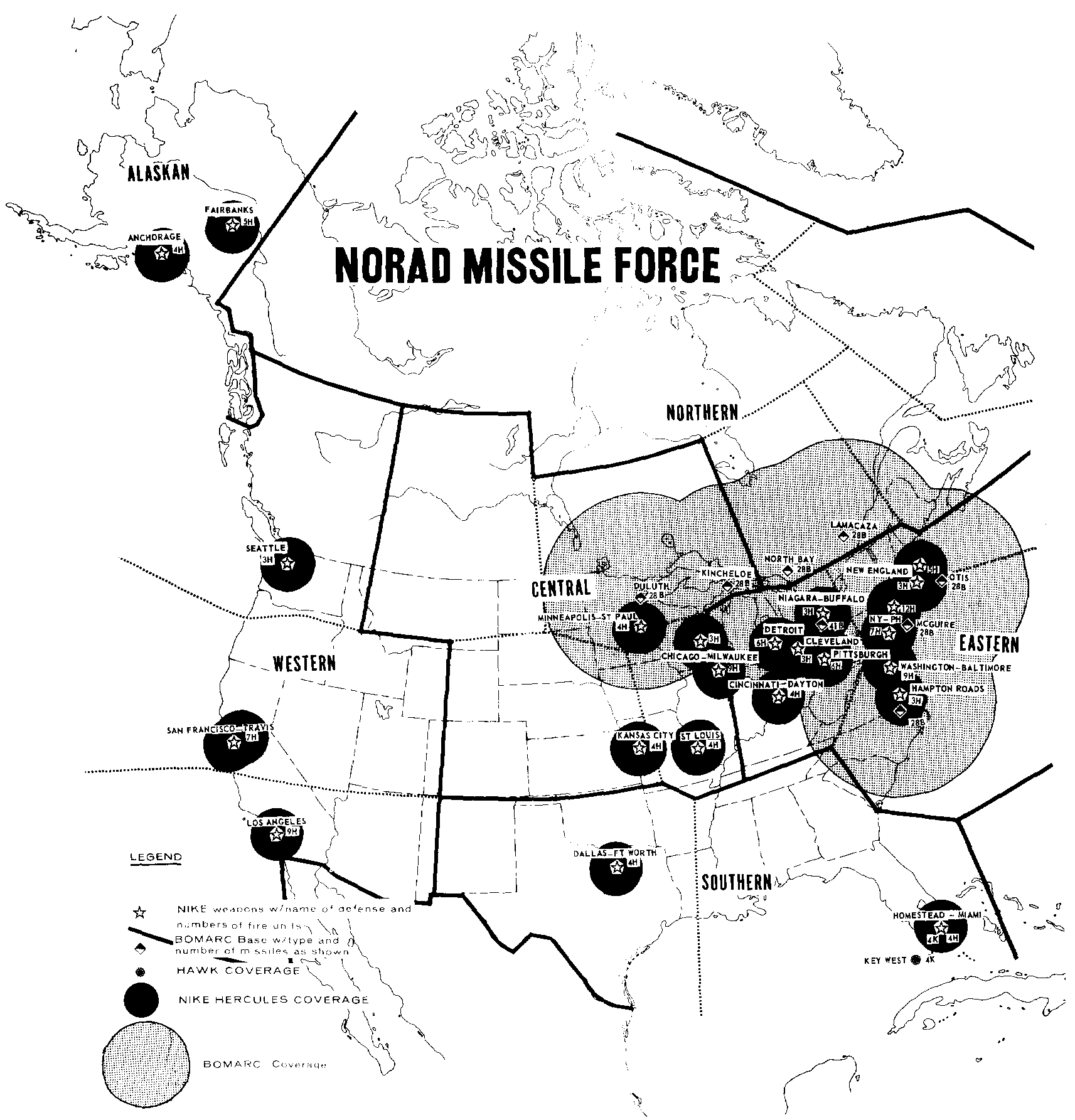 NORAD MISSILE FORCE
BOMARC CIM-10B
(S) In November 1965, OSD had approved a USAF request for regular Canadian participation in the BOMARC B Combat Evaluation Launch (CEL) Program. [*]
[* – (U) For a description of this program see NORAD/CONAD Historical Summary, Jul-Dec 1964, pp. 77-80.]
The program allowed each of the eight BOMARC squadrons (6 U.S./2 Canadian) to process and fire one missile each year. The first 15 missiles to be fired under the CEL Program were to come from the Niagara BOMARC Squadron. This reduction would bring the Niagara Squadron down to the same level as the other squadrons (28 missiles). At the conclusion of this phase, a gradual reduction in the missiles of each BOMARC squadron was anticipated.
(S) 447 SAM Squadron, LaMacaza, Que., was scheduled for a launch on 15 March 1966. However, due to three consecutive missile range safety destruct system failures, which prevented missile destruction after intercept, launches were suspended. On 14 February, ADC set up a new launch schedule. This schedule was based on the Ogden Air Materiel Area (OOAMA) being able to come up with a new destruct system in time for the first launch on 26 April 1966.
(S) When the 22 ADMS, Langley AFB, was unable to perform the scheduled launch on 26 April 1966, because of a conflict with an upcoming NORAD ORI of the 26th Air Division, the 446 SAM Squadron, North Bay, Ontario, was scheduled to conduct its launch instead. A new destruct system was ready by the end of March and the launch was carried out on 26 April 1966 successfully. Also, the 447 SAM Squadron was scheduled for a launch on 21 June 1966, but the mission was aborted due to telemetry malfunctions. It was re-scheduled for 28 June 1966, and was successful at that time.
(S) On 18 July 1966, ADC discontinued using QF-104 drones for these launches because they were in short supply and were needed for higher priority projects. This shortage was a result of the improved accuracy of the BOMARC B, to the extent that direct hits had resulted in the loss of several targets on the last few launches.
NIKE HERCULES
(S) Since 1962, NORAD had recommended the re-deployment of 18 NIKE Hercules units from nine soft SAC bases and four units from Thule AB. [*] NORAD proposed moving the 22 units to unprotected urban/industrial areas. In May 1965, the Army proposed to delete the 22 Hercules units during FY 1966. At that same time, the JCS recommended to the Secretary of Defense that eight Hercules units be used for USARSTRIKE and Guam requirements and that the rest be inactivated in FY 1966. However, on 8 December 1965, the Secretary of Defense decided to inactivate all 22 units. [**]
[* – (U) For a detailed background, see NORAD/CONAD Historical Summary Jan-Jun 1964, pp. 67-71.]
[** – (C) Four units from Thule AB were inactivated 1 June 1965, but their eventual disposition was not decided until 8 December.]
(S) On 22 December 1965, the NIKE Hercules fire units (eight total) defending Barksdale, Fairchild, Turner and Robbins AFB's were removed from operational status. On 1 March 1966, the fire units (10 total) defending Loring, Dyess, Bergstrom and Lincoln-Offutt AFB's were removed from operational status.
(S) Early in November 1966, ARADCOM was directed by the Army to make a comprehensive review of its NIKE Hercules defenses. This study, which was requested by the Secretary of Defense, was to be reviewed by the JCS prior to submission to DOD. The study was to include recommendations on identification of sites for deletion, improvement of siting, and other operational adjustments.
(S) On 30 November 1966, ARADCOM asked for NORAD war gaming assistance for the study. Two area defense war games were conducted on 20 December, with four to six additional games to be carried out in early 1967. The Army wanted the study by 15 March 1967.
NIKE X
(S) Since 1958, NORAD had stated a requirement for Nike-Zeus -- an active Anti-Intercontinental Ballistic Missile System -- in each of its annual objectives plans as one of its primary objectives. From 1960 on, the requirement was NORAD's first priority. However, the Zeus program never advanced beyond the research and development (R&D) stage and the initial employment date of 1962, slipped to 1967.
(S) The FY 1963 Army budget provided funds for development of a prototype ZMAR (Zeus Multi-purpose Array Radar), and funds to initiate R&D on SPRINT (the high performance quick reacting missile). At the end of 1962, OSD proposed to cancel further development of the basic Zeus system and proceed with R&D of ZMAR and SPRINT. The JCS rejected the proposal with the concurrence of the Army, Navy, and USAF, although USAF also recommended deferring deployment of the Zeus until its capability was proven by more testing.
(S) During 1963, NORAD's most urgent requirement, which still was to obtain an active defense against the ballistic missile threat, was not fulfilled. The prospect of deploying an operational AICBM system in the near future had brightened little over the years, and passive defense measures, such as warning and very limited hardening, were the only operational realities. The road to an AICBM system was mired by technical uncertainties and prohibitive costs.
(S) Thinking changed from trying to get a system for launch or mid-course destruction to gaining a terminal destruction capability. In FY 1964, the NIKE Zeus program was replaced by Nike X. The Army's Nike X development plan dated 30 September 1963, was presented to the Secretary of Defense on 6 November 1963. The basic Nike X system consisted of Surveillance Array Radars (SAR's), Multi-function Phased Array Radars (MAR's) Missile Site Radars (MSR's), data processing equipment, and Sprint and Zeus missiles. Initially, deployments developed were designed for a concept of several defended areas. Sophistication of deployment options depended on the size and importance of the area to be defended.
(S) By improving the Zeus missile capability and substituting a Tactical Multi-function Array Radar (TACMAR) for the MAR, a less expensive deployment option called the Light Attack Defense Option (LADO), was completed while growth potential to the full Nike X system was retained. A PCP for the LADO was presented to DOD in June 1965 to get pre-production funds in the FY 1967 budget. The Secretary of Defense then asked for an Army LADO deployment proposal.
(S) Meanwhile, NORAD published NQR 6-65, 15 July 1965, for a Terminal Ballistic Missile Defense System. In the NQR, NORAD stated that Nike X could fulfill this role. The Army made a Nike X deployment study (DEPEX) and presented a LADO deployment proposal to the Secretary of Defense on 8 October 1965. However, it was disapproved by DOD in January 1966, and the deployment decision was postponed for another year.
(S) The Army went ahead with several other deployment studies called Nike X Studies for 1966 (short title: X-66). The studies developed four basic types of deployments for the United States and three each for NATO and Japan. The four CONUS deployments included:
1. A defense against an early Chinese Communist threat.
2. A defense against a more sophisticated Chinese Communist threat.
3. A defense capable of major damage limiting against the Soviet threat.
4. Hardsite defense of strategic offensive missile forces. (The hardsite defense requirement was later reassigned to a joint Army-Air Force study group).
(S) On 9 May 1966, the JCS directed CINCONAD to find out what effects Nike X would have on other military systems. To make this study in the manner prescribed by the JCS, CINCONAD established the CONAD Nike X Impact Task Force (CXTF) on 26 May 1966. Approximately sixty military and civilian specialists were assigned to the CXTF. Maj. Gen. A. G. Salisbury, USAF, replaced Maj. Gen. F. R. Terrell, USAF, on 15 August as Director of the Task Force. The study was to be completed in February 1967.
(S) Beginning in September 1960, NORAD had conducted three consecutive annual large-scale exercises called Sky Shield. The primary purpose of these was to exercise the entire air defense system against a mass attack on the North American Continent, within an ECM environment. To permit unrestricted use of ECM, all non-participating civil and military traffic in Canada and the U.S. was grounded during the exercises. SAC furnished most of the attacking force. NORAD had planned to run Sky Shield IV in August or September 1963, but SAC did not want to participate. SAC preferred the SAC/ NORAD program for region exercises which, it said, gave its crews better training and was more realistic than Sky Shield. [*] The JCS agreed with SAC and cancelled Sky Shield IV. The original annual exercise plan had been for one command-wide, large-scale exercise (Sky Shield), and three semi-large-sca1e exercises named Top Rung. When Sky Shield IV was cancelled, an additional Top Rung exercise was substituted. Since that time, Sky Shields have not been held, but Top Rungs have been conducted quarterly instead.
[* – See NORAD/CONAD Historical Summary, Jan-Jun 1963, pp. 72-74, for more detail. ]
(U) During 1966, Top Rungs were NORAD/SAC exercises for giving maximum air defense training in an ECM environment to the entire NORAD system within an exercise area. As well, they were used to examine and improve specific aspects of air defense operations. In providing a strike force of between 85 and 90 aircraft, SAC's primary objective was to exercise and evaluate penetration tactics and equipment.
(S) Four Top Rung exercises were conducted during 1966: Top Rung XI on 3-4 February for what is now Central NORAD Region; Top Rung XII on 6 May for Western and Alaskan Regions; Top Rung XIII on 5 August for Eastern and Northern Regions; and Top Rung XIV on 4 November for Central and Southern Regions.
(S) With the phase out of the SAC EB-47 ECM force (fourth quarter FY 1965) that had provided most of NORAD's ECCM training, NORAD's concern increased about facilities for ECCM training and evaluation of its forces.