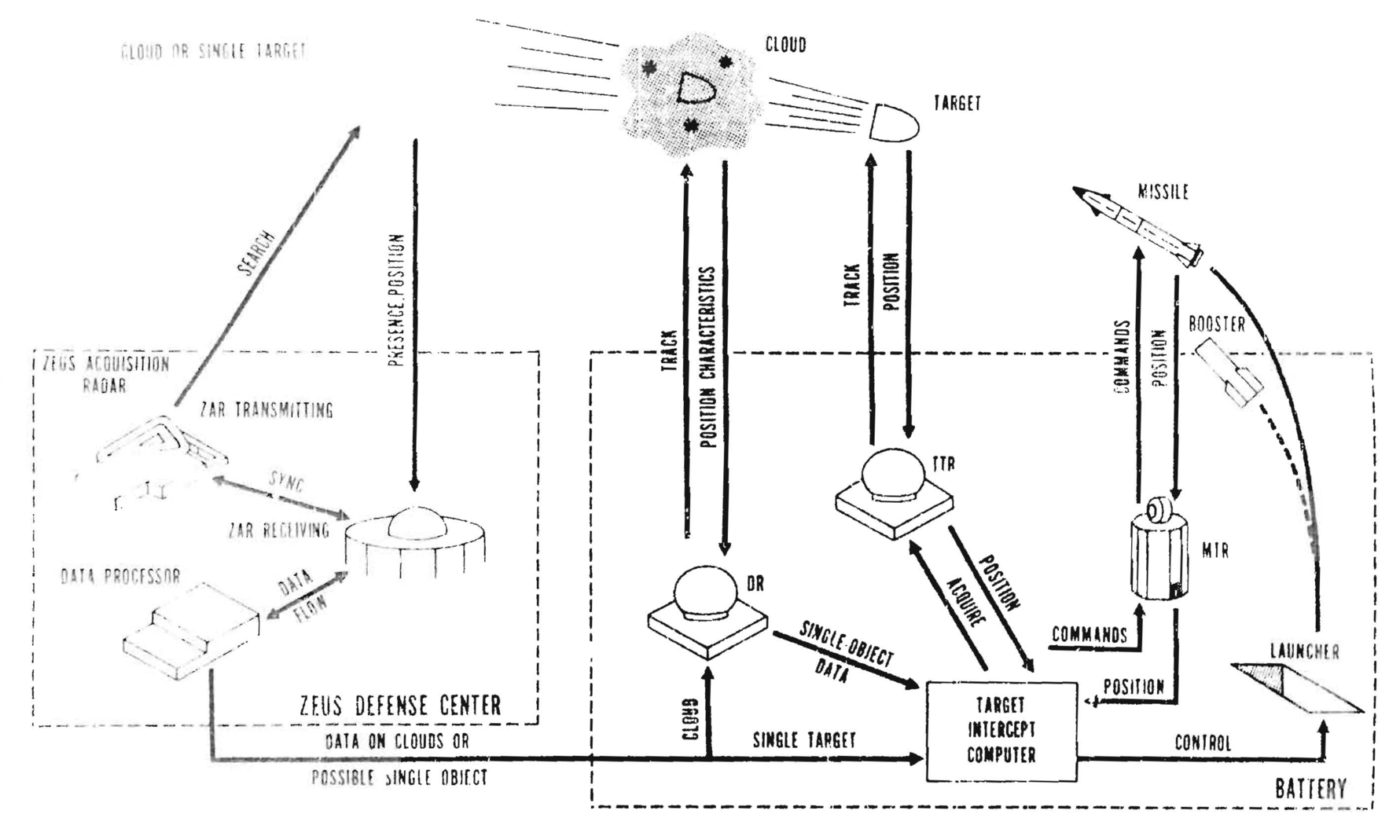
SIMPLIFIED BLOCK DIAGRAM OF NIKE-ZEUS SYSTEM
NORAD'S QUEST FOR NIKE ZEUS AND A LONG-RANGE INTERCEPTORHistorical Reference Paper No. 61 July 1962Directorate of Command
History
|
This is a study of NORAD's efforts to get two weapons systems: Nike Zeus and a long-range interceptor. Both were considered by NORAD to be vital to the defense of the continent. No other requirements in air defense history have been sought after for a longer period of time.
Colorado Springs, Colorado
1 July 1962
L. H. BUSS
Director of Command History
CHAPTER I - NORAD REQUIREMENT FOR NIKE ZEUS
Nike Zeus Background
Summary of NORAD's Requirement for Nike Zeus
CADOP 56-66
NADOP 59-63
NADOP 61-65
NADOP 62-66
NADOP 63-67
NADOP 64-73
Interim Satellite Intercept Capability
CHAPTER II - THE LONG RANGE INTERCEPTOR
Background
Early Attempts to Get a Long Range Interceptor
Beginning of the F-108 Program
Support and Decline of the F-108 Program
Continued Efforts to Get a Long Range Interceptor
SOURCES
ILLUSTRATIONS:
Simplified Block Diagram of Nike Zeus System
Nike Zeus DM-15B
Map Showing NADOP 64-73 Nike Zeus Deployment
The F-108
– – – – – – – – – – – – – – – – – – – – – – – – – – – – – –
SIMPLIFIED BLOCK DIAGRAM OF NIKE-ZEUS SYSTEM
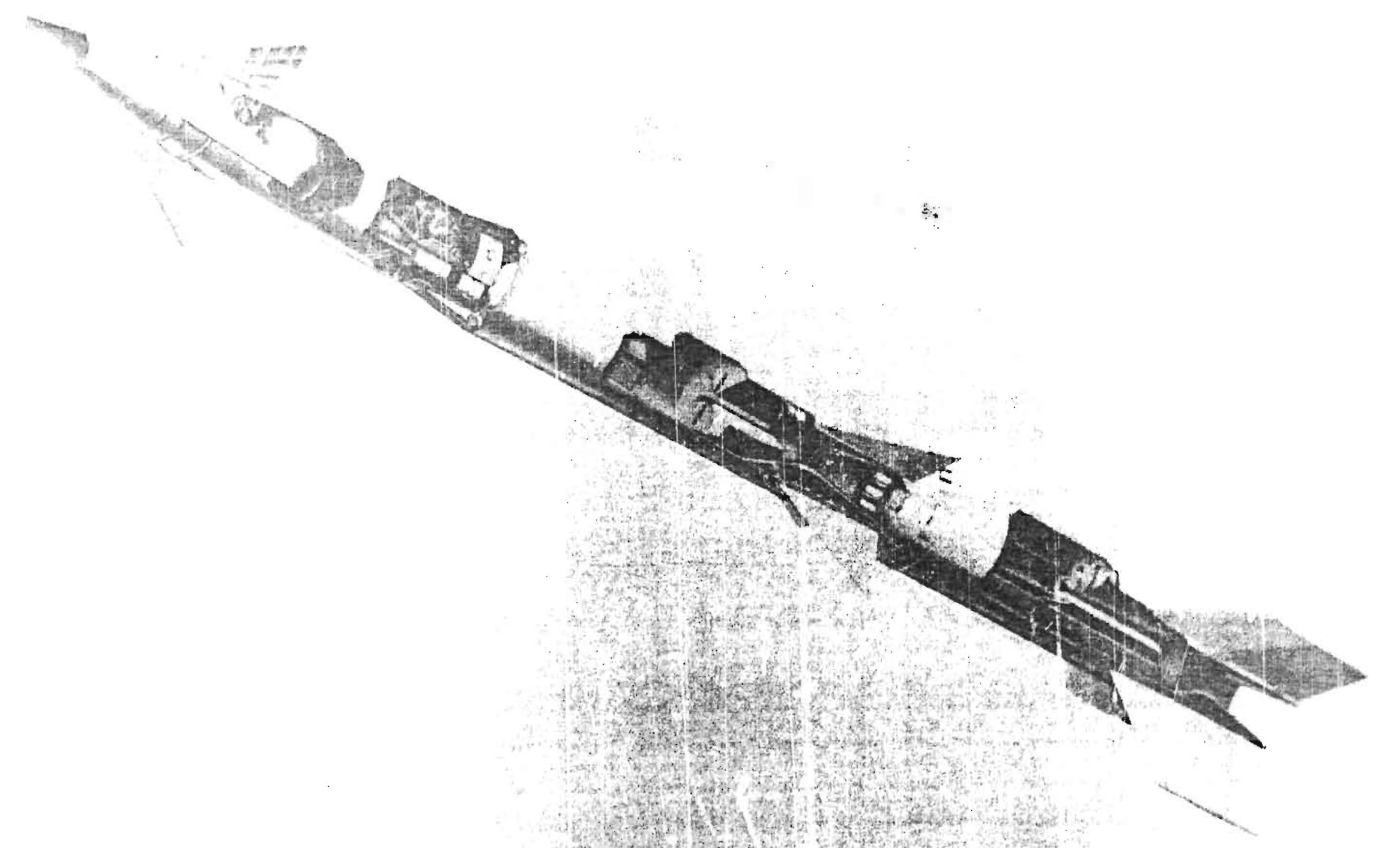
NIKE-ZEUS DM-15B
Nike Zeus, which was originally called the Nike II project, had its origin back in 1955. In March of that year, the Army gave a contract to Bell Telephone Laboratories and the Douglas Aircraft Company for a study on ground-to-air guided missile systems capable of engaging the threat to the U.S. in the 1960-1970 period. [1] The primary emphasis was to be given to defense against ballistic missiles. Out of this came the Nike Zeus concept. The study was completed and delivered to the Army in late 1956. The concept of the Nike Zeus was approved and on 14 March 1957, the Zeus project was formally established. [2]
While the Zeus project was getting underway, the U.S. Army Air Defense Command (ARADCOM) made a study of the needs to combat the threat to the U.S. during the 1960's. This was submitted to DA in December 1957. The concept outlined in this study was that the Nike Zeus system would be deployed to defeat the ballistic missile threat and the Superhawk system to defeat the airborne threat. [3] On 31 January 1958, DA stated that the study was consistent with Army staff concepts on positions in this area. The Department of Defense approved funding for development of both systems. In January 1958, Zeus was given the highest national priority by the National Security Council. [4]
As it eventually developed, the Nike Zeus research and development program became a team effort directed by Bell Telephone Laboratories with 16 major subcontractors and 58 other subcontractors. Douglas Aircraft Company was responsible for the design and development of the missile, the launcher, and associated ground handling equipment.
Testing of the Zeus system was being carried out at four different sites: White Sands Missile Range, New Mexico; Point Mugu, California; Ascension Island; and Kwajalein Island. The first firing of a Zeus missile took place at White Sands on 26 August 1959. This was only partially successful. The first fully successful flight took place in February 1960. A missile was fired first from Point Mugu in September 1961 and from Kwajalein in December 1961. Also in the latter month, a Zeus successfully intercepted a Hercules missile at White Sands.
Kwajalein was selected as the site for demonstration of the full system capability less nuclear warhead intercept. Zeus missiles were scheduled, beginning in 1962, to be fired against Atlas and Titan ICBM-carried Zeus target vehicles launched from Vandenberg AFB, California.
The tactical site of the Zeus system consists of two major parts. [5] These are the Zeus Defense Center and the Zeus Firing Sites. The former is the control center of the system. It can control up to five batteries. It consists of a Zeus Acquisition Radar (ZAR), which initially detects ballistic objects, data processing and control equipment, and communications terminals. The ZAR has a designed range of 525 - 550 nautical miles on a target of 0.1 square meter. The Firing Site consists of all equipment for the actual conduct of an engagement. It contains tracking and discrimination radars, ground guidance equipment, Zeus missiles, and communications terminals.
The Zeus missile consists of a booster, sustainer, and jet head control terminal stage and has an overall length of 48-1 3 feet. Solid propellants are used in the motors. The jet head controls provide control out of the sensible atmosphere with control within the sensible atmosphere provided by the aerodynamic surfaces. Missiles of varying numbers would be assigned to a Battery and emplaced in nests of four in underground vertical launchers.
In defending against an ICBM attack, the Zeus Acquisition Radar would detect the incoming re-entry body or cloud and track the target and determine the threat value. If the target is unaccompanied by decoys, the ZAR would assign the battery target intercept computer and target track radar to carry the track. If the warhead is accompanied by a cloud of decoys, it would assign a discrimination radar. [*]
[* – The first research and development model of this radar was scheduled for operation at White Sands in the fall of 1962 and the second at Kwajalein late in 1963.]
This radar would subject the returns from the objects in the clouds to various tests and determine the likelihood ratio for each object (probability that it is a warhead, over the probability that it is not). Once discrimination has been accomplished and the target track radar, missile track radar and defensive missile assigned, the missile is launched and engagement made at maximum possible range. The time for ordering burst is determined by the computer from the predicted intercept geometry. Burst is ordered when the kill probability is greatest.
As of mid-1962, Nike Zeus remained in a research, development and testing stage. It was still the only AICBM system available and was sought after by NORAD as its first priority.
As shown on the table on the following page, beginning in 1958, NORAD put a requirement for Nike Zeus, as one of its primary objectives, in each of its annual objectives plans. Beginning in 1960, the requirement for an active AICBM system was placed in first priority in NORAD objectives plans. In the 1962 NADOP (64-73), NORAD stated that the early deployment of Zeus, as the only AICBM system available, was its first priority.
In each NADOP, the desired date of attainment of the requirement had to be pushed farther and farther into the future. The first NADOP (59-63), issued in 1958, stated an objective of having an initial deployment at 16 locations by FY 1962. The 1962 NADOP had to push this date for initial deployment (a much smaller deployment) back to FY 1967, five years later.
Following is the record of the ups and downs of Zeus, some of the important statements about it, and NORAD's quest for it.
NORAD (established in September 1957) asked for Zeus by name for the first time in 1958. CONAD had issued an objectives plan in late 1956 that included a general requirement for a ballistic missile defense system. It covered no specific equipment, deployment, or time.
CONAD backed this up with a letter to USAF, as Executive Agency for the JCS, in March 1957, asking that full recognition and effort be put on this requirement to get a system to meet the threat. CONAD declared that a ballistic missile defense system was its most urgent future requirement. USAF's Vice Chief of Staff, General Thomas D. White, replied that the Air Force would fully support CONAD's views on the urgency of timely development of a ballistic missile defense system. [6]
The first detailed, specific requirement for a ballistic missile defense system was contained in NORAD's two-volume objectives plan issued in December 1958: North American Air Defense Objectives 1959-1969 (NADO 59-69) and North American Air Defense Objectives Plan 1959-1963 (NADOP 59-63). NADO, a ten-year projection, covered concepts, philosophies, and qualitative objectives. NADOP, a five-year projection, set forth the qualitative and quantitative force structures.
In NADO, NORAD said that a ballistic missile defense was a prime requirement: "Regardless of cost, if we are to prevent war, we must acquire an effective AICBM as a matter of the highest priority." In NADOP, NORAD stated an objective specifically for Zeus and included a requirement for contingency funds for an accelerated Zeus program.
Right after NORAD's plan was issued, the Commander of the Army Air Defense Command, Lieutenant General Charles E. Hart, wrote to CINCNORAD, General Earle E. Partridge, asking him to appeal to the JCS for an immediate commitment to production of Zeus. General Hart said that in the preceding November, the JCS had considered production but had not given approval. The JCS action, General Hart said, was a split paper in which the Army concurred in FY 1960 production, whereas the Navy and Air Force dissented. [7]
General Hart pointed out that when the decision was made to hold up on production, NORAD's NADOP, published in December, was not available. So the door was still open for assertion of an urgent requirement.
General Partridge was not sure that another appeal would help. He replied that he had discussed the matter in Washington and had been told that the deletion of funds from the Army's budget for 1960 to initiate production was by direction from the highest level. [8] So he said he did not believe it would be profitable to reopen the subject at JCS level.
A few days later, General Partridge discussed Zeus with Dr. Herbert F. York, Director of Defense Research and Engineering. Dr. York indicated that he was opposed to Zeus' production at that time, the General reported, because this "would only lead us down a false path from which we would have to withdraw in order to follow another approach to a successful missile." [9]
Following this there seemed to be some shift in Washington and apparently at the request of the JCS, CINCNORAD made an appeal in May 1959 to the JCS for the authorization of 150 million dollars out of FY 1960 funds for pre-production procurement and tooling. [10] And some success seemed possible with the issuance in June 1959 by the Secretary of Defense of his "Continental Air Defense Program." This was a set of objectives for air defense of the continental U.S. sent to the JCS.
In regard to Zeus, he directed that the Army was to go ahead with the R&D program at the maximum rate and with production and feasibility studies and the engineering, tooling, and facilities necessary to prepare for production. FY 1960 funding of $137 million was authorized for this preparation for production.
But nothing came of this. The Bureau of the Budget and the Office of the Secretary of Defense withheld the $137 million. [11]
In August 1959, General Laurence J. Kuter succeeded General Partridge as Commander-in-Chief of NORAD/CONAD. In October, General Kuter sent a strong recommendation to the JCS to get Zeus underway. He urged: [12]
a. FY-1960 pre-production funds be committed as early as possible in order to get the NIKE ZEUS program started.
b. Adequate production and military construction funds be included in the FY-1961 Army basic budget to insure the provision of a minimum defense posture against the ballistic missile threat as a matter of greatest urgency.
He added that from the NORAD point of view "there appears to be no advantage in further deferring the decision to go ahead with Zeus. In fact, the risks of not going ahead appear to be increasing."
The JCS replied that it was recognized that there was an urgent requirement for an active anti-ballistic missile system, but that it was considered premature to enter into production of the Nike Zeus. This system would be continued as a high priority research and development program. If a scientific breakthrough occurred on this or any other system, action would be taken promptly for the appropriations whenever production of a specific system was justified, the JCS said.
In the meantime, NORAD representatives attended a conference at Bell Telephone Laboratories in October 1959 to discuss Zeus developments. They learned of an important change that resulted from a heightened appreciation of the decoy discrimination problem. The problem of what could be done with a sky full of decoys was one of the main criticisms of the Zeus system. Now envisaged was a separate discrimination radar to distinguish enemy warheads from decoys. (see Chapter One).
NORAD's next formal statement of requirement for Nike Zeus was made in its NADOP (61-65) issued in November 1959. In this NADOP, as in the previous one, NORAD placed an active ballistic missile defense system in second priority in recommending service programs for air defense.
NORAD said that Zeus was the only AICBM system available and must be accorded the highest priority consistent with maintenance of a proper balance in the over-all air defense system. "The urgency," NORAD stressed, "of attaining the earliest possible operational date cannot be overemphasized."
The JCS comment on this NADOP in regard to Zeus, received by NORAD in February 1960, was simply that it remained a high priority research and development program awaiting production decision. The JCS added that the Secretary of Defense decision not to release FY 1960 preparation for production funds and the absence of FY 1961 procurement funds would not permit Zeus to be operational prior to FY 1965.
Just before this, General Kuter had met in Colorado Springs with representatives of the DOD Defense Research and Engineering Office. One of these men, Dr. Hector Skifter, said that paper analysis had proven that Zeus should not be produced, considering the amount of money that the system entailed and the degree of results obtained, General Kuter reported. [13]
In March 1960, NORAD issued its next NADOP (62-66), with identical results in regard to Zeus. In this NADOP, for the first time, NORAD placed an AICBM system in first priority. Stated General Kuter in the foreword:
In view of the relatively small numbers of missiles required on the part of the Soviets to achieve a strategic advantage which may be decisive if we have no active missile defense, I now must place the attainment of an AICBM capability in first priority for the allocation of resources. Notwithstanding previous delays and the resultant lateness of achievable deployments, NIKE ZEUS is still the only AICBM which can be put into immediate production and produce an acceptable degree of defense. No other system of which I am aware can be provided in operational units before 1970. Studies and wargames of this headquarters and other agencies have repeatedly and forceably demonstrated that our survival is dependent upon a reasonably effective ballistic missile defense. These studies confirm my judgment that it is imperative that Zeus be procured and deployed at the earliest possible date.
NORAD also stated a requirement in this NADOP for an advanced AICBM system to supplement and complement Nike Zeus.
The JCS comment on this NADOP carried the same statement that Zeus remained a high priority research and development program and that no decision to produce Zeus had been made.
In the spring of 1960, General Kuter and others spoke on Zeus before Congressional committees in Washington. In March, the House Subcommittee on DOD Appropriations heard testimony from witnesses representing the Department of Defense, the Advanced Research Projects Agency, and Service R&D Chiefs. The ARPA Director said that about one-half of his budget was devoted to ballistic missile defense research. The objective of the project, he said, was to develop an advanced system of defense either supplementary to or extending beyond the present Nike Zeus terminal intercept concept. ARPA considered the ballistic missile defense project its most important assignment and the most urgent defense problem facing the country, he said.
The Army's Chief of Research and Development, Lieutenant General Arthur G. Trudeau, said that he was confident that the Zeus system would achieve its design objectives, that its growth potential was dynamic, and that it could and would be successfully developed to meet and master the ballistic missile threat of the Soviet Union and extend our knowledge toward meeting the satellite threat.
Dr. Herbert York, Director of Defense Research and Engineering, told why the decision was made not to produce Zeus:
While substantial progress is being made in developing this system, the technical problems involved are most difficult. The speed, reliability and precision required of this system present unprecedented technical problems. The effective radius that could be defended by a NIKE ZEUS battery would be relatively small. This would mean that even for a program to defend only a part of the U.S., a tremendous investment -- up to $15 billion -- would be required.
After a most painstaking review, it was decided to press forward as rapidly as practicable with the research, development, test and evaluation of this system, but not to place it in production.
In April 1960, General Kuter appeared before the Senate Subcommittee on Military Construction. During the questioning which followed his prepared statement, Senator John C. Stennis of Mississippi asked General Kuter if he would develop his thoughts on Zeus.
KUTER: Both General Partridge and I have pushed the need for Zeus. It is our first stated priority to the JCS. I have discussed this with the scientists.
STENNIS: Are we moving fast enough? Should production proceed?
KUTER: Yes. We dare not remain naked to ICBM's for an indefinite number of years. We should have the greatest concern if the Soviets were developing an AICBM of their own. They would then have an opportunity to exert greater pressures. Only Zeus offers hope. It is not 100% perfected at this time.
STENNIS: After all is considered, your opinion is for it?
KUTER: Yes, but the scientists do not agree with me.
The fortunes of Zeus seemed to take an upswing in the fall of 1960. What appeared to be the closest approach to production and deployment to that time arose with the appointment by the Army in late October of an Ad Hoc Committee to study problems relating to early production and deployment. This committee, headed by Mr. Richard S. Morse, Director of Research and Development, Office of the Secretary of the Army, was asked to determine the desirability and feasibility of starting an early interim production and deployment prior to completion of the Kwajalein tests.
The committee reported in November on its conclusion that it was highly desirable to initiate a limited interim production. It pointed out that the R&D and test program would provide information on the operating characteristics of the system, but there would still be no experience on production, deployment, operation, and training. The committee felt that it was essential to verify that it was possible to build and operate such a complex. Limited interim production would provide this knowledge and experience, would save one to two years in the deployment of the first active missile defense units, and would make some contribution to the defense. [14]
The plan worked out (ARADCOM and NORAD representatives met with the committee) recommended starting production without delay for four batteries, two defense centers, and 200 missiles per year (number of years not specified). Deployment was to be in accordance with NORAD's recommendations. NORAD provided a three-year plan. The first year's production was to go to the East Coast, the second to be split between the West Coast and Midwest, and the third to be divided between the West and East Coasts. [15]
Following this, General Kuter wired the JCS that he backed the committee's recommendations. [16] He reaffirmed, however, NORAD's requirement for a system of larger scope as set forth in NADOP 62-66.
All of this turned out to be an academic exercise, however. No production funds were included in the FY 1961 supplemental appropriation request or in the revision of the FY 1962 budget.
NORAD issued two more NADOP's in 1961: 63-67 in March and a supplement, 63-73, in July. In 63-67, the annual NADOP, NORAD again placed an active ballistic missile defense system in first priority. Said NORAD:
The most alarming gap in our defense is the lack of a ballistic missile defense system. Because of lead time involved there is only one ballistic missile defense system available to us during the period of this plan. This is NIKE ZEUS.... In our opinion we cannot afford to delay ZEUS production and deployment any longer. Too much time has been wasted in arguments on the need for demonstrating the full effectiveness of the ZEUS system before initiating production.
NORAD also repeated its requirement for the development of an advanced anti-ballistic missile system to supplement and complement Nike Zeus. In 63-73, the supplement issued in July, NORAD reaffirmed the top priority requirement for a ballistic missile defense system and the recommendations of 63-67 for deployment of Zeus and for an advanced system.
JCS comment on 63-67 was the same as on previous NADOP's in regard to Zeus.
In the fall of 1961, there was another upturn in the Zeus cycle. Late in August, following a briefing by representatives from Bell Telephone Laboratories, the Secretary of Defense asked the Army Ordnance Missile Command to provide cost estimates and schedules for the first two phases of a three-phase production program. [17] On 22 September, the Secretary approved Phase I of the program which would provide protection for six sites. [18] The Zeus system would consist of six defense centers and 12 batteries. Each battery would have one discrimination radar, six target track radars, 12 missile track radars, and 96 missiles.
Again NORAD went to work on deployments. But, as before, nothing came of it. In November, Zeus production was turned down, apparently by the President, and in December, the Bureau of the Budget deleted all production funds from the budget. [19]
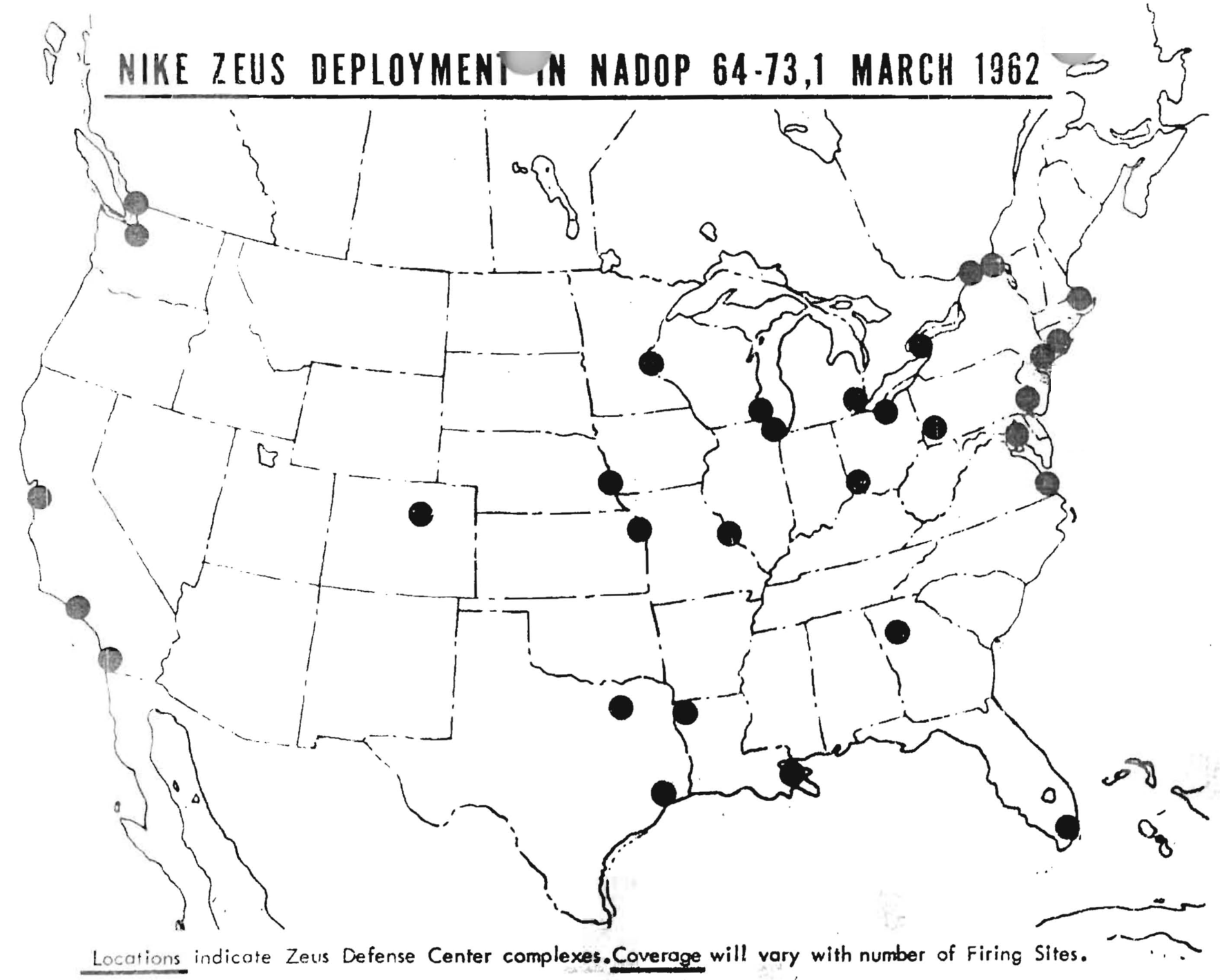
NIKE-ZEUS DEPLOYMENT IN NADOP 64-73, 1 MARCH
1962
Locations indicate Zeus Defense Center complexes.
Coverage will
vary with number of Firing Sites.
|
OCR'ers Note: This is my best guess of locations for ZEUS Batteries under NADOP 64-73: Miami, FL |
NORAD persisted, however. In its 1962 NADOP (64-73), 1 March, the command again pressed hard for Zeus. Said CINCNORAD in the foreword:
An analysis using war gaming techniques was made to determine the effectiveness of the NORAD defense capability over the time period of the plan, if programmed aerospace defense forces should remain at the levels provided by current funding. The results clearly point out that the defense capability of this continent will be intolerable after 1964. ... To close this growing gap between Soviet offensive missile capability and North American defenses we must have a family of weapons ranging from an area defense system to a terminal system. The only AICBM system now available is NIKE-ZEUS and we emphasize, as our first priority, its early deployment. Concurrently, we urge that increased emphasis be given an R&D program to provide an advanced ballistic missile defense system which has an area defense capability....
But Zeus still remained in an R&D stage on a top priority basis. In hearings in January 1962, a House of Representatives subcommittee on DOD Appropriations for 1963, Secretary of Defense Robert S. McNamara made the following statement:
Because of serious questions as to the practicality of the Nike Zeus system, we are not recommending funds for its procurement and deployment at this time, but we are requesting the maximum amount of funds which can be effectively used in 1963 in the research and development program to continue development and testing on a top priority basis. The tests now underway should yield a significant amount of additional data on the many problems of ballistic missile defense.
During a continuation of these hearings in February, Mr. McNamara explained to Congressman Gerald R. Ford, Jr., of Michigan, that the upcoming Kwajalein tests would not affect this decision.
I think the tests by themselves will have little effect on the decision as to whether we will or will not proceed into production. ... (Off the record discussion of problems). All of these problems are known to you. None of these problems will be resolved by tests at Kwajalein and Vandenberg. Therefore, the decision we are making today, that is, not to request funds for production, is not dependent on the outcome of those tests. ... It is possible -- I think highly unlikely, but possible -- that between now and the time the tests occur, breakthroughs will occur in the development which might cause us to modify the decision, but that change of decision will be unrelated to these particular tests.
Another interesting development in Zeus, though not in regard to ballistic missile defense, occurred in April 1962. On the 27th, the Secretary of Defense approved an Army recommendation to develop an interim satellite intercept capability by modifying the Zeus Kwajalein facility by May 1963. [20] The development was to parallel the current and future AICBM program, but was to be accomplished on a non-interference basis.
The system was to have intercept capability for satellites of 200 nautical miles altitude, acquisition and track of satellites of at least two square meter cross sectional areas at ranges to 1,000 nautical miles, and multi-pass capability. Fifteen million dollars was to be allocated from emergency OSD funds during FY 1963 to provide for this capability at Kwajalein.
According to the NORAD Deputy Chief of Staff for Plans and Policy, the end result of this program would be the potential to demonstrate an operational intercept capability against satellites from 100 to 200 nautical miles altitude should the political situation indicate such a demonstration to be desirable. [21]
– – – – – – – – – – – – – – – – – – – – – – – – – – – – – – – –
Air defense planners have long seen a need to intercept enemy bombers as soon as they were detected and to destroy them before they reached the vital areas of the continent. As Soviet bombers and the weapons they carried improved, and the early warning lines were pushed farther out to meet the threat, the need for longer range interceptors became more urgent. As matters stood in 1962 the picture was little changed, for the threat of the manned bomber still loomed large.
The current threat to North America was a ballistic missile attack followed by an attack of 200 bombers on two-way missions. [1] And recently, the subsonic bomber threat had been increased by the addition of supersonic air-to-surface missiles of 350-mile range (estimated to increase to 500 miles by 1963). Moreover, it was estimated that a Mach 1.5 dash bomber would soon be added to the threat, followed by a Mach 3 bomber towards the end of the decade. [2] In any case, present short-range interceptors and missiles could not destroy existing bombers before they released their ASM's against primary targets, such as SAC bases. [3]
Thus the requirement for a long range interceptor, first raised in the fifties, was no less valid in the sixties. Accordingly, the LRIX was high on NORAD's list of priorities for air defense.
Air Defense Command submitted the first requirement for an LRIX to USAF in April 1953. It was for a two-man crew aircraft capable of a thousand-mile radius, a combat ceiling of 60,000 feet, and speed between Mach 1.5 and 2. ADC justified the need on the basis that the early warning coverage would ultimately be extended, which would permit engaging the enemy 250 to 500 miles beyond the borders of the United States. ADC wanted the aircraft to be ready for evaluation by 1956-57.
USAF agreed to the requirement but set 1960 as a more realistic date. ADC then wanted a Mach 3 aircraft with a combat altitude of 70,000 feet. It was to carry three atomic missiles, have a fire control system with a lock-on range of 50 miles and a completely integrated electronic system. In range, ADC now wanted an LRIX which could proceed to a control point 600 miles away, loiter for three hours, then proceed at Mach 2.5 to an intercept point 200 miles away, and finally to a re-service base 300 miles away. Also, ADC switched to the idea of a one-man crew interceptor.
It was May 1954 before the Air Research and Development Command was directed to hold an industry-wide design competition for the LRIX. And then, the military specifications given the contractors were not the same as the ADC requirements. They were asked to design an aircraft which could reach a speed of Mach 1.7 at 40,000 feet, cruise at an altitude of 60,000 feet, and offer a 1,000-mile radius. It was to carry a two-man crew.
Eight firms submitted proposals for an LRIX, but none met the military specifications. Thus, the 1954 competition was a failure.
The next year was spent trying to find a solution to ADC's requirement for an aircraft to meet the threat of the sixties. Many ideas were advanced including building an aircraft of shorter range or adapting the B-47, or even the B-58, to an interceptor. All were rejected. [4]
ADC continued to press for an LRIX. For example, just before he retired as ADC Commander, General Chidlaw wrote General Twinning on 28 May 1955, with the purpose of pointing out "certain particular areas of concern, which require far more than normal emphasis if we are to move out rapidly to an acceptable air defense capability." In particular he said, "Despite continued pleas and protestations on the part of ADC, we still do not have an approved project for a long range fighter interceptor." [5]
In July 1955, a new General Operational Requirement was written. But despite the failure of the design competition of 1954, the new document was more stringent than the earlier GOR. It called for a combat ceiling of 75,000 feet (88,000 feet desired), combat speed of Mach 2.5 (3.25 desired), and 1,000-mile radius. The operational date for the LRIX had now crept to 1963.
The result was another design competition -- this time between Northrop, Lockheed, and North American. But this 1955-56 competition was as indecisive as the one in 1954. Although North American was the winner, their model was far short of meeting the expected threat in 1960-65. Besides it approached B-47 size, and "a bomber to catch a bomber" was not a popular concept. [6]
This eventually led to USAF changing the GOR, in November 1956, to Mach 2.5 and ceiling 60,000 feet. But ADC wanted Mach 3 and 70,000 feet. The upshot was that USAF appointed a board of general officers to resolve the issue.
The board arrived at a compromise between ADC and USAF. It recommended development of an LRIX that would fly at Mach 3 within a 330-mile radius and offer 10 [or 20?] minutes of combat at 70,000 feet, or 1,000-mile radius at Mach 0.9 plus 5 minutes of combat at Mach 3. It was to include airborne radar capable of detecting a target the size of a B-47 at 100 miles and carry two nuclear missiles with a range of 15-25 miles. Finally, it was to be capable of attacking a target (up to 100,000 feet) with an altitude differential of 40,000 feet.
North American, which had won the 1956 competition, was to build the airframe to meet these requirements. Hughes and Radio Corporation of America were to conduct parallel and competitive development of the weapon control system.
Finally, on 11 April 1957, ARDC was directed to proceed with development of the re-oriented long range interceptor. By mid-year, the aircraft was given the name F-108. [7]
When NORAD came into existence, the F-108 program had only just gotten under way and was still in the design-study stage. From the start there were indications that the F-108 would die on the vine because of design as well as funding ills. When NORAD heard the program might be discontinued, it was quick to respond. On 18 January 1958, General Partridge, the first CINCNORAD, told the Secretary of the Air Force, Mr. James Douglas, that he considered it mandatory to continue development and fully supported the requirement for the F-108. However, he emphasized that to be acceptable in the air defense role, the development must include not only the airframe itself but the radar and fire control gear, the engine, the missiles, and the associated ground environment. [8]
NORAD then included the F-108 in its first objectives plan -- NADOP 59-63 -- issued 12 December 1958. This plan showed one F-108 squadron deployed in NORAD's interceptor force for 1963. [9]
Although the development program of the F-108 progressed during 1958, its death knell was faintly audible in November at the time USAF was preparing the FY 1960 budget. By the end of 1958, USAF forecast the operational date would be delayed from 1963 to 1964 and the number of test aircraft reduced from 31 to 20. [10]
Financial pressures against the F-108 program continued to mount during 1959. Finally in August, word came to NORAD which portended certain death to the program. In this month, USAF advised ARDC that the F-108 development program would have to be continued on a very austere basis because of limited funds. Several components of the system were deleted from the program and the first flight date and the first squadron date were changed. [11]
ADC was concerned with USAF's action as was NORAD. Lieutenant General Joseph H. Atkinson, ADC Commander, told General Thomas White, USAF Chief of Staff, he had learned that a reoriented B-70 bomber program might replace the F-108 program. He said the B-70 would not meet air defense requirements. The F-108 was the only known manned vehicle which would meet the threat. [12]
In September, General Kuter notified the JCS that he considered the F-108 as the first real breakthrough in solving the problem of long range interception of enemy aircraft. He said he felt the B-70 could not do the job. It had a slow reaction time and poor maneuverability. A comparison of costs of the two systems indicated that use of the B-70 for air defense would be a more costly solution than the F-108. He concluded that, "While I recognize that [illegible] considerations will in the end prevail, it [illegible sentence] air defense against current subsonic [illegible] and agreed [illegible] supersonic threat [illegible] alternative to the development [illegible] [13]
None of the arguments advanced seemed to help. On 23 September, USAF [illegible] ARDC of its decision to stop all efforts on development and production of the F-108. [14]
However, it was decided to continue development of the ASG-18 fire control system and the GAR-9 air-to-air missile on a reduced basis. [15] Both of these systems had been under development since 1956 and were originally programmed for the F-108. They were the heart of the LRIX concept and represented a tremendous improvement over existing fire control systems and missiles. Their continued development would permit a rapid acceleration to a full weapon system program. Funding for the ASG-18 and GAR-9 continued at $24.1 million for FY's 1960 and 1961, $16.4 million for FY 1962, and $24 million for FY 1963. The first flight of the prototype ASG-18 took place in March 1960 in a B-58; the first air-to-air firing on the GAR-9 took place in January 1962. [16]
Although the F-108 program was cancelled, NORAD continued to support it. The JCS, too, supported the F-108 requirement to the Secretary of Defense in October 1959. Then, in November, NORAD submitted NADOP 61-65, in which it called for the immediate reinstatement of the F-108 program. It stated that the main purpose of the weapon was to destroy the bombers before they launched their air-to-surface missiles. [18]
Later, in December 1959, NORAD was informed that USAF and OSD (R&E) were studying several interceptor improvement programs which called for using semi-active ASM's and high-powered pulse doppler radars....
[illegible paragraph]
But based on the JCS funding guidelines, this aircraft could not be considered.
Within the funding levels outlined, CINCONAD recommended procurement of the Mach 2.5 F-108 (SCI) weapon system. The remaining aircraft were rejected for various reasons, including one of the existing contenders, the North American Aviation A-3J. This aircraft had insufficient range at high sustained speed to enable it to attack a significant number of bombers prior to release of ASMs. However, CINCONAD concluded, if, in spite of his recommendation, money was allocated for the procurement of any other system, purchase of the A-3J was the least objectionable. [19]
Neither was ADC keen on the A-3J. After completing an extensive evaluation, ADC told NORAD in October 1960, that the A-3J would not provide the required degree of increased capability. ADC also concluded that the A-3J had no airframe growth potential to materially improve its capability against the higher speed threats expected in the post-1965 period. [20]
Throughout 1960, NORAD persisted in its efforts to have the F-108 program revived. The requirement once again was emphasized in NADOP 62-66, which was issued 31 March 1960. [21] Then in April, General Kuter testified before the Senate Subcommittee on Military Construction. Among other things he reiterated the requirement for the F-108. He said NORAD had agreed to a plan to reduce the number of F-106, F-102, and F-101 squadrons to accommodate F-108 squadrons. The planned reduction of the current interceptors had been accelerated, he pointed out, although the F-108 on which that reduction was premised had been cancelled. [22]
Later, on 17 August 1960, General Kuter urged General Thomas D. White, USAF Chief of Staff, to spend the $100 million contained in the FY 1961 appropriations for procurement of fighters to reinstate the LRIX program. General Kuter pointed out that intelligence indicated the Soviets had in production a supersonic dash bomber comparable to the U.S. B-58 and B-70. Such bombers carrying ASMs posed a threat, he said, with which current interceptors and air defense missiles could not cope. He concluded: [23]
Of course additional funds in the FY 62 and subsequent budgets would have to follow to provide an operational F-108 force at the earliest possible date, but the hundred million will have bought at least one full year on a program which I believe will eventually be demanded and on a crash basis.
General White's reply on 26 August 1960, repeated an earlier promise that development activity in the LRIX field would continue so long as there were no more budget cuts. He also said it seemed likely that the budget might be increased and, if so, "rest assured that I will give every consideration to re-establishing a full scale long range interceptor program." [24]
General Kuter then turned to the Deputy Secretary of Defense, Mr. James Douglas, for support of an LRIX against the Soviet threat. Mr. Douglas promised only that if the Soviets began full-scale production of advanced bombers and ASMs, DOD priorities would be...
[illegible paragraph]
Both ADC and NORAD continued to strive for a long range interceptor, but as time passed, the threat demanded a weapon system with far greater effectiveness than the F-108.
In November 1960, ADC prepared a draft QOR for an Advanced Piloted Interceptor and asked NORAD's opinion. ADC wanted it to be capable of operating at 100,000 feet altitude at Mach 5 speed, possess a range of 1500 nautical miles, and be able to make three kills with a 500-mile missile against all post-1966 threats except the IRBM and ICBM. The operational date was to be no later than 1966. [26]
In its reply, NORAD posed a series of questions which, in essence, wondered if the proposed interceptor were not too complex to meet the imminent threat of the supersonic bomber. Any realistic proposal for solving the problem would receive NORAD's heartiest blessing and support. But this particular design did not seem to fit the bill. [27]
In the light of NORAD's comments, USAF ADC modified its QOR, lowering the speed and operating altitude to Mach 1.5 and 90,000 feet, and including more detailed information on the concept of employment. In April 1961, USAF ADC sent the QOR to USAF for study and action. [29] At the same time, it asked NORAD to submit its comments on this revised version for forwarding to USAF. [30]
These were furnished by NORAD on 31 May. While agreeing that the post-1966 threat called for a drastic increase in range, speed, and endurance of interceptors, NORAD expressed doubt that the proposed system was the answer. It appeared to go too far into the ballistic defense area, thereby over-complicating fire control and armament requirements and, perhaps, overlapping projects already in the mill under the "family of weapons" concept of air defense. Also, the 3-kill capacity was too low for NORAD's requirements. Thus, NORAD's criticisms remained the same: the proposed system appeared to be too complex and too expensive. NORAD doubted that it could be developed in time to meet the threat. [31]
In the meantime, on 31 March 1961, NORAD issued NADOP 63-67, which stressed the requirement for an improved interceptor over the F-108. The Commander-in-Chief stated, "Since the last NADOP was published we have positive evidence of Soviet development and test of a supersonic bomber...." The plan called for a weapon having "a quick reaction time and possess sufficient speed and range to engage the enemy far out over the northlands of Canada and the waters bordering the North American continent." NORAD asked for two squadrons of the LRIX by 1966 and six by 1967. [32]
The following year, NORAD issued NADOP 64-73 on 1 March 1962. In it NORAD stated a requirement for two long-range interceptors. The first, called an Improved Manned Interceptor (IMI), was needed "to compensate for the attrition and obsolescence of current USAF interceptors." No requirement was stated for additional USAF aircraft of current types. The IMI was to incorporate the maximum state-of-the-art available in the 1966 time period. It was to be a Mach 3, 1,000-mile radius-of-action interceptor, and have a capability beyond the ASG-18 fire control system. The plan envisaged 17 squadrons by 1968 (18 aircraft). [33]
The second long range interceptor NORAD wanted was called the Advanced Manned Interceptor (AMI). The requirement was stated for vigorous R&D to provide an AMI against the future manned bomber threat. The characteristics of the AMI were (1) ability to operate with a lesser degree of close control, (2) a sophisticated fire control system (infra-red capability out to 800 nm and radar of 500 nm), (3) employ a 500 nm weapon (effective from ground up to 200 nm), (4) operate at a sustained speed of Mach 3, 4.5 dash at altitudes of 90,000 to 100,000 feet. NADOP 64-73 recommended 16 squadrons (18 aircraft) -- 13 squadrons for the U.S. and 3 for Canada -- during the latter period of the plan. [34]
NORAD's need for an LRIX was demonstrated in a convincing and practical way on 26 September 1961. Alaskan radar detected an unknown track containing two objects over the Chukotski Peninsula. The track crossed the International Date Line and penetrated the Alaskan Coastal APS2. Fighters from Alaskan NORAD Region were scrambled to intercept the intruders, but because of the fighters' limited range they were forced to turn short prior to interception. [35]
General Kuter reported this to General Lemnitzer, Chairman of the JCS. [36] The JCS reply of 13 October sounded a note of encouragement to NORAD. "The JCS have recommended to the Secretary of Defense approval of the Air Force FY 1963 budget program for the LRIX/GAR-9 ASG-18 R&D and proposal for decision to proceed on production as early as possible consistent with the R&D program." [37] Further, the JCS said the requirement for the LRIX would be considered during a review of the FY 1963 budget program packages, as requested by the Secretary of Defense.
Events during 1962 continued to give NORAD some hope that its long-sought-after need would eventually be satisfied, at least to some degree. On 19 March, the JCS told NORAD they had been directed by the Secretary of Defense to "devise plans to strengthen northern, perimeter defenses, which will provide …
[paragraph illegible]
endurance, low aititude and long range fire control capabilities...."
NORAD was to prepare plans to implement the above. [38] In the plans submitted to the JCS on 16 April, NORAD said: "Within the limitations of utilizing an existing airframe, the A-3J modified to carry the ASG-18/GAR-9 system appears to come closer to meeting our current operational requirements than any other existing airframe." NORAD's plan called for eight A-3J squadrons to provide area defense along the northern perimeter. It emphasized this number would be only a modicum of the requirement to defend the entire NORAD area, however.
NORAD's plan went on to compare the A-3J with the IMI described in NADOP 64-73. The major difference was in speed. The A-3J would have a cruise speed of Mach 0.9 and would be limited to a dash speed of 1.6 (when configured with the ASG18 and GAR-9). Whereas, the IMI would be Mach 3 throughout. Moreover, state-of-the-art would enable production of the IMI by 1967, as compared to 1965 for the A-3J. [39]
In the meantime, ADC was preparing a study on the relative capabilities of the IMI and the A-3J. The results were to be presented to DOD in an attempt to gain acceptance of the IMI over the A-3J interceptor. USAF was strongly backing the IMI. [40]
Also, NORAD learned that USAF was planning on directing AFSC to go out with a study contract in industry on a comparison of IMI versus AMI interceptor, and Eagle Aerie. [*] [41]
[* – The Aerie concept was using a large, long range aircraft (such as a modified KC-135) carrying something like 30 high speed missiles (Eagle Mach 3), which could be launched rapidly and directed against different targets. The Aerie could provide its own radar cover or accept and display information from the ground environment, and operate from airfields on a tenant basis with minimum support. – Recovered from NORAD History: Jan-Jun 1962 ]
USAF however, was also doing a preliminary study on comparing the IMI, the A-3J, the TF-X and the F-110. The results of the preliminary study were to be given to DOD on 22 June and the ADC study was to be attached to the USAF study as an appendix. [42]
1. U.S. Army Air Defense School, Combat Development Study Project, #USAADS 58-9, 21 Feb 1961, "Tentative Doctrine for Employment of Nike Zeus."
2. ARADCOM, ADGC, "Zeus Project File," 1 May 1962 (232).
3. ARADCOM Command Report, 1 Jul-31 Dec 1957; ARADCOM Command Report, 1 Jan-30 Jun 1958.
4. As in Note 2.
5. As described in Bell Telephone Labs, Semiannual Progress Report, 1 Jul 61-1 Jan 62, "Nike Zeus Guided Missile System;" ARADCOM, ADGC, Nike Zeus Project File, 1 May 1962 (232).
6. JCS to CONAD, "Defense Against Ballistic Missiles," 22 Mar 1957 (503).
7. Hart to Partridge, 17 Feb 1959 (502X503). 0
8. Memo from Partridge to Hart, 3 Mar 1959.
9. Memo for the Record, Meeting with Drs. York and Skifter, Washington, 4 Mar 1959, 5 Mar 1959, by Gen E. E. Partridge.
10. Msg, CINCNORAD to CJCS. NHCR X-040, 27 May 1959 (502X503).
11. ARADCOM, ADGC. Zeus Project File, 1 May 1962.
12. NORAD to JCS, "Requirement for the Nike Zeus System," 21 Oct 1959 (504).
13. Msg, NORAD to JCS, NPAP X-006, 22 Dec 1959.
14. Report of the Zeus Ad Hoc Advisory Committee, 18 Nov 1960.
15. NORAD to ARADCOM, "Deployment Concept for Nike Zeus," 15 Nov 1960 (504).
16. Msg, CINCNORAD to JCS, NHCR X-050, 14 Dec 1960 (504).
17. Memo for Gen Wise, NPSD, "Nike Zeus Study," 29 Sep 1961 (232).
18. Memo for the C/S, NPPP-PL, "Nike Zeus Deployments," 17 Oct 1961 (232).
19. ARADCOM ADGC, Zeus Project File, 1 May 1962; Memo for Gen Kuter, NGAM, "Status of Funding for Nike Zeus," 30 Dec 1961 (232).
20. ARADCOM ADGC, Zeus Project File, 1 May 1962.
21. Memo for Gen Kuter, NPSD-B, "Interim Satellite Intercept Capability," 3 May 1962 (232).
1. CANUS-62
2. NORIP, 1 May 1961
3. Msg, Kuter to JCS, X-031, 28 Sep 1961; Skyshield Report to COSC and JCS, 30 Nov and 1 Dec 1961.
4. ADC Historical Study No. 12
5. General B. W. Chidlaw to General N. F. Twining, 28 May 1955 (Doc 495 to History of CONAD and ADC, Jan-Jun 1955).
6. ADC Historical Study No. 12
7. Ibid.
8. Msg, General Earle E. Partridge to Mr. James Douglas, SDO 2001, 18 Jan 1958.
9. NADOP 59-63, 16 Dec 1958.
10. ADC Historical Study No. 12.
11. Msg, USAF to ARDC & AMC, AFDRD 66322, 21 Aug 1959.
12. Msg, ADC to USAF, ADHCR 0835, 28 Aug 1959.
13. Msg, NORAD to JCS, NPPP X-001, 1 Sep 1959.
14. Msg, USAF to ARDC, et al., AFMPP-WS-2 76028, 23 Sep 1959.
15. Ibid.
16. DOD Document -- Weapons Dictionary Sheet, LRIX/ASG-18/GAR-9. Program Element 6.3.082, 15 Jan 1962.
17. Deputy Secretary of Defense to General L. S. Kuter, 26 Nov 1960.
18. NADOP 61-65, 20 Nov 1959.
19. Msg, JCS to NORAD, JCS 969436, 9 Dec 1959; Msg, CONAD to JCS, CPPP X-003, 13 Jan 1960.
20. ADC to NORAD, "(U) ASJ Evaluation," 28 Oct 1960.
21. NADOP 62-66, 31 Mar 1960.
22. DCS Programs, "Periodic Legislative Resume, No. 10," 25 Apr 1960.
23. Msg, NORAD to USAF, NPPP-X022, 17 Aug 1960.
24. General T. D. White to General L. S. Kuter, "Long Range Interceptor," 26 Aug 1960.
25. Deputy Secretary of Defense to General L. S. Kuter, 26 Nov 1960.
26. USAF ADC to NORAD, "Qualitative Operational Requirement for a Long Range Advanced Piloted Interceptor System," 14 Nov 1960.
27. NORAD to USAF ADC, "Qualitative Operational Requirement for a Long Range Advanced Piloted Interceptor System," 22 Dec 1960.
28. Memo for Record, attached to Ltr, NORAD to USAF ADC, "QOR for the Long Range Advanced Piloted Interceptor System," 31 May 1961.
29. USAF ADC to USAF, "QOR for a Long Range Advanced Piloted Interceptor System," 11 Apr 1961.
30. Gen Lee to Gen. Kuter, 17 Apr 1961; USAF ADC to CINCNORAD, "QOR for the Long Range Advanced Piloted Interceptor System," 17 Apr 1961.
31. NORAD to USAF ADC, "QOR for the Long Range Advanced Piloted Interceptor System," 31 May 1961.
32. NADOP 63-67, 31 Mar 1961.
33. NADOP 64-73, 1 Mar 1962.
34. Ibid.
35. NOCC to NOPS, "(C) Siberian Intruder North of Alaska, 7 Sep 61," 7 Sep 1961; Msg, NORAD to JCS, NBCR X-031, 28 Sep 1961.
36. Ibid.
37. Msg, JCS to NORAD, JCS 1860, 13 Oct 1961.
38. JCS to NORAD, "Continental Air Defense," 19 Mar 1962.
39. NORAD to JCS, "Defense of Northern Perimeter and ICBM Sites (U)," 16 Apr 1962.
40. Status Report on Follow-up Actions for Implementing NADOP 64-73 (U), 10 May 1962.
41. Ibid.
42. Interview with Lt Colonel Joseph E. Mestemaker, 21 Jun 1962.
– – – – – – – – – – – – – – – – – – – – – – – – – – – – – – – –
DISTRIBUTION
|
JCS |
1 |
REDISTRIBUTED BY HQ NORAD |
|
|
ARADCOM, ATTN:ADGC |
1 |
NHCR |
1 |
|
USAF ADC |
1 |
NAPA |
1 |
|
Hq NORAD |
32 |
NINT |
1 |
|
Total |
35 |
NNFO |
1 |
|
|
|
NOPS |
1 |
|
|
|
NOOP |
1 |
|
|
|
NOEV |
1 |
|
|
|
NOST |
1 |
|
|
|
NOCC |
1 |
|
|
|
NOOA |
1 |
|
|
|
NLOG |
1 |
|
|
|
NPAP |
1 |
|
|
|
NPPP |
1 |
|
|
|
NPMO |
1 |
|
|
|
NELC |
1 |
|
|
|
NEEC |
1 |
|
|
|
NECO |
1 |
|
|
|
NGAM |
1 |
|
|
|
NNCH |
13 |