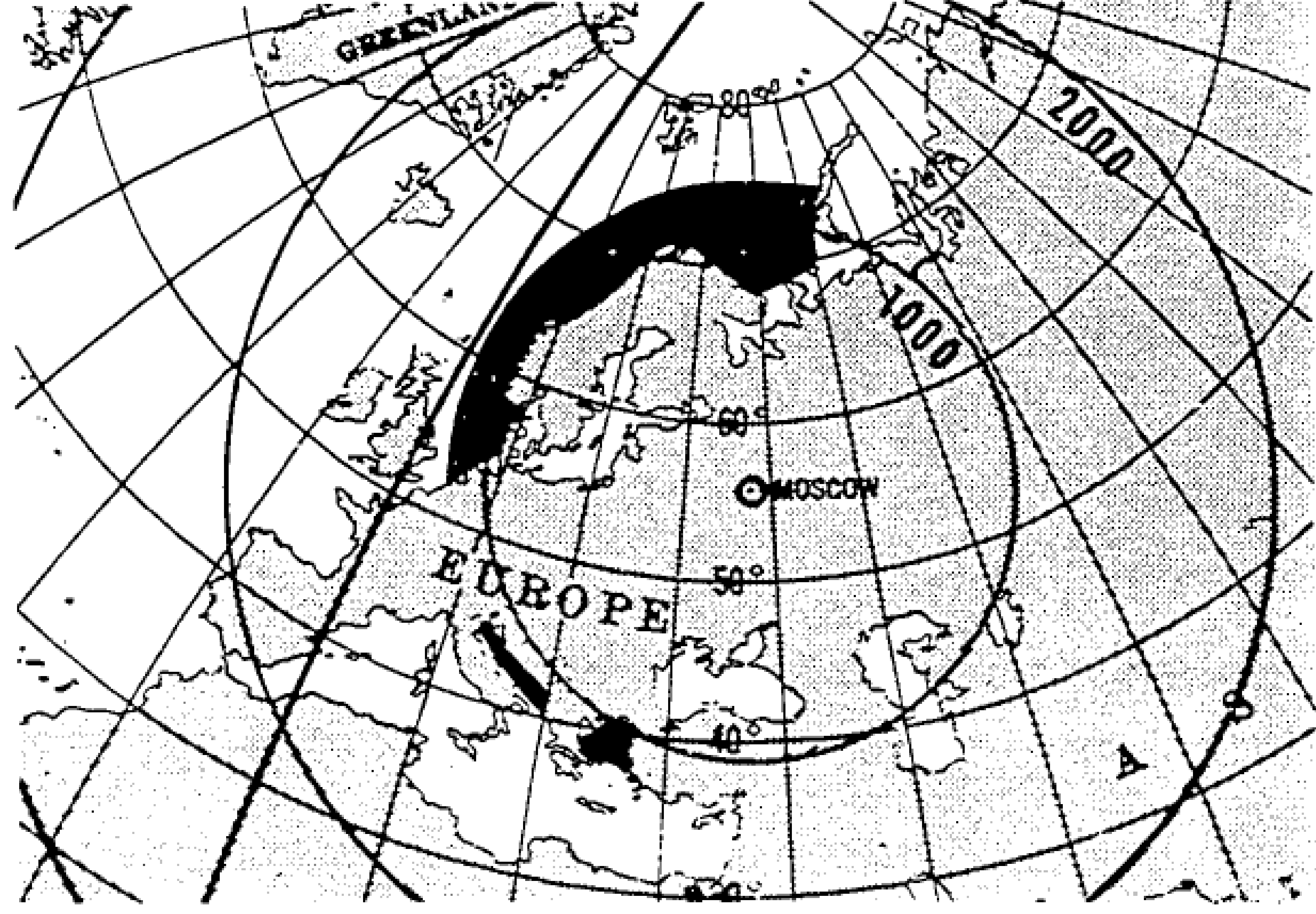
FIG. 1: OPERATING AREAS FOR ATTACK ON MOSCOW |
NAVAL WARFARE ANALYSIS GROUPOFFICE OF THE CHIEF OF NAVAL OPERATIONS STUDY 1 INTRODUCTION OF THE FLEET BALLISTIC MISSILE INTO SERVICE |
DEPARTMENT OF THE NAVY
OFFICE OF THE CHIEF OF
NAVAL OPERATIONS
WASHINGTON 25, D. C.
IN REPLY REFER TO
Op93B/mam
Ser
007P93
30 JAN 1957
SECRET - UNCLASSIFIED WHEN ENCL REMOVED
From: Chief of Naval Operations
To: Distribution List
Subj: Study on the Introduction of the Fleet Ballistic Missile into Service; forwarding of
Encl: (1) NAVWAG Study No. 1, Introduction of Fleet Ballistic Missile into Service
1. The subject study, conducted by the Naval Warfare Analysis Group in the Office of the Chief of Naval Operations (Op93), is forwarded for information.
2. Extracts from an internal OPNAV implementing memorandum are appended hereto.
[ILLEGIBLE SIGNATURE]
DISTRIBUTION LIST FOR OPNAV SERIAL: 007P93
CNO
Op 00
Op 09
Op 90
Op 92
Op 03
Op 03B
Op 03B1
Op 31
Op 33
Op 34
Op 36
Op 37
Op 04
Op 40
Op 43E
Op 05
Op 05W
Op 51
Op 55
Op 06
Op 60
BUSHIPS
100
300
525
527
533W
BUAER
AER
BUORD
A
PL
PLb
PLe
Re
Req
Ree
ReS
ReU
ReW
Sp00
ONR
100
460
900
ASSTSECNAVAIR
CINCPACFLT
CINCLANTFLT
COMFIRSTFLT
COMSECONDFLT
COMSIXTHFLT
COMSEVENTHFLT
COMNOL
– – – – – – – – – – – – – – – – – – – – – – – – – – – – – – – – – – – – – – – – – – – –
NAVAL WARFARE ANALYSIS GROUP
STUDY NO. 1
INTRODUCTION OF THE FLEET BALLISTIC MISSILE INTO SERVICE
This material contains information affecting the national defense of the United States within the meaning of the Espionage Laws, Title 18, U.S.C. Sections 793 and 794. In addition, it contains restricted data within the meaning of the Atomic Energy Act of 1954. Its transmission or the revelation of its contents in any manner not authorized by the appropriate act is prohibited by law.
Prepared by the
NAVAL WARFARE ANALYSIS
GROUP
Office of the Chief of Naval Operations (Op 93)
– – – – – – – – – – – – – – – – – – – – – – – – – – – – – – – – – – – – – – – – – – – –
EXTRACTS FROM CNO MEMORANDUM
(Secret serial
0011P03 of 15 January 1957)
|
Subj: Introduction of the Fleet Ballistic Missile into Service ---------------------------------------------------------------- 1. "Reference (a) (NAVWAG Study No. 1) is a study of the introduction of the FBM into the Naval family of strike weapon systems. It contains the following salient points: a. The SSG(N) (FBM) is the optimum launching vehicle in terms of survival and economy of force. b. The mission of the FBM system should be expressed as a deterrent capability. c. The initial force requirements for SSG(N) (FBM) should be modest, with a 1965 objective of six such submarines in inventory. Acceptance of this program will require modification of the current five-year shipbuilding program. 2. The concept of FBM utilization as expressed in paragraph 1 above is approved and accepted as the basis of Navy planning for the introduction of the FBM into service. This is specifically applicable to the drafting of the operational requirement, development characteristics and ship characteristics, and shall be used as a guideline by the Standing Committee on Shipbuilding and Conversion. 3. Studies are currently under way to determine what
type surface combatant ship is best suited for task force
employment of the FBM, how many such ships should be planned, and
in which Shipbuilding and Conversion Program years such ship or
ships should be included. Decisions in these matters will be
forthcoming subsequent to the completion of the
studies. |
– – – – – – – – – – – – – – – – – – – – – – – – – – – – – – – – – – – – – – – – – – – –
This study examines those matters which require prompt decisions, for the Navy to achieve a rapid and orderly development of a deterrent capability using the fleet ballistic missile. Among the subjects included are a study of the optimum launch vehicle for the first operational introduction, a concept for employment, and an estimate of force requirements. In preparing this analysis the following assumptions have been used:
a. The problems of operating early increments of an FBM force contribute as much to determining first generation requirements, as do considerations of the ultimate composition of the force.
b. Adequate test and evaluation facilities will be provided by Mariners I and II, so that only the early operational vehicles need be considered.
c. Only the most elementary force requirements can be intelligently considered at present, since the eventual requirement will probably involve decisions by higher authority as to composition of the national deterrent capability, and considerations of different weapons systems which can diversify our effort and make more difficult the enemy problem of countermeasures.
1. The nuclear powered missile submarine (SSG(N)-FBM) is the only missile-launching vehicle capable of providing assurance of survival when deployed in small numbers.
2. Since considerable "growth potential" is anticipated for both the vehicle and the missile, quantitative specifications are not deemed sufficiently important (within rather broad limits) to warrant delay in introducing the earliest types.
3. Characteristics other than submerged endurance, quiet operation and rapidity of launch require only routine emphasis, since submarines can operate near friendly or neutral shores. Submarine size should be that which is most economical per missile; it should carry at least 3 but not over 10 missiles. Surface launch is acceptable, but submerged launch is preferable and should be developed.
4. Later SSG(N's) should emphasize reduced cost, through the use of smaller submarines, possibly with external missile stowage. Development of a subsurface-to-air weapon system would make a larger submarine acceptable in the more distant future.
5. Initial force requirements for submarines should be fairly modest; a capability to maintain two or three on station will contribute significantly to 1963-65 requirements, will furnish valuable operational experience and will demonstrate unique Naval capabilities.
6. Increased SSG(N) forces should be contingent upon the availability of increased funds, so as not to interfere with other vital Naval missions.
7. If pressures to attain an earlier capability than the SSG-Polaris combination should enforce adoption of an interim surface vessel configuration, it is recommended that conversions of combatant hulls be made, unless new construction can be available sooner or would be cheaper in absolute cost.
8. Other launching vehicles, such as Q-ships, and combatant surface vessels, should be considered for development only for later phases of the program when longer range missiles become available; they would be of value in forcing the enemy to divert his initial attack to many targets.
1. A range of 1150 miles is adequate for the initial missiles. Later versions should be capable of 1500 miles, with 2500 miles as the ultimate goal. Initial specifications of minimum range are not critical (800 miles would be acceptable); ultimately, a range band of about 1000 miles is desired.
2. Accuracy and yield should be the best available in a small warhead. For the first generation a yield of 0.4 MT and an over-all system accuracy of 4-mile CEP would be acceptable. Subsequent generations should increase yield and accuracy. Ultimately yield requirements might even be decreased as accuracy increases, to a minimum of about one-third MT, depending on target damage criteria.
3. High launch rates, submerged launch, and longer range should be programmed for development to enhance submarine safety and permit penetration to more distant targets. One ultimate goal, which may not be technologically feasible is a delayed-launch to be planted by a submerged SSG(N) about an hour in advance. Longer ranges are necessary to permit the missile to be used on surface vessels without restriction on location of operating areas.
4. Conventional two-stage warheads are adequate. A separate study, soon to be completed, demonstrates no dramatic increase in radiological warfare effectiveness by using "salted" weapons, although there is a minor decrease in strontium-90 world-wide contamination.
1. A small FBM capability will permit penetration of the limited number of targets, such as Moscow, whose defenses will be difficult to penetrate with other weapons. Missile characteristics desirable for other targets should be deferred beyond this initial stage. CNO should emphasize only the desired early operational capability and desired trends in missile design, and should only specify minimum acceptable missile performance.
2. Very highly defended population or industrial targets should be specified by CNO as the target for the initial FBM capability. A large fraction of targets of naval interest are more suitably attacked by aircraft, or air-breathing missiles of the Triton type.
This part of the study contains the supporting discussion for the conclusions and recommendations, and is divided into four sections: considerations of the launching vehicle for the missile: the missile itself, including range, accuracy, and yield; considerations related to programming, operational requirements and military characteristics; and finally the relationship of the weapon system to the missions of the other services.
The basic problem to be resolved by the Navy with regard to the missile-launching vehicle is to choose among the several vehicles which might possibly be used:
A submarine
A slow auxiliary, defended during its run-in to launch
A fast auxiliary, operating with task forces
Combatant ship, new construction; or conversions, operating with task forces
An auxiliary disguised as a merchantman, or Q-ship
An airborne vehicle, probably a seaplane
The primary factor to be considered in arriving at a choice of vehicle, or combination of vehicles, from among these for our earliest operational units is the probability of survival, since the enemy can potentially concentrate large forces against our limited numbers. However, the technical state of the art, restrictions on the mobility of conventional task forces, and budgetary restrictions on the building or conversion program must also be weighed. Table I summarizes these considerations among alternative vehicles.
|
TABLE I – COMPARISON OF LAUNCHING VEHICLES |
|||
|
Alternative Measure |
Technical State of the Art |
Restrictions on Existing Task Forces |
Build-up Rate |
|
Missile Submarine |
SP states SSG(N) can easily meet Polaris schedule |
None, except possible necessity of deploying SS(N) as decoys |
Adequate: Concept permits 2-3 SSG to evade tracking by enemy |
|
Slow auxiliary plus Talos ships, or defended fast auxiliary. |
Satisfactory |
None |
Inadequate: Enemy could saturate defenses of any conceivable early build-up forces. |
|
Fast auxiliary or new construction combatant operating with existing task forces |
Inadequate range to free task forces from geographical limitations |
Considerable, at present state of art: Sixth Fleet would be tied to limited area. |
Adequate: Could achieve sooner than SSG(N) |
|
Conversion of CA or CVA-9 |
As above |
As above |
Faster build-up than auxiliary. Short service life no defect, if adopted for quick liquid Jupiter use, since this system would be outmoded quickly. |
|
Q-Ship |
Inadequate: longer range missile required to permit use of high density shipping areas |
None |
Barely adequate: many more than 2-3 Q-ships required to inhibit continuous tracking by air or SS. |
|
Seaplane |
Inadequate |
None |
Must await later generations of guidance and navigational gear. |
Soviet force requirements to contain the missile submarine threat are derived in appendix A; each of the possible launching vehicles is discussed qualitatively in the subsections below.
The SSG(N)-FBM.
Figure 1 illustrates the areas from which the SSG(N) could launch an 1150 mile missile against Moscow. Even after 1965, the areas shown as feasible for launching are not expected to be defended by enemy underwater detection barriers. Nor is it likely, as evident from appendix A, that the Soviets can maintain sufficiently intense aircraft patrols to deny surfaced submarine launching, if the launch time is kept short.
|
FIG. 1: OPERATING AREAS FOR ATTACK ON MOSCOW |
In view of the Soviet's probable inability to defend adequately the submarine's missile launching areas, they might attempt to shadow the SSG from its port of departure as a matter of routine. However, holding contact for long would be very difficult, and self-generated countermeasures and tactical deception by other submarine types could defeat this enemy tactic. Once contact is lost on the SSG, the Soviets are unlikely to have the ASW capability to regain contact.
Defended Surface Vessels
Several considerations militate against the use of task forces containing the missile-launching ship, at least in the initial program. In the first place, no matter how well defended the force may be, some level of enemy attack will always saturate it, so that complete or even high assurance of survival is denied. Second, although restricted ranges of first generation missiles would still be adequate for some vehicles, they would demand task force operations in relatively untenable areas; it seems highly desirable to avoid such restrictions on task force mobility.
On the other hand, it is desirable to have enough retaliatory capability in a task force to require the enemy to allocate some of his effort to the task force as part of his initial attack, thus diverting part of his offensive capabilities from other targets. Also, it is generally desirable to diversify our offensive forces, and thus to present the enemy with a series of threats which require a variety of types of force and coordinated planning to counter.
If launch rates were rapid enough to permit the missiles to be launched from a task force between the time a mass raid were first detected and the time the missile ship were sunk, the force could retaliate despite saturation raids. But this would require a policy enabling the task force commander to launch missiles when he considered a serious attack to be underway; since these missiles cannot be recalled, any such policy appears totally unrealistic.
In view of these arguments, it is reasonable to recommend that task force use of the fleet ballistic missile be assigned a role subsidiary to other functions of the force. This does not exclude the possible use of FBM ships with such forces as the Sixth Fleet, if the need for a short-term measure were sufficiently great. But it does argue against either initial build-up or long-term primary reliance on task force FBM.
The possible use of FBM in task forces should await development of a missile with 2500 miles range, and which is small and light enough to permit it to be added to the task force arsenal without interfering with the basic missions of the force.
Q-Ships
If the demand for missiles becomes large, Q-ships should be considered as a possible element of an ultimate program, since they have several advantages. However, they must meet two essential requirements: they must be camouflaged to prevent enemy identification, and they must be able to defeat attempts to track them from ports where their identity may have been compromised.
The star-tracking equipment and launchers which characterize the Mariner missile ships could probably be submerged below decks, permitting the ship to simulate some common merchant type. But Q-ships will have to operate in regions of reasonably high shipping density to avoid the enemy countermeasure of simply sinking every ship in areas where the Q-ships are suspected of operating. However, a missile range of only 1500 miles or less restricts present possible operating areas to regions such as the Tyrrhenian Sea, where submarine and shore-based surveillance might permit a Q-ship to be tracked. Figure 2 shows shipping densities in areas of possible Q-ship operation.
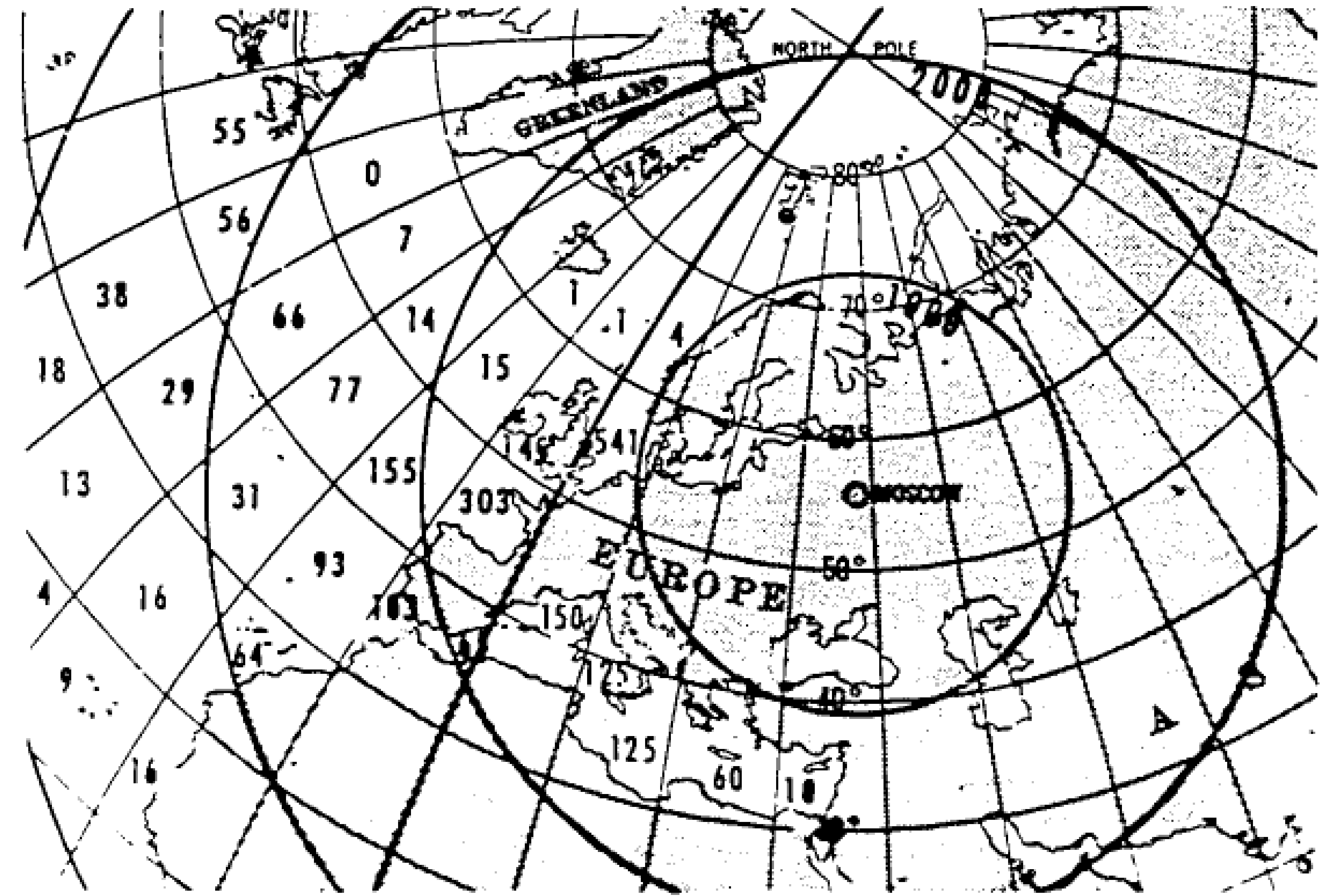
FIG. 2: SHIPS OVER 1000 TONS ON HIGH SEAS |
These considerations militate against Q-ship operations until the greater missile ranges now anticipated are realized. At that time, the large force requirements and the unique type of forces needed for reconnaissance against Q-ships may make them a promising vehicle.
Airborne Vehicles
Long-range air-launched ballistic missiles may be technologically feasible, but not in time to justify consideration here.
Range
Figure 1 shows that with a missile range of 1150 miles, launches against Moscow could be accomplished by an SSG(N) from relatively safe waters. This range thus seems adequate for the initial missiles.
Ranges from 1500 to 2500 miles should be sought in subsequent lots, in order to permit the missile to reach those targets which the Soviets will increasingly defend in such strength as to preclude aircraft or cruise missile attack. Longer range will also permit task force use, and reduce the SSG operating problem if the USSR were to occupy Norway and Greece, or to extend its ASW capabilities.
Accuracy and Yield
Requirements for yield and accuracy should be subordinated to early availability of the weapon. The first generation of Polaris will probably be limited to Moscow and a few other major targets, calling for only a few weapon bursts, so that the trade-off between the number of bursts required to achieve a given level of destruction, and missile accuracy and yield is secondary at this time.
Appendix B discusses considerations of yield and accuracy further, and indicates some of the types of decisions which must be made at a later date.
Programming
The development of ballistic missiles is advancing rapidly, as evidenced by the recent displacement of Jupiter by Polaris. Consequently, it would be wasteful to risk obsolescence by committing more forces at a time than are necessary to meet operational requirements. For this reason a limited operational requirement for the FBM has been emphasized, as has the ability of other weapons to compete with it except against exceptionally heavy defenses.
Programming the FBM beyond a modest force should also be contingent upon acquiring additional funds at the expense of competing thermonuclear delivery systems. Otherwise the deterrent role of the FBM would be provided at the expense of other Naval missions which cannot be adequately substituted for.
Appendix C presents a possible program for purchase, construction, and deployment of SSG's. The appendix also discusses the possibility of using external stowage for missiles in later development stages, with consequent savings in SSG size and cost. The suggested program involves construction of 6 SSG's at an initial cost of about $1.4 billion; the first SSG would be on station during 1963, and 2 or 3 could be maintained on station in late 1964. A proposed augmented program, the beginning of a build-up of 4 SSG's per year, is also presented in the appendix: it is not believed such a program should be proposed at the present time, but cost and program data are given as a matter of interest.
Operational Requirements
Since the FBM is a specialized weapon for use primarily against very heavily defended targets, the Navy should be permitted to plan for its use against the most obvious target, Moscow, and against other similar targets. This is mandatory if a plausible concept of employment is to be followed. Operations analysis should eventually be able to determine the manner in which targets of different importance and characteristics should be divided among the various attack weapons. However, although solutions to such problems are not difficult to arrive at, the arbitrary assumptions presently necessary can easily lead to misleading and trivial results. This will continue to be the case until basic policy decisions are furnished which recognize Naval interest in deterrent targets, and define the mission so that target systems can be analyzed.
Assurance, Diversification, and Political Factors
The FBM offers unique capabilities, important to our military posture, which are not shared by other attack weapons. To recognize its capabilities, we must develop a concept of the enemy's planning and deployment in initiating thermonuclear war.
The enemy's first concern will be the surprise forestalling of U.S. retaliation. To accomplish this he must consider the reaction time we require to decide to retaliate, our ability to survive beyond this period, and the ability of his own defenses to deal with our surviving retaliatory forces.
We have several present or potential types of retaliatory systems, considered below.
The first of these, SAC, can be recalled after launch. Consequently, elements can be made airborne when early warning is received, and recalled if the warning is spurious. But SAC cannot now with certainty launch a large percentage of its forces, even with present and anticipated warning, although such a development is rumored to be underway. Even at present this capability is expensive, and it could be made prohibitively so if warning were drastically reduced by enemy use of ICBM. Moreover, enemy local defense can be made sufficiently strong against manned aircraft ultimately to reduce SAC effectiveness drastically. Local defense can be partially met by greater stand-off's through use of air-to-surface missiles, but for launching from beyond good radar range this deprives aircraft of their principal advantage, target recognition. At this point cruise missiles become competitive.
Missile systems, including the ICBM and cruise missiles based in the U.S., cannot be recalled once launched. Consequently the decision to launch or withhold is onerous if the enemy forestalls by attacking missile sites. Since the enemy's attack is limited only by his fear of self-inflicted strontium-90 contamination, he can plan a devastating attack on the U.S. The countermeasure would be to have U.S. missile sites built to withstand this attack. But enemy judgment of our remaining ability to retaliate, whatever the true facts of the case, determines whether he will accept this risk.
Any of our weapons systems which depend on overseas bases ashore are vulnerable to political pressures on our allies, a subject which needs no elaboration.
Compared to the above weapons systems, one which is afloat has several advantages in providing assurance against forestalling by the enemy. Ballistic missiles will not be effective against forces at sea for some time, if ever. Thus, manned aircraft will be needed for reconnaissance and attack, with some time between detection and saturation attack.
Naval task forces have the disadvantage, however, that some forms of attack on them may not in some circumstances be considered grounds for retaliation, as would attack on the U.S. Consequently, the enemy may be able to allot a formidable effort against future task forces in advance of a major attack on the U.S.
Submarines are uniquely free from all of the disadvantages noted for the other weapons systems. Although the enemy could develop a highly competent ASW force, and loss of submarines would be inevitable, effective ASW is largely dependent on passive measures and is slow to accomplish. Either anti-transit barriers must be used, or extremely large forces must search the oceans, appendix A. With 2500 mile FBM's ultimately possible, no conceivable ASW capability is likely to forestall an SSG within the time necessary.
In the face of maximum ASW effort, the great threat to the missile submarine will be from forces which detect the submarine at launch. Submerged launch is only a partial countermeasure to this, since recent studies estimate that the ascending missile itself can be detected from over 1000 miles by infra-red means in high-altitude aircraft. Smaller SSG's with few missiles and/or rapid rates of fire must be an ultimate requirement, since airborne systems such as explosive echo-ranging can locate a submarine after arrival at datum as much as one hour late. Consequently, safety against having subsequent launches forestalled depends on completing the launch before an aircraft can be vectored on the basis of earlier launches. Submarine safety thus demands that complete launching be accomplished before enemy aircraft can arrive within an hour's flight of the launch point.
Economic Comparisons
This section presents cost estimates as a basis for comparison only, since cost prediction is admittedly inaccurate.
Reference (a) [*] estimates that 80 ICBM sites which could launch 800 missiles in 10 days would cost $1 to 1.7 billion, excluding missiles: it would cost $360 to 820 million a year to operate these sites, depending on whether they were underground, surface, or mobile.
[* – References for this study appear at end of Appendix C.]
Although costs of the SSG missile system are uncertain, they lie between the BuOrd SP estimate of $90 million follow-ship cost for an 8-missile configuration, to the NOBSKA estimate of $20 million for a 3-missile type; i.e., from $7 to 11 million per missile. External stowage may reduce these costs considerably. ONR estimates that Polaris will cost $0.6 million each in quantity. Thus, a conservative $9 million of capital per missile will buy a 220-FBM launch, or 27 SSG's of 8 missiles each, for a total of $2 billion. Operating costs will be about $100 million a year, exclusive of missiles. The 10 of these 27 SSG's which could be on station would have an immediate launch capability the same as the first day of ICBM fire (viz., 80 missiles). However, it would be several days before the remainder reached the firing line and replenishment of the original missile submarine had been accomplished.
Rand estimates that an immediate launch of all 800 missiles would cost $12 to 14 billion, which would buy about 1300 FBM on submarines, of which 500 might be kept on station.
Procurement cost comparisons alone thus favor the ICBM over the SSG-missile system.
Operating cost comparisons are even more difficult to make than capital cost estimates, particularly since the major annual cost is missile replacement, and missile shelf-life is difficult to predict. Rand's figure of a 5-year shelf life and $1.2 million per missile gives a replacement cost of $0.24 million per missile or about $200 million per year for 800 missiles. An FBM with the same shelf life would cost about half as much. The results of amortizing initial costs over 20 years for both systems, and combining operating and replacement costs, are shown in table II.
|
TABLE II |
|||||
|
|
Initial cost |
Annual Cost, Amortized Base |
Annual Cost, Amortized Weapon |
Annual Cost, Operating |
Annual Cost, Total |
|
ICBM sites |
1.2 |
0.06 |
|
|
|
|
[ICBM] Missiles |
1.2 |
|
0.24 |
0.5 |
0.8 |
|
FBM submarines |
9.0 |
0.45 |
|
|
|
|
[FBM] Missiles |
0.6 |
|
0.12 |
0.5 |
1.07 |
The cost difference between $0.8 million for ICBM and $1.07 million for SSG missiles is too small to be significant in view of the rough data available, showing that real costs may not be far apart despite high SSG procurement cost.
These cost comparisons do not reflect the differences in military capabilities between the two systems. Questions of vulnerability to surprise attack reliability, accuracy, yield and political exigency are more important.
Deterrent Force Levels
The U.S. has the power capability to damage a potential aggressor. The payoff of this power capability is its effect on the plans and policy of a potential enemy; that is, to be effective our ability to attack must inhibit enemy plans for all-out attack. However, the problem of just how much ability to damage an aggressor we need and against what kinds of targets, is more political and psychological than military. Since the FBM will originally comprise only a small part of our total deterrent forces, these considerations need not enter this early phase.
Submitted by
J.P. Coyle
Naval Warfare
Analysis Group
Approved by
M. L. Ernst
Director of Research
Naval Warfare Analysis
Group
– – – – – – – – – – – – – – – – – – – – – – – – – – – – – – – – – – – – – – – – – – – –
It is assumed that the situation by 1963-65 will not permit the USSR to operate SOSUS systems based in Norway, Denmark, the Faeroes, the UK, Greece, or the Aegean Islands. It is further assumed that maintenance of extensive surface or SSK active sonar surveillance of any large part of the area outlined in figure 1 would not be feasible to an extent that would permit peacetime tracking of missile submarines. It is of interest, then, to compute the Air Force requirements to maintain an adequate air surveillance, to forestall the launch of missiles from a missile submarine that surfaced to launch.
Suppose the submarine must remain on the surface for 10 minutes before launching the ballistic missile, and that the defender uses patrol aircraft with an endurance of 15 hours at 175 knots and with a limited 270 knot dash capability. The area that must be defended, the shaded area in figure 1, totals approximately 1,000,000 square miles. According to reference (b), most effective operation will result from the use of separate aircraft for the surveillance and attack functions. Force requirements for complete coverage are about 175 search/attack teams on station per 1,000,000 square miles. Assuming that bases averaging about 500 miles from the launching areas can be found, and that the high aircraft utilization rate of 180 flying hours per aircraft per month can be sustained, the defense would require 2300 aircraft in operational squadrons for this task. A smaller number of aircraft could somewhat inhibit missile-launching operations, but the order of magnitude of forces could not be reduced without great loss of ASW effectiveness.
Since the assumed air ASW capability is probably as good as can be expected during the 1965 era, and the resulting force requirements are excessive, it is concluded that surfaced launch is acceptable in the first generation of FBM submarines.
In considering ultimate enemy capabilities, however, it appears that the most significant hazard will be from aircraft called on to investigate fixes which were obtained from missile trajectories, specifically infra-red observation of the ascending missile.
It is necessary here to distinguish between the opportunity thus afforded to forestall further launches and the capability to destroy the empty missile submarine. If we assume successful development of explosive echo ranging which may be able to locate a submarine after a time-late of as much as one hour, it is conceivable that comparatively modest force levels could ensure destruction of the submarine, unless the area searched could be extended considerably.
Ultimate development of a rapid rate of fire, permitting all missiles to be launched within minutes, would make forestalling of missile fire by this means, virtually impossible. It is for this reason that smaller, more numerous missile submarines, with higher rates of fire appear to deserve greater emphasis then submerged launch, as a security feature.
Increased missile range has the principal effect of significantly increasing the area over which any enemy countermeasures must be applied to be successful. Growth of missile range capability should thus contribute significantly to the survival of the submarine even when improved ASW capabilities are developed by the enemy. There is no limit to the ultimate range desired, except that increased weight and space requirements will make range an expensive commodity. Diminishing returns may occur at about 2500 miles. Continuing evaluation of operational implications of the "state of the art" will be required to ensure that appropriate specifications are written for each successive generation.
An ultimate capability which would appear to make the submarine practically secure against any countermeasure short of total disarmament, is a missile that delays its actual launch until the submarine has retired beyond the trapping capability of an enemy aircraft.
– – – – – – – – – – – – – – – – – – – – – – – – – – – – – – – – – – – – – – – – – – – –
Figures B-1 and B-2 adapted from reference (c), illustrate the trade-off between number of weapons delivered to achieve a given level of destruction and the accuracy and yield. Decisions must be made as to criterion of damage in order to choose an appropriate curve. Assuming 50 percent of industrial capital destroyed to be the criterion it can be seen that about 20 1 MT missiles are required with a 4 mile CEP, while 3 would do if the CEP were 2 miles. Similarly a decrease to 0.5 MT would require over 30 missiles with 4 mile CEP and 15 for a 2 mile CEP. This is a tough criterion compared with personnel casualties as is indicated in figure B-2 where many fewer weapons are required and the sensitivity to CEP and yield is much less significant.
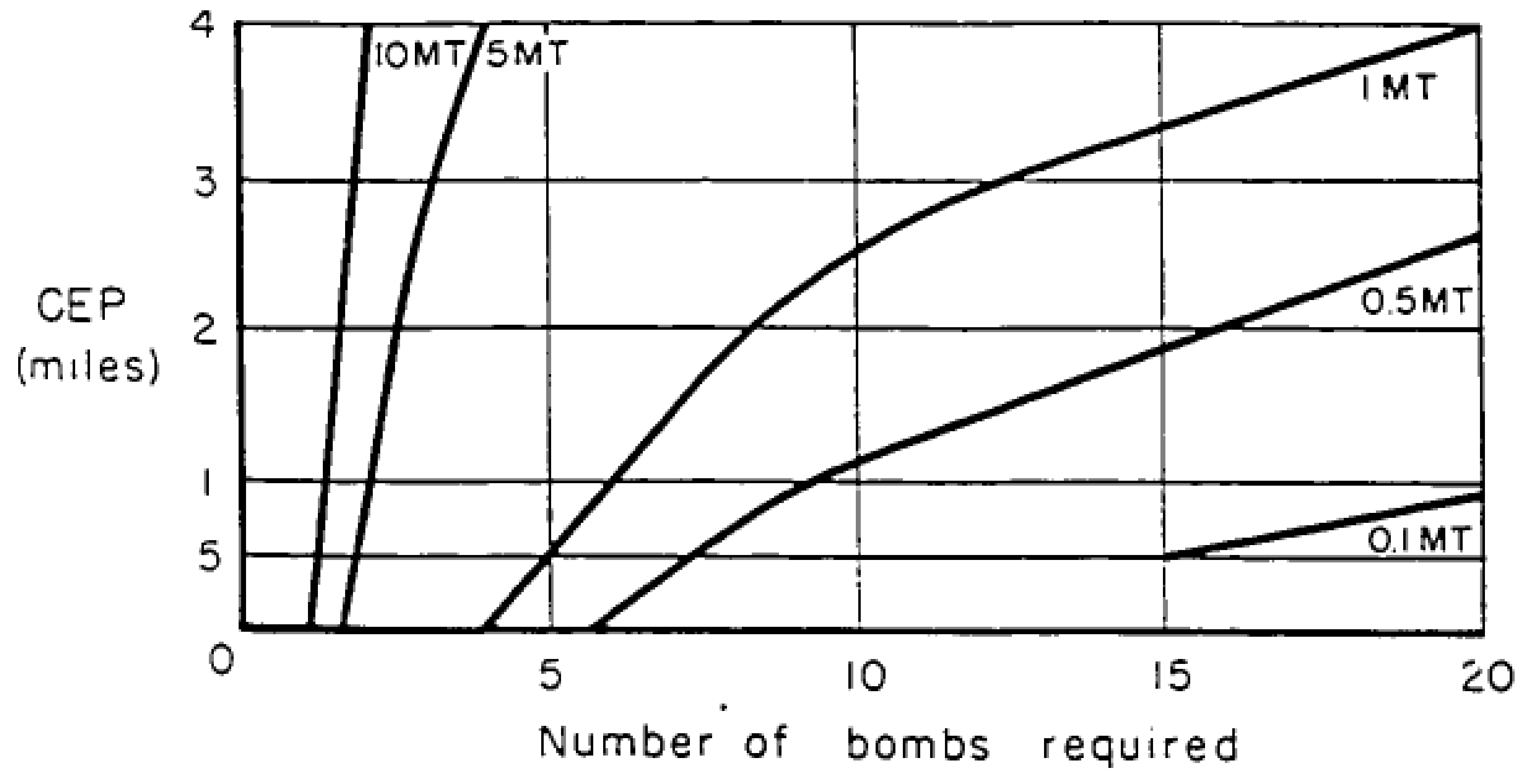
FIG. B-1: CEP-YIELD, MOSCOW INDUSTRY |
Lest it be assumed that adoption of [illegible] criterion forever relieves weapons in the megaton class from a need for accuracy, note figure B-3 which does for Dayton, Ohio what a figure B-2 does for Moscow. Here one can interpolate to conclude that a 500 KT weapon with a CEP of 0.5 miles will accomplish the same expected damage as a 5 MT weapon with a 4 mile CEP. Where constraints exist on the total yield (strontium 90 contamination) and simply as a matter of economy this is an excellent argument for accuracy, and cruise missiles, against smaller targets than Moscow.
Magnitogorsk, a city of the size of Dayton, Ohio, is only 40th in rank of population size. Consequently, an attack of such magnitude as to include 40 USSR cities would be expected to involve such accuracy-yield trade-off considerations as figure B-3 illustrates.
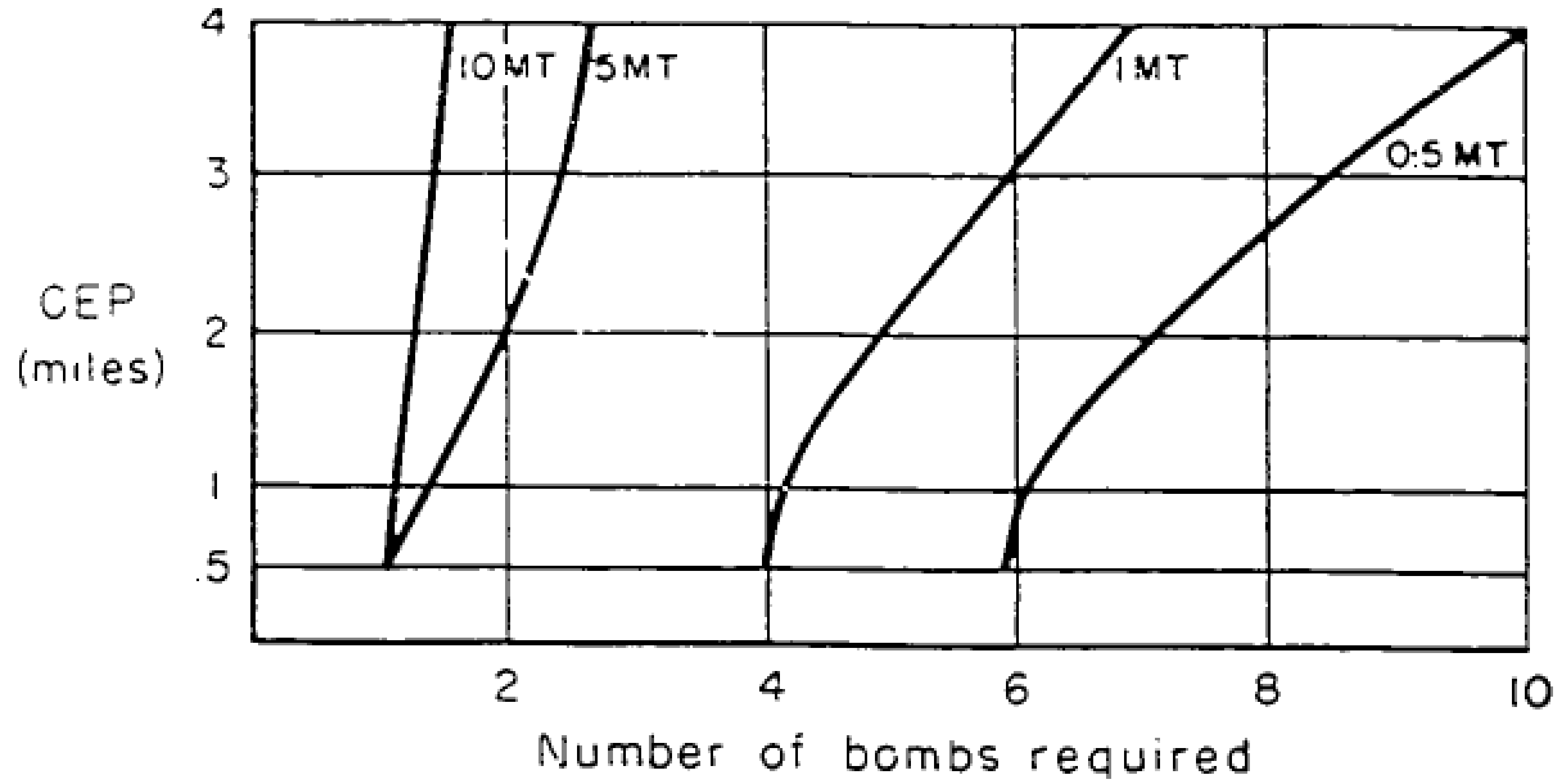
FIG. B-2: CEP-YIELD, MOSCOW POPULATION |
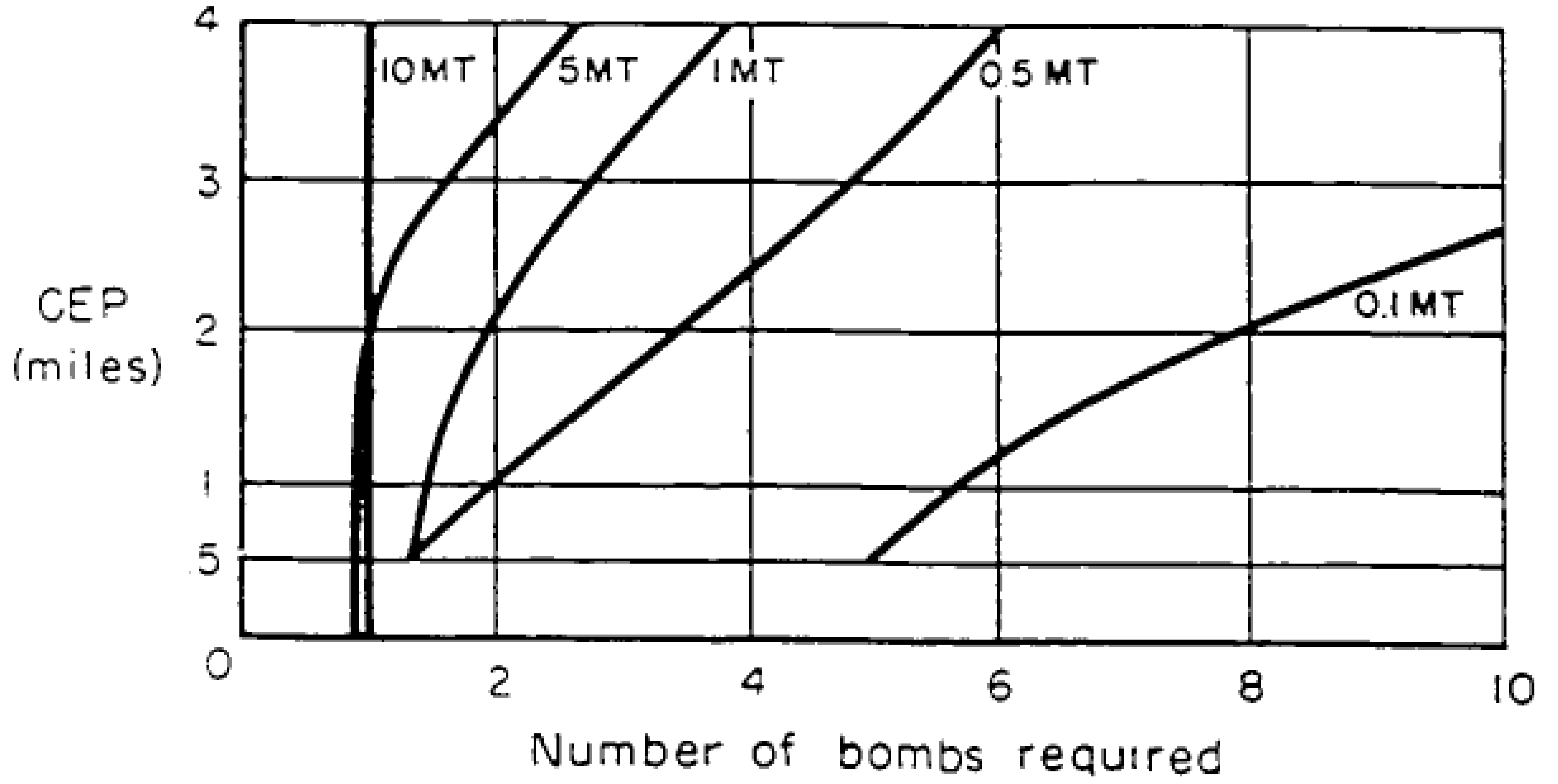
FIG. B-3 CEP-YIELD, DAYTON POPULATION |
– – – – – – – – – – – – – – – – – – – – – – – – – – – – – – – – – – – – – – – – – – – –
Programming and Employment.
Figure C-1 graphically illustrates a possible program in money expenditures and submarine construction and the resulting arrival of units available for deployment. The solid lines represent the program recommended in this report, the dotted extensions are a feasible continuation, assuming establishment of a requirement and continued availability of funds. The program shown is a copy of one proposed by Op51, except that a surface-combatant ship is deleted from the '59 program and missile submarines in various numbers are added during various years. This represents a schedule considerably accelerated over routine practice for introduction of new types and is both risky and expensive. Maximum priorities will be required if such a schedule is to be met. Fortunately, the requirements are sufficiently loose that the risk that unacceptable characteristics will result seems small.
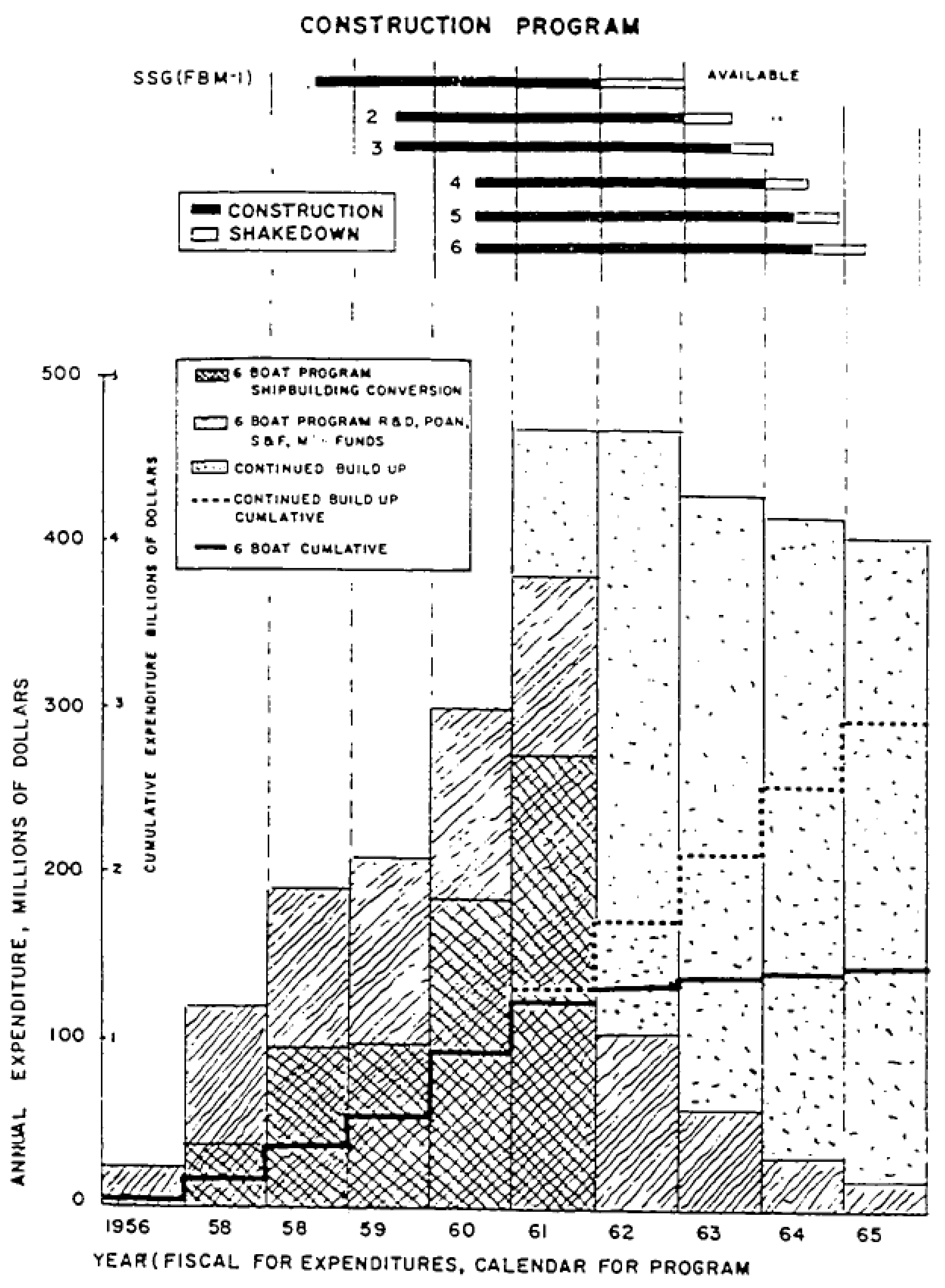
FIG. C-1: POSSIBLE CONSTRUCTION PROGRAM |
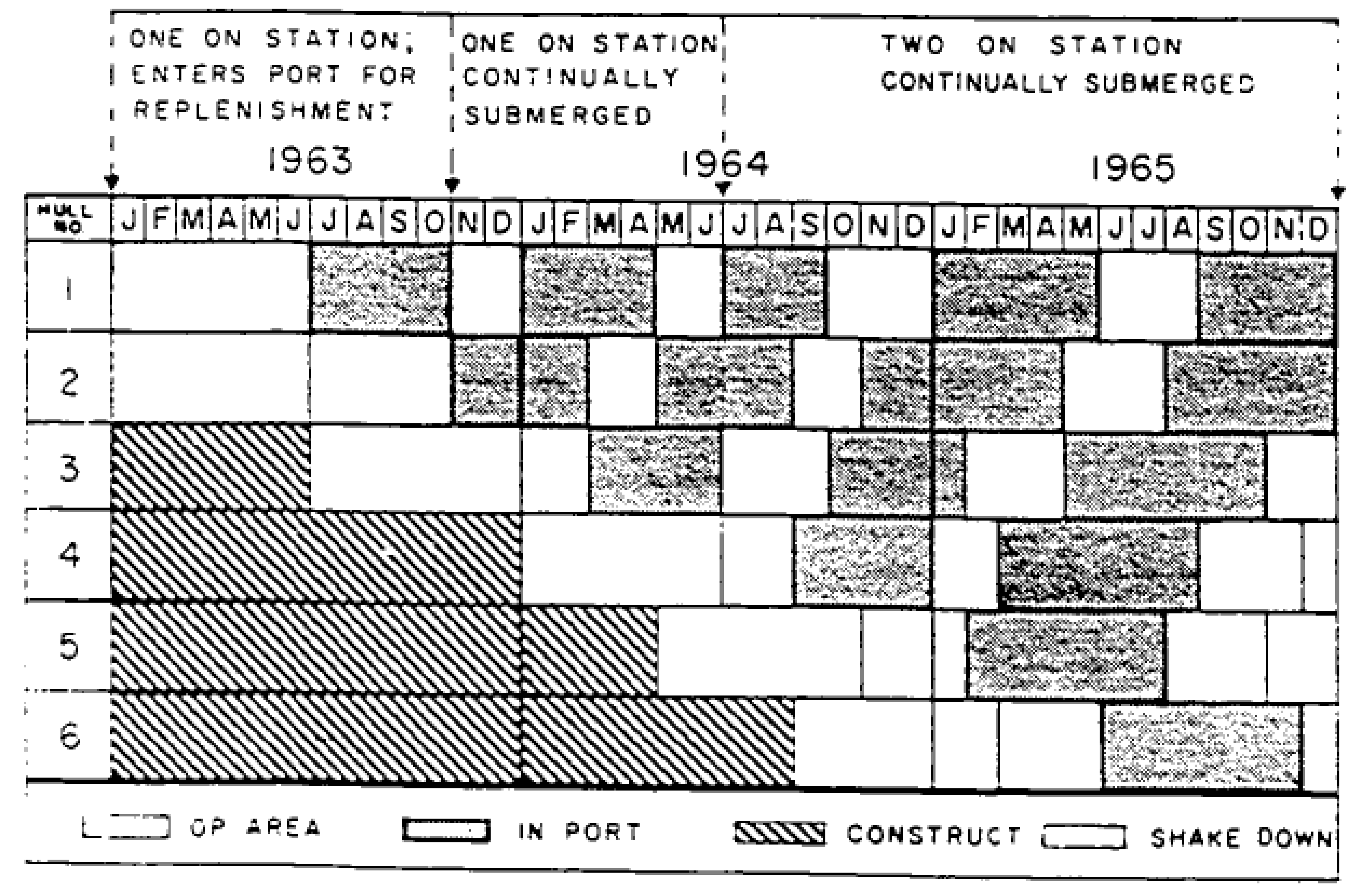
FIG. C-2: CONSTRUCTION, OPERATIONAL EMPLOYMENT SCHEDULE |
Figure C-2 illustrates a proposed phasing-in employment schedule yielding a limited but still significant capability for the first year. Maximum deterrent capability would result if the single missile submarine on station for the first 11 months were to be permitted to enter port without prior scheduling, and with random lengths of stay. Whether arrangements to permit this could be made is not now known. By the middle of 1964, the availability of boats should permit two of them to be maintained on station totally submerged throughout the patrol.
Future Programs.
A significant technological development that can be anticipated ultimately with some confidence is the capability to construct a "wooden" FBM that would be launched submerged in a capsule carried externally on submarines. Not only would this have the obvious advantages of increased freedom from detection and forestalling, but this would significantly affect the optimum size of the missile submarine.
The internally stowed Polaris required for the early generations to avoid delays in development militates toward a large submarine, since missile capacity must be bought for valuable internal space, after a "price of admission" for propulsion, SINS, etc., has been paid.
Since the deck area of a submarine (or ship) is proportional to the 2/3 power of its tonnage, the deck area per ton will increase with decreasing size. Consequently, if missiles are stowed externally, the optimum size missile submarine will be approximately the smallest that can contain the necessary propulsion, navigation and crew quarters, etc. Such a smaller submarine would greatly enhance the security and decrease the cost of an FBM force by permitting much wider dispersal within a given total budgetary limit.
REFERENCES
(a) RAND RM1451 Costs of Possible Alternative Methods for Operating the WS107 A System Secret 5 Apr 1955
(b) OEG Study No. 406 Defense of Coastal Metropolitan Areas Against Submarines Launching or Attempting to Launch Guided Missiles Secret 28 Oct 1949
(c) RAND R272 A Study of Complex Targets Moscow, Dayton, and Geneva Steel Secret Restr Data 15 Nov 1954