
COPY NO. 1 FOR THE PRESIDENT OF THE UNITED STATES
– – – – – – – – – – – – – – – – – – – – – – – – – – – – – – – – – – – – – – – – – – – – – –
WARNING
This document contains information affecting the national defense of the United States within the meaning of the Espionage Act, 50 U.S.C., 31 and 32, as amended. Its transmission or the revelation of its contents in any manner to an unauthorized person is prohibited by law.
– – – – – – – – – – – – – – – – – – – – – – – – – – – – – – – – – – – – – – – – – – – – – –
1. This copy of this publication is for the information and use of the recipient designated on the front cover and of individuals under the jurisdiction of the recipient’s office who require the information for the performance of their official duties. Further dissemination elsewhere in the department to other offices which require the information for the performance of official duties may be authorized by the following:
a. Special Assistant to the Secretary of State for Research and Intelligence, for the Department of State
b. Director of Intelligence, GS, USA, for the Department of the Army
c. Chief, Naval Intelligence, for the Department of the Navy
d. Director of Intelligence, USAF, for the Department of the Air Force
e. Director of Security and Intelligence, AEC, for the Atomic Energy Commission
f. Deputy Director for Intelligence, Joint Staff, for the Joint Staff
g. Assistant Director for Collection and Dissemination, CIA, for any other Department or Agency
2. This copy may be either retained or destroyed by burning in accordance with applicable security regulations, or returned to the Central Intelligence Agency by arrangement with the Office of Collection and Dissemination, CIA.
DISTRIBUTION:
Office
of the President
National Security Council
National Security
Resources Board
Department of State
Office of Secretary of
Defense
Department of the Army
Department of the
Navy
Department of the Air Force
State-Army-Navy-Air Force
Coordinating Committee
Joint Chiefs of Staff
Atomic Energy
Commission
Research and Development Board
– – – – – – – – – – – – – – – – – – – – – – – – – – – – – – – – – – – – – – – – – – – – – –
SECRET
ORE 77-48
CHINESE COMMUNIST CAPABILITIES FOR CONTROL OF ALL CHINA
Note: The information in this report is as of 1 December 1948. The intelligence organizations of the Departments of State, Army, Navy, and the Air Force have concurred in this report.
SUMMARY
The rapid disintegration of the Nationalist Army indicates that organized resistance to the military forces of the Chinese Communist Party will probably cease within a few months. When there is no further Nationalist resistance directed from a central headquarters, Communist forces will proceed at leisure to the reduction of anti-Communist forces in Inner Mongolia and South and western China.
The Communists are not, as yet, officially advancing a program of radical reform. Their measures in newly acquired territory have been moderate and conciliatory, gaining them increased popular support. The Communists have exploited the hopeless economic situation in North and Central China to the point where any Communist program appears more desirable to the people than a Nationalist survival.
A Communist-dominated government will probably come to power as a result of what is in effect the surrender of the National Government. This government will probably be proclaimed as a “coalition,” and it will include many non-Communists, among them members of the present National Government. As a “coalition” it will have the advantage of not necessarily forfeiting international recognition. It is almost certain, however, that Communist officials will dictate the policies of such a government.
There is no doubt that the Chinese Communist Party has been and is an instrument of Soviet policy. While there is no guarantee that the USSR will always find the Chinese Communists dependable, there appears to be no chance of a split within the Party or between the Party and the USSR until the time of Communist domination of China.
– – – – – – – – – – – – – – – – – – – – – – – – – – – – – – – – – – – – – – – – – – – – – –
– – – – – – – – – – – – – – – – – – – – – – – – – – – – – – – – – – – – – – – – – – – – – –
This paper assumes that the intention of the Chinese Communist Party is to gain absolute control of all China. It is the purpose of this paper to determine whether the Chinese Communists are capable of so doing.
The Military Phase
The strength and the tactical success of the Chinese Communist Forces have been the chief instruments in the ascent of the Communist Party, and will continue to be so until all organized resistance by the Nationalist Army has been overcome. As the Nationalist Army is the major obstacle to that ascent, the mission of the Communist Forces will be to proceed with the annihilation of the Nationalists’ vital strength. The Communist Forces, through extremely able use of available human resources, through support (derived or extracted) from the populace in Communist-held areas, and through a clever use of propaganda, have overcome initial limitations in the materials of war and have reached or exceeded parity with the Nationalists in numbers, weapons, and equipment. The Communists’ greatest advantage over their opponent is found in this expert exploitation of human resources, and their prospect of eventual victory rests upon that ability.
a. The Human Factor.
High morale and excellent leadership, repetitive and finally credible propaganda themes, plus a well-developed sense of purpose, have elevated the once materially weak Communist Forces to their present position of superiority in the civil conflict. The morale of the opposing Nationalists is excessively low, and is reflected not only in a marked preference for passive tactics but often in a wholesale refusal to fight. Entire armies surrender en masse, and even those units which choose to fight often find that the defections of neighboring units have rendered their position tactically untenable. As continued resistance appears pointless, and as Communist propaganda emphasizes this, the defenses soon collapse. Further, the loss of such defense centers as Chin-hsien, Mukden, or Tsinan, has the same effect in an over-all strategic sense as do local defections in a tactical sense.
Communist propaganda is aimed both at strengthening internal Communist morale and at weakening the morale of National Government supporters. A simple theme, constantly repeated—things are better under the Communists—creates in time, and under the proper circumstances, a conviction in the minds of the Nationalist officers and men that this is true. The Communists have offered equivalent grades to those who “come over”; they offer food as a lure; they reiterate the essential brotherhood of all Chinese and the futility of internecine warfare (especially the futility of continued resistance to the Communist tide); they point out corruption and discrimination within the Nationalist Forces; in fact there is, in Communist propaganda, something for everybody. It is effective, for the will of the Nationalists to resist has been so weakened as to make highly improbable any continued effective resistance over a significant period of time. The insidious effects of the Communist Fifth Column and the obvious superiority of Communist intelligence, contribute heavily both to the Communists’ military and political successes. Nationalist counter-efforts in each of these fields have been puerile failures.
b. The Material Factor.
It is estimated that the strength of the Communist Forces is about 1,500,000, the great majority being combat effectives. In addition, they possess a strategic reserve. They are opposed by slightly over a million Nationalists, the great majority of whom will offer only token resistance before defecting to the Communists. It is unnecessary for the Communists to integrate the growing number of Nationalist renegades into their army inasmuch as present Communist combat forces are sufficiently large to fulfill their mission; if they were to absorb large numbers of defected Nationalist Forces, they would probably dilute their real strength. In addition to their first-line troops, the Communists can, when necessary, call upon the combat services of some 2,000,000 irregulars, whose indoctrination, from the Communist viewpoint, is superior to that of disaffected Nationalists.
The Communists’ logistic position is such that they now have a marked advantage over the Nationalist Army. The former, with Japanese, Chinese, and US arms garnered from a variety of sources, can now outgun the latter at almost any point. As neither combatant can supply itself from current arsenal production, each must remain dependent upon outside supply. The US has supplied, and again is supplying, arms and ammunition to the National Government, while the chief source of supply for the Communist Forces remains the capture of materiel from the Nationalists. The USSR allowed the Communists to take over the large stocks of the Japanese Kwantung Army in Manchuria (which materiel is probably only now running out), and even now may be extending them technical advice, but no concrete evidence exists to support the contention that the USSR is currently supplying Japanese or Soviet materiel to the Chinese Communists.
The Communists control the great majority of the rural, food-producing areas of North and Northeast China, and are thereby enabled to employ food as a weapon in the civil contest. Shortages of food, later starvation, in Nationalist-held cities, surrounded and cut off from the normal sources of food, play an important role in their eventual capitulation. By making effective use of all means of transport available to them, and by conditioning tactics to their limitations in this regard, the Communists have enjoyed a relative advantage in combat supply. More recently the railways of Manchuria have lent the Communists a new and apparently devastating-mobility and striking power. Nationalist transport has, on the contrary, gone from bad to worse, and is now reduced to short stretches of highway and railway within or leading into the combat areas. These truncated channels are supplemented by waterborne and aerial transportation, which are, though inadequate, the most important available to the Nationalists.
The Nationalists possess the only extant navy and air force, and thus enjoy certain limited tactical advantages. The Nationalist Air Force, however, has shown itself to be an ineffective organization in the fields of bombing and fighter support. In addition, shortages of almost all materials required to operate an air force have reduced the Nationalist Air Force to a primary function of transport.
c. Strategy and Probable Future Trends.
A shift in the Communist tactical emphasis has paralleled the growth of its army. At first tentatively, but lately with assurance, the Communists have assaulted large, comparatively well-defended cities. Although this has produced a portion of the Communist Army, which, departing from the traditional Communist concept of guerrilla warfare, is probably capable of taking any Nationalist-held city, there remains a considerable section of Communist units still operating primarily along guerrilla lines. The latter groups will be principally employed in the initial phases of any new operations. The assault troops will undertake to reduce Nationalist-held pockets which have been encircled and are about to fall. Communist strategy will continue to invite Nationalist defections and will probably be highly successful.
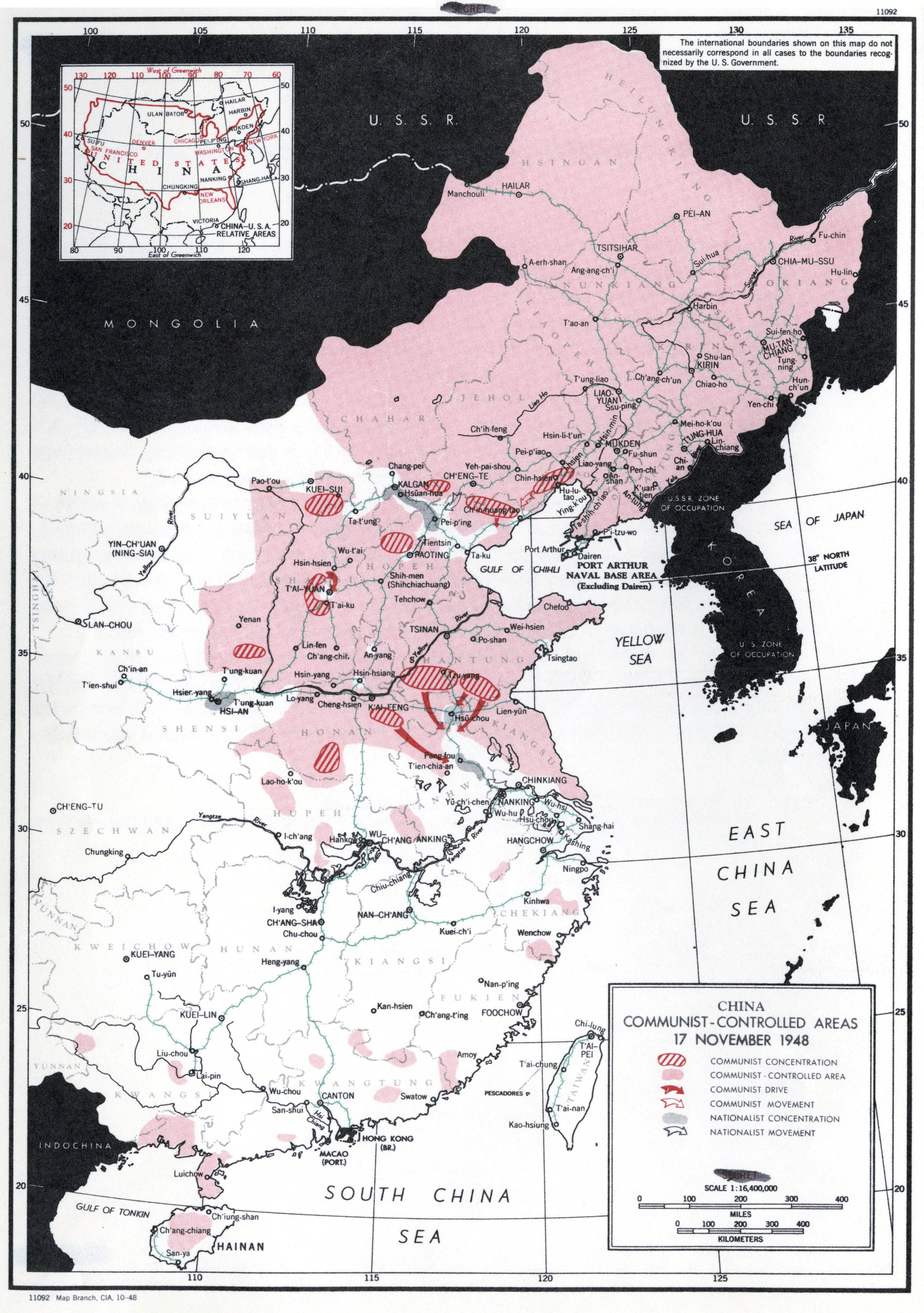
At present the principal areas of Nationalist resistance are in the Tientsin-Kalgan area of North China, and the Central China area around Hsuchou. Greatly superior Communist forces are moving into position to attack the former region, while a strong Communist drive in the Hsuchou area is well under way. This drive, which threatens to engulf all Nationalist units in the area and open a clear pathway to lightly defended Nanking, might well prove the coup de grace to organized resistance by the Nationalist Army. Other areas of Nationalist resistance, at Sian, Kueisui, Taiyuan, and Hankow, are now being reduced or can be reduced later without much difficulty by the Communists. There are no effective Nationalist forces, nor are there any local troops that could successfully resist the Communists, in South, Southwest, or West China, and it can be assumed that the extension of Communist authority into these areas will inevitably follow the termination of organized military operations by the Nationalist Army.
The Economic Phase.
The Chinese Communist Party will not be faced with any economic problems which in scope or kind will prevent it from attaining its immediate military and political goals. As the military program of the Communist Army nears completion, and the islands of Nationalist resistance are reduced, the pattern of the Communist economy will gradually develop from a loose federation of relatively self-sufficient and economically independent regions into a structure with increased integration and interdependence.
a. Agricultural Factor.
The food situation, in areas occupied by the Communists, will not be serious. Although agricultural prospects are not favorable, the food situation in Communist areas should not be worse than it has been under the Nationalists. Insect plagues in southern Manchuria have reduced the normally large grain surplus from Manchuria, but the outlook for North China is good, and production should be close to that of prewar. In North China there will be, as always, a few famine areas, notably in parts of Shansi and the flooded areas of the Huai River and the Hungtze and Weishan Lakes, but this may be partly overcome by moving food from areas of more adequate production. The unification of the economic regions of North China may have an immediate salutary effect on the distribution system which formerly linked the farmers and the numerous small towns dotting the North China plains. The problem of feeding the large cities which have come under Communist control, or which will fall to the Communists in the near future, will be offset by possession of through rail connections which will permit transportation of food from surplus areas. While the obligation of feeding these additional cities will strain the Communists’ food resources, the standard of living in the cities will probably not be reduced under Communist rule.
b. The Industrial Factor.
The Chinese Communists have thus far exploited the resources and industry of Manchuria only to a limited extent, and further rehabilitation of transportation, mining, and industry in Communist areas will probably prove difficult. There has been no large-scale resumption of the heavy iron and steel industry once built up in this region. With the exception of a few consumer items, such as textiles, the present limited production of small-scale home industries, augmented by the smuggling of goods from Nationalist areas, apparently meets the immediate needs of the Communists’ economy.
North China would have a possible excess of industrial capacity over the Chinese Communists’ immediate requirements if the Communists acquire control of the large textile and other industrial installations in North China cities; textile shortages in Manchuria could thus be eased.
By capturing Tsinan and Mukden intact, the Communists have gained possession of large industrial installations and stocks of raw materials and finished goods. This may establish a precedent, and, if Tientsin or other large cities fall to the Communists, the industrial installations, power plants, and railway networks may be taken over by them in a comparatively undamaged state. In attempting to rehabilitate the industry of newly won areas, the Communists will necessarily be faced with the problem of replacing worn-out machinery and equipment, but in the immediate future, all of the Communists’ industrial needs can be met even with the plants in their present under-maintained and obsolete condition. The Communists will not be faced with any large-scale shortages of skilled personnel, for most of the technicians operating-Nationalist factories probably can be induced to stay on the job under a Communist regime.
The large arsenal at Mukden has fallen to the Communist Forces and will add to the Communist military potential. Furthermore, the Communists have acquired such a vast stock of weapons and equipment in their capture of Nationalist military units that, even without the arsenal, the Communist Forces would have an adequate supply of munitions.
There is no shortage of coal in Manchuria, mining capacity being well in excess of requirements for power plants, railroads, and fuel. When the Kailan mines (north of Tientsin) fall into Communist hands, there will be a surplus of coal over and above Communist domestic requirements in North China.
The transportation system in North China and Manchuria, although undermaintained and in most cases seriously deteriorated, will be of great benefit to the Communists in their consolidation of the areas of North and Northeast China. Through rail routes are already in operation, and several more seem about to be. In addition, the capture of the North China ports might give the Communists a number of small vessels, totaling perhaps 100,000 tons, which would provide adequate shipping for coastal requirements.
c. Possible Future Trends.
A basic advantage which the Communists possess derives from the fact that the economic situation under the Nationalists in North and Central China has so completely deteriorated that any change for the better, no matter how slight, will afford the Communists great psychological benefits. By re-establishing normal relationships between the major cities of North China and Manchuria and their surrounding countryside, the wartime barriers to trade and communication will be eliminated, and the Communists’ opportunity for consolidating their gains in this part of China will be immeasurably advanced.
The Political Phase.
In the period during which the Communist political effort will be parallel to, and dependent upon, the military effort, the Chinese Communist Party will simultaneously: (a) consolidate its control over areas which it already occupies, (b) prepare to administer areas which will presently be under its control, and (c) continue to erect a framework for a Communist-dominated government for all of China.
a. Consolidation of Control.
Within China, the Communist Party has derived its principal popular support from the peasant masses, and to a lesser extent from industrial workers and urban intelligentsia. The Communist Party has skillfully exploited three major and genuine grievances: peasant misery, affronts to national sovereignty, and the corruption and ineptitude of the National Government. By carrying out, on a larger scale than has the National Government, such basic agrarian reforms as redistribution of land and reduction of rent and taxes, the Communist Party apparently has demonstrated, to the majority of the populace in Communist-controlled areas, its practical superiority to the National Government. The promise of the CCP to defend China against foreign aggression has in some quarters been received with favor, despite the Chinese Communists’ affinity with the USSR. The character of the National Government, a government which not only has not solved but has refused even to attack the basic economic and political problems of China, has of course been a major asset to the Communists. The peasant masses have never supported the National Government and do not now resist the advances of the Communists. The latter are, furthermore, attracting increasingly large numbers of urban workingmen, businessmen, intellectuals, and officials.
The various areas of China occupied by the Communists have in the past been administered through the Central Executive Committee of the Chinese Communist Party; this body does not, however, fully perform the functions of a central government, and unconsolidated areas are apparently permitted to exercise some degree of administrative autonomy. About three months ago the Communist Party proclaimed a “North China People’s Government,” formalizing the previous unification of two northern border region governments. This North China government may be the prototype for a number of other “People’s Governments,” to be formally established elsewhere in China as rapidly as the Communist Party consolidates its control. It is further possible that these various regional governments will be administered by a central government, but public proclamation of such a government would not be necessary to the Communist plan for effecting a “coalition” with other dissident groups and various elements of the present National Government. In the meantime, it is probable that the various regional governments will be permitted to pursue policies best adapted to the particular area.
b. Preparations for Control.
At present the Communists are pursuing a policy of moderation both in the areas which they control and toward the areas which they are preparing to control. Before Communist Forces enter a besieged city, the Communist Party promises to cooperate with businessmen, landlords, and Nationalist troops, and appeals to the people of the city to maintain order, preserve the governmental apparatus, and remain on the job; the Communist Party promises that it will be lenient with all elements which “cooperate” with it. These tactics appear to indicate that the Communists, because they lack trained personnel, must rely in part upon Nationalist urban administrations, but in any case this practice enables the Communists to control any given city rapidly and to administer it efficiently. Political officers accompany Communist troops into the city; the military administration is replaced by a civil body as soon as practicable. The maintenance of order and the restoration of the municipal government and economy, can be presented by the Communists as a favorable contrast to the disorder and confusion which preceded its entry and which exist in many Nationalist-occupied cities not yet threatened by the Communists. The Communists even claim that they will protect the interests of private industry so long as such industries “cooperate.” The Communists lack experience and personnel for the operation of large industries, and they are apparently willing, temporarily, to accept assistance from any quarter. Thus the above claim certainly encourages propertied elements in their hope of survival in health under a Communist government. It is highly probable, however, that the Communist will assume complete control of all enterprises when they are prepared to do so.
The Communist Party also is following a moderate policy toward rural areas. The practice of outright expropriation of land, liquidation of landlords, and terrorization of the populace as a whole, has been officially condemned by the Communist Party as “extremist.” Agrarian reform, especially in areas occupied by the Communists in the past several months, has apparently become cautious and gradual. The program of rapid agrarian reform in Central China has been postponed indefinitely; at present, only the reduction of rent and interest rates is being effected. The Communists claim that the peasant masses are not yet “ideologically prepared” for a swift and complete reformation. This is apparently an admission that the Communist Party faces real problems in consolidating its control, but it also means that, by pursuing a moderate policy, the Communists will considerably broaden their support in rural areas.
c. Government for All China.
In planning for a government for all of China, the Communist Party must choose one of the following alternatives: (a) to establish a “coalition” government in the area which it already controls, this government to include the various Communist regional governments, with the anti-Nationalist Kuomintang Revolutionary Committee (KMTRC), the Democratic League, and other dissident groups; or (b) to continue to plan, together with the above groups, a government which will proceed toward control of all of China, and which will probably be proclaimed as a “coalition,” to include elements of the National Government. (It is not necessary that the Communists proclaim a “coalition”; but it would probably appear to them desirable.)
It does not seem likely that the Communists will choose the first course cited above. A premature “coalition” government, merely with the KMTRC and Democratic League, and merely in areas already held by the Communists, would have few positive advantages, and the great disadvantage of necessarily forfeiting international recognition. In addition, it is probable that the Nationalists will soon have no alternative to that of attempting to negotiate with the Communists, perhaps through the good offices of the USSR, for a “coalition” government for all of China, such “coalition” to be dominated by the Communists.
It is probable that a Communist-dominated government will come to power as a result of, perhaps at the time of, what is in effect the surrender of the National Government, but that the new government will be proclaimed as a “coalition,” which would not necessarily forfeit international recognition. This government will include representatives of the KMTRC, the Democratic League, and elements of the present National Government. It is quite possible that the Communists will prefer to have a non-Communist as titular head of the government, and to have non-Communists as titular heads of a number of departments of government; but it is almost certain that genuine authority, at every level of the government, will in time be exercised by the Communist Party alone.
The subsequent relations of the Communist-dominated “coalition” government with the USSR and the US will be a matter of considerable complexity. In accordance with the present strategy of the Soviet-directed international Communist movement, the Chinese Communist Party presents itself to Chinese primarily in terms of national interest, rather than in its role in the international Communist movement. The policy of both the Chinese Communists and the USSR, moreover, in emphasizing the former’s positive achievements in China, has been extremely effective, in that only a small proportion of Chinese realize fully the implications of a Soviet-oriented Communist government. The Communist Party shares with the USSR a common ideology, a common political organization, common strategies and techniques, and, at present, a common goal. The Chinese Communist Party has never publicly deviated from the Soviet Party line, has never publicly criticized any Soviet action or representative, and has never publicly given any indication whatsoever that it could be oriented away from the USSR and toward the United States. It is certain that the Chinese Communist Party has been and is an instrument of Soviet policy. While it is not certain that the Communist Party is or will be an absolutely reliable instrument, there appears to be no chance of a split within the Chinese Communist Party or between the USSR and the Chinese Communists, until at least such time as a Communist-dominated government of China comes to power.