TOP SECRET
RESTRICTED DATA
29 JUL 1963
DCI Briefing to Joint Chiefs of
Staff
30 July 1963
1000 Hours
I a. What is the present position of the USSR
in relation to that of the US in nuclear technology and weaponry in
the field of strategic nuclear weapons, anti-missile missile defense
and tactical nuclear weapons.
A. Strategic Nuclear Weapons
1. Comparison on a yield-to-weight basis
It is estimated that at the present time the US and USSR without
further tests can achieve the yield-to-weight ratios in thermonuclear
weapons shown in Chart I.
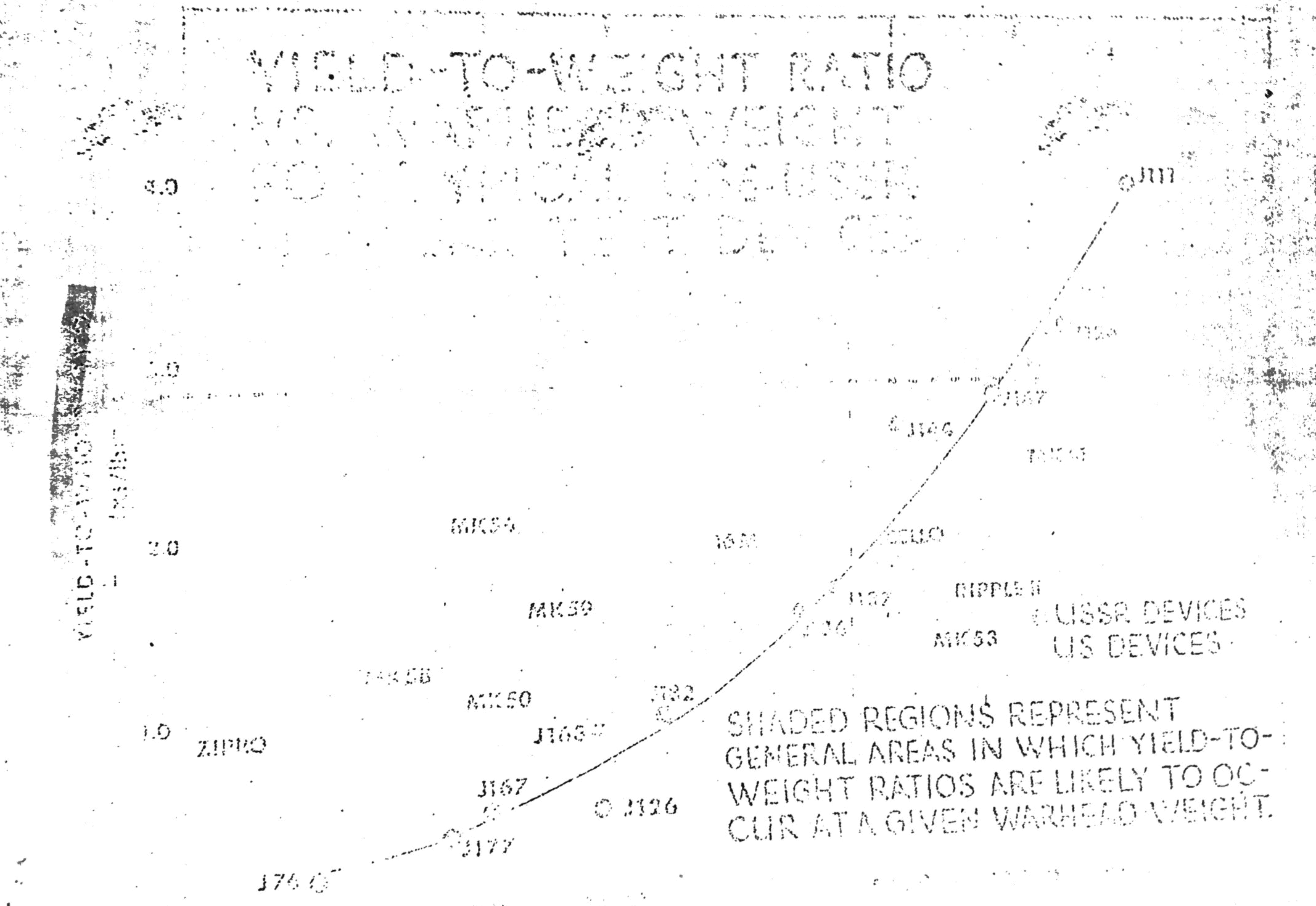
As you can see from the chart, the USSR appears superior to the US
in yield-to-weight ratios in very high yield weapons. It is
approximately equal to the US in medium and high yield weapons from 2
to 10 MT, though the US has an edge toward the lower end of this
range. Below 2 MT the US has clear superiority in yield-to-weight
ratios, and, in fact, we have detected no Soviet thermonuclear device
less than 600 pounds and less than 150 KT.
These same data are graphically depicted in Chart II in terms of
actual US and USSR shots.
2. Very High Yield Weapons
The Soviets have demonstrated a device of 60 MT which could be
scaled up to about 100 MT warhead at about 25,000 pounds. According
to intelligence estimates, the Soviets probably have no missile at
this time which will deliver their 100 MT warhead to ICBM ranges.
Therefore, at this time, the Soviet's scaled-up 100 MT weapon is
probably suitable only for delivery as an air-dropped bomb. However,
even under a test ban the Soviets could develop a missile capable of
delivering the 100 MT warhead to intercontinental distances and in
fact are believed to be currently developing larger rocket boosters,
which will probably enable them to carry the 50-60 MT weapon to these
distances.
The Soviets tested, in 1962, devices of a new design at 13 and 24
MT which can be weaponized both as bombs and warheads. We estimate
that with the development of new re-entry vehicles, they can be used
as warheads for the SS-6 ICBM with ranges of 6000 and 4500 n. miles
for the 13 MT and 24 MT warheads respectively. We believe the Soviets
have only a few of the SS-6 ICBMs deployed and in operational status.
Current estimates are that the SS-7 is the Soviet ICBM now being
deployed in considerable numbers. The SS-7 has a 3 MT warhead at
present, and is capable of conversion to 6 MT without further
testing. While this is the largest yield capability attributed to the
SS-7 for full 6,000 mile firings, we are presently examining the
possibility that the USSR could attain even higher yields with this
missile in reduced range firings which would still threaten US
targets from existing Soviet bases.
The US has stockpiled bombs of 9 MT and 23 MT and is deploying the
Titan II with a 9 MT warhead, scheduled to go to 10 MT in the future.
Missile delivery capability for larger yield warheads would depend on
development of a new vehicle or conversion to military use of one of
the large space boosters now under development, such as Titan III or
one of the Saturns.
The United States presently has the capability of designing for
stockpiling, with no additional tests, a 50 to 60 MT device at 30,000
pounds. Full weaponization would allow this device to be a laydown
bomb with an additional 10,000 pounds of weight.
3. Medium to High Yield Weapons
In weapons with yields between 1.5 and 9 MT, the US and the USSR
appear to have achieved comparable technology, with US showing some
superiority toward the lower portion of this range. Currently
deployed and soon to be deployed strategic systems involving aircraft
and missile delivery for both the US and USSR have warheads in this
range.
4. Relative Capabilities Against Hardened Sites
Chart III gives some concept of the relative effectiveness of
different weapon yields against a hardened missile site (300 psi).
Increased effectiveness against hardened missile sites is strongly
dependent on either developing larger missile systems with very high
yield warheads, or increasing the reliability and accuracy of present
missile systems. The chart indicates that greater gains accrue from
improving accuracy than from increasing warhead yields. At present
the US has a distinct advantage in the survivability of its strategic
missile force, in that the majority of Soviet currently deployed
missile sites are not hardened.
We believe that Soviet knowledge of the effects of multimegaton
warheads on hardened missile sites or upon associated electrical
equipment is no better than that of the US. Thus they will continue
to be faced with the same difficult yield extrapolation problems
faced by US planners and both sides will be compelled to overdesign
hardened missile sites to compensate for uncertainties in effects
knowledge.
B. Anti-Ballistic Missiles
In designing an ABM system, the major parameters are reaction
speed, missile performance, traffic handling capacity, decoy
discrimination, evasion of blackout effects and warhead technology.
Analysis of nuclear tests detected and analyzed to date suggest
the initial Soviet ABM system, the first segment of which may now be
being constructed around Leningrad, may be considerably different
from that envisaged by the US. The lack of detected tests involving
the enhanced radiation principle and the lack of thermonuclear
devices with weights below 600 pounds suggest the USSR may be using a
different kill mechanism or even a considerably larger anti-missile
missile than the US.
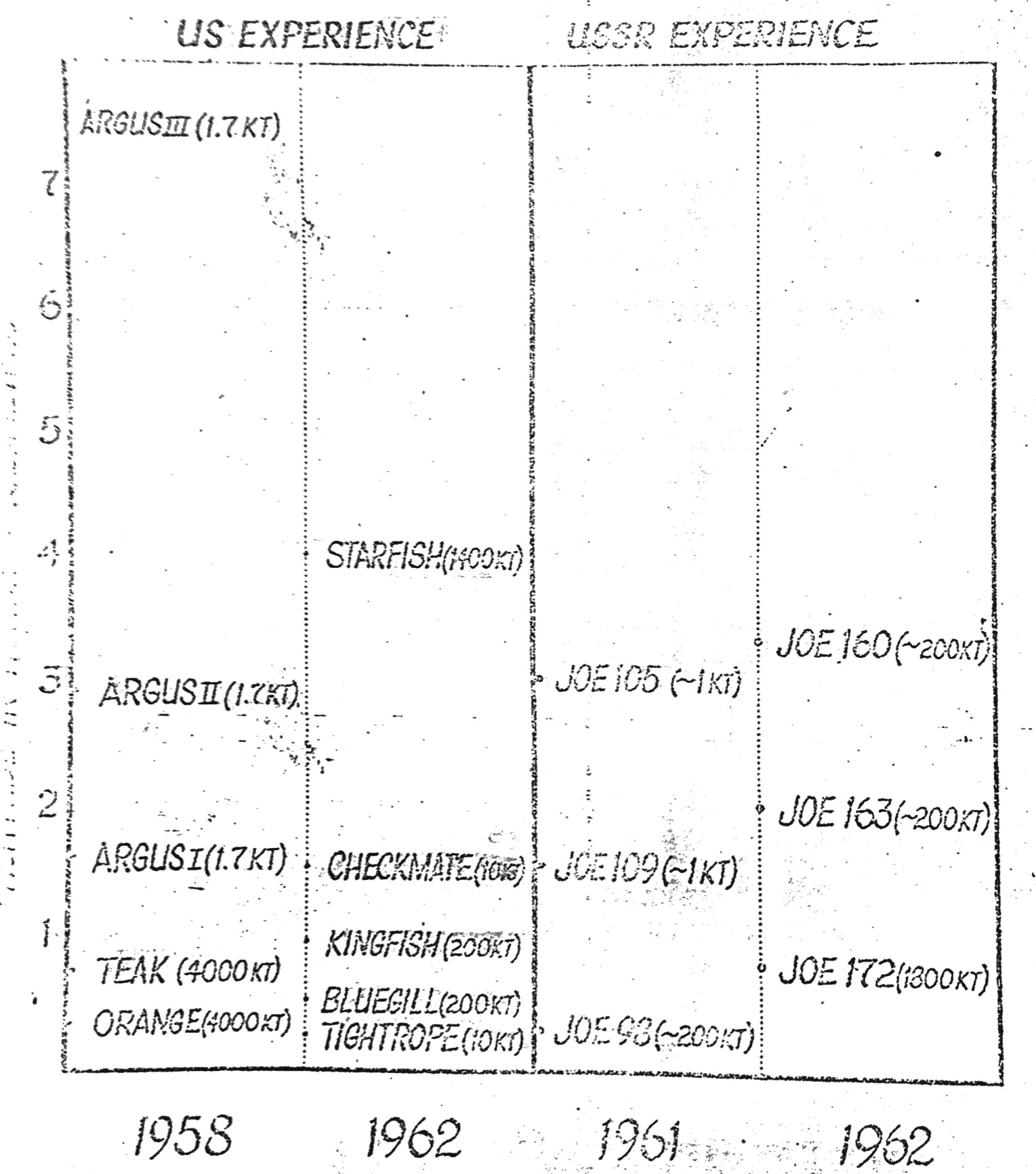
Both sides have only incomplete information on kill and blackout
effects in connection with ABM systems. The Soviets to date have
conducted six tests at over 100,000 feet, as against ten US tests.
(Chart IV) The US experience indicates that every altitude and every
yield introduce significant differences in the effects produced, and
it seems clear that neither side has all the data it would like.
Thus, although the Soviet tests have been sophisticated enough to
provide much developmental data, neither side can be confident of the
effectiveness of any ABM system chosen on the basis of present data.
In these circumstances, any ABM system widely deployed by either side
probably will be overdesigned to compensate for uncertainties, and
hence will be more costly than one which could have been designed
with continued nuclear testing in the atmosphere and in space.
C. Tactical Weapons
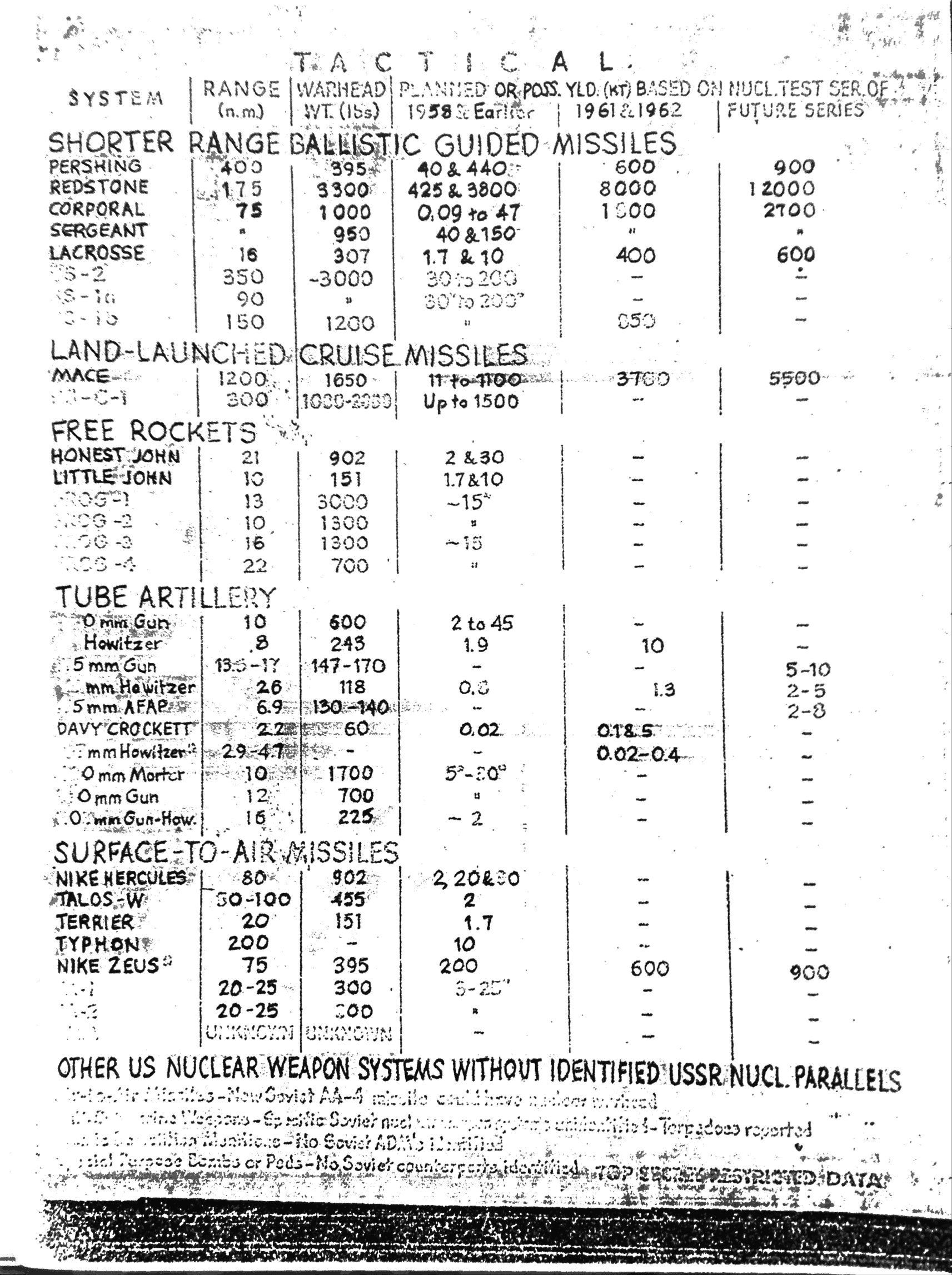
The United States at present has in stockpile or planned for
stockpile a number of nuclear warheads for tactical purposes ranging
in yield options from 20 tons to 1.5 MT. These weapons are planned
for employment on the battlefield, in anti-submarine and anti-ship
warfare, and against aircraft; they consist of warheads for artillery
and mortar-fired projectiles, battlefield missiles, demolition
munitions, bombs, depth charges, air-to-air missiles and
surface-to-air missiles.
Although Khrushchev as recently as 1959 denied that he was going
to give tactical weapons to his military, we believe that the USSR at
present also has in stockpile a number of nuclear warheads for
tactical use as bombs, artillery and mortar-fired projectiles,
battlefield guided and unguided ballistic missiles,
surface-to-surface aerodynamic missiles, surface-to-air missiles and
torpedoes. The yield capabilities associated with these weapons
extends from about 1.1 kiloton to more than a megaton. Soviet
official statements suggest a capability down to tens of tons but
there is no confirmatory evidence of this. It should be pointed out
that data from small Soviet shots is less firm than that from the
large yields.
The USSR is not known to possess, as yet, nuclear land mines;
depth charges; air-to-air missiles; or highly mobile short range,
very light weight, free rockets with a nuclear capability.
In the light of our estimates about the USSR, the US is presently
superior in design, diversity and numbers of nuclear weapons in most
tactical systems. It should be noted that design criteria, such as
the probable Soviet objective of minimizing the use of fissionable
material per weapon, have generally resulted in Soviet tactical
systems being larger, heavier and less mobile than those of the US.
There is no information indicating that the USSR has successfully
designed and detonated low-yield thermonuclear devices with enhanced
radiation and reduced fission or devices with the secondary heavily
loaded with oralloy such as the US TUBA device. In the case of
reduced fission devices the chance of collection and analysis of test
debris is markedly reduced for low yield tests and thus the absence
of debris analysis indicating the detonation of such devices in the
1961-62 test series cannot be considered conclusive negative
evidence.
With unlimited underground testing over a period of years we
believe the Soviets would be able to overcome the present US lead in
light-weight thermonuclear warheads and in small diameter weapons for
tactical employment. Both countries could continue development of
enhanced effects weapons, such as clean weapons for tactical use,
minimum fission weapons for ABM application and, ultimately, pure
fusion weapons. Eventually the two countries should approach the same
physics limits in all these developments. In the case of
thermonuclear weapons presumably the Soviets would be able to
extrapolate up from underground tests at perhaps 200 kilotons to
develop megaton warheads as we have done for MINUTEMAN.
I. b. What level of confidence do you accord
to these estimates.
In constructing our estimates of Soviet weapon capabilities the
basic procedure is to combine geophysical yield data with data from
the radiochemical analysis of debris, resulting in a calculation of
the weight of the device which could have achieved the measured bang.
These weights and the related yield-to-weight ratios are highly
dependent on the quality of both recorded geophysical yield data and
the samples of collected debris. Generally, debris data in its final
form is more accurate than yield data.
In the case of yields above 100 KT, the estimated error in our
determinations is in the range of 20-30%. For yields below 100 KT
this estimated error ranges from 40-100% (the latter for one
measurement on small yields). With regard to assigning specific
yields to a given warhead, the procedure involves a determination of
the weight carrying capacity of a given missile by the missile
community, then an assignment of a warhead based on its weight, on
comparable periods of development, on collateral information, and, in
a few cases, on apparent systems tests. It is thus quite possible,
depending on specific Soviet decisions of which we have no knowledge,
that the warhead yields assigned to the missiles are not in fact the
ones which the Soviets are stockpiling. Our estimates tend to give
the Soviets the maximum capability consistent with the data at hand.
II. To what extent will we be able to
determine whether the USSR is testing clandestinely? What
contribution can intelligence make toward supplementing the proposed
detection system? If Soviet cheating is detected, how much
information will the US be able to disclose in order to convince the
world of their guilt without declassifying the US detection system or
US intelligence that should be safeguarded?
A. Detection Capabilities
You are familiar with the detection capabilities of the principal
intelligence asset in the nuclear test detection field, the
AFTAC-operated Atomic Energy Detection System. This system as it now
stands has a good chance of detecting atmospheric tests of 5 KT or
greater detonated over the USSR and China. With the introduction of a
satellite based detection system later this year, reasonable
detection capabilities will be extended out to 100,000,000 km,
although some problems remain in the 10 to 25 km altitude region.
Intelligence resources are helpful in complementing the current US
AEDS and they would be useful in supplementing any future system.
However, history has proven that many of our intelligence resources
are highly perishable. Once it becomes known that we are using
particular intelligence assets in establishing Soviet intentions or
the existence of actual events, many sources have disappeared.
Clandestine efforts have been of little value in the past in
detecting Soviet tests. A real value of the existence of agents,
however, is that we believe the Soviets do not know what we obtain
through agents and hence cannot appraise the real risk they are
taking.
1. High Yield Tests
High yield tests could not be contained underground and could not
escape detection except in deep space. It is likely that a series of
such tests would be needed to develop really important new weapon
principles. Such tests, if conducted in deep space, would be very
complex and subject to a high probability of malfunction in either
the vehicle or instrumentation apparatus.
Our intelligence capability to detect the launching of Soviet
space probes to lunar orbit distances and beyond is an important
adjunct to the AEDS. Any Soviet launchings of space probes from their
present Tyura Tam Range using present instrumentation would almost
certainly be detected, especially if the Soviets continue utilizing
earth parking orbits as a preliminary step to deep space penetration.
Even a direct ascent from Tyura Tam would probably be identified.
Were the Soviets to launch a space vehicle from a site other than
Tyura Tam, our capability to detect the vehicle would be somewhat
reduced. A single direct ascent from such a site might escape
detection but multiple or repetitive launches would rapidly increase
the probability of detection.
2. Underwater Tests
Other than for effects information, it does not appear likely that
the Soviets would have reason to conduct low yield underwater tests.
Their present underwater testing experience probably gives them
adequate effects information except at great depths. If the Soviets
were to attempt cheating by conducting underwater tests, we believe
that any such tests conducted in international deep water would
probably be detected but that low yield underwater tests in remote
sheltered areas would be difficult for us, if not impossible, to
detect. Seismic shocks from underwater nuclear blasts around 1-2 KT
can only be detected up to about a thousand miles away. We have some
hydrophone capability but this is also of rather limited range. In
addition, there is as yet no system deployed which will determine
technically that the shocks came from a nuclear blast rather than an
earthquake.
The movement of surface ships necessary for the conduct of such
tests would probably be revealed, for we carefully monitor all Soviet
shipping. However, this is not true in the case of submarines and
their movements are not always known. As the conduct of tests by
submarines is both difficult and expensive, this seems an unlikely
alternative. In summary, however, there appears little reason for
conducting clandestine underwater tests when such tests can more
easily be conducted underground, and without treaty violation.
3. Atmospheric Tests
Effects tests in the atmosphere or at high altitudes would have to
be conducted at fairly high yields to obtain information the Soviets
probably now lack and thus would be quite susceptible to detection by
the AEDS.
How much the US would have to disclose of its detection system or
of other parts of its intelligence system, should the USSR be
detected cheating, really depends on the circumstances. Generally
speaking, a strong US unilateral reaction could be based on an
assertion that the US had detected Soviet cheating, whereas a US
decision to present proof to other nations would probably require
disclosure of part of our detection mechanisms.
-- -- -- -- -- -- -- -- -- -- -- -- -- -- -- -- -- --
-- -- -- -- -- -- -- -- -- -- -- -- -- -- -- -- -- --
CHART I
GAINS IN THERMONUCLEAR WARHEAD
YIELD TO WEIGHT RATIOS FEASIBLE TO STOCKPILE. FROM 1961-62 NUCL.
TESTS
|
|
WARHEAD WT CLASS
|
KT/LB PRIOR TO 1961
US
|
KT/LB PRIOR TO 1961
USSR
|
KT/LB AFTER 1962
US
|
KT/LB AFTER 1962
USSR
|
|
100
|
0.1
|
*
|
1.0
|
*
|
|
200
|
0.9
|
*
|
1.3
|
*
|
|
400
|
1.1
|
*
|
1.5
|
*
|
|
600
|
2.0 (1)
|
0.4
|
2.0
|
0.65
|
|
2,000
|
1.0
|
0.9
|
2.5
|
1.3
|
|
4,000
|
1.5
|
1.0
|
2.5
|
1.9
|
|
6,000
|
1.5
|
1.2
|
2.0 (2)
|
2.3
|
|
10,000
|
2.3
|
*
|
2.3 (2)
|
2.9
|
|
13,000
|
*
|
*
|
*
|
3.2
|
|
19,000
|
*
|
*
|
*
|
4.0
|
|
25,000
|
*
|
*
|
*
|
4.0
|
|
* NO MODERN DEVELOPMENTS IN THIS WT CLASS IDENTIFIED TO DATE.
(1) NOT ACTUALLY DEMONSTRATED UNTIL 1962 TESTS.
(2) NO ADDITIONAL TESTS CONTRIBUTING TO STOCKPILING IN THESE
AREAS.
|
CHART II
|
CHART III
Approximate Maximum Distance
at which Various Yields will Severely Damage Minuteman Silo
|
|
Yield
|
1.2 MT
|
9 MT
|
100 MT
|
|
Distance
|
0.43 mi.
|
0.85 mi.
|
1.9 mi.
|
CHART IV
HIGH ALTITUDE TEST EXPERIENCE
|
TOP SECRET RESTRICTED DATA
US & USSR NUCLEAR WEAPONS SYSTEMS
20 DECEMBER 1962
|
STRATEGIC
(original page)
|
|
INTERCONTINENTAL BALLISTIC MISSILES
|
RANGE (n.m)
|
WARHEAD WT. (lbs)
|
Planned or Poss. YLD (KT) based on
Nuclear Test Series of: 1958 & earlier
|
Planned or Poss. YLD (KT) based on
Nuclear Test Series of: 1961 & 1962
|
Planned or Poss. YLD (KT) based on
Nuclear Test Series of: Future Series
|
|
ATLAS D
|
5,500
|
1,665
|
1,450
|
3,700
|
5,500
|
|
ATLAS E
|
5,500
|
3,300
|
4,500
|
8,000
|
12,000
|
|
ATLAS F
|
6,300
|
3,300
|
4,500
|
8,000
|
12,000
|
|
TITAN I
|
5,500
|
3,300
|
4,500
|
8,000
|
12,000
|
|
TITAN II
|
5,500
|
6,190
|
9,000
|
10,000
|
15,000
|
|
TITAN II
|
5,500
|
8,500
|
--
|
--
|
20,000 – 40,000
or
15 @ 250 ea.
|
|
MINUTEMAN
|
5,500-7,500
|
550
|
800
|
--
|
1,200
|
|
MINUTEMAN
|
5,500-7,500
|
600
|
1,200
|
|
1,300
|
|
MINUTEMAN
|
5,500-7,500
|
750
|
--
|
1,500
or
3 @ 250 ea.
|
2,250
or
3 @ 350 ea.
|
|
SS-6
|
6,000
|
7,000
|
8,000
|
|
|
|
SS-6
|
6,000
|
5,500
|
--
|
10,000 - 13,000
|
--
|
|
SS-6
|
4,500
|
9,000
|
--
|
20,000 - 24,000
|
--
|
|
SS-7
|
6,000
|
3,000
|
3,000
|
--
|
--
|
|
SS-7
|
6,000
|
~3,500
|
--
|
5,000-5,800
|
--
|
|
[illeg.] (IF SMALL)
|
6,000
|
~3,500
|
3,000
|
--
|
--
|
|
[illeg.] (IF LARGE)
|
6,000
|
~17,500
|
--
|
40,000 - 60,000
|
--
|
|
SUB-LAUNCHED BALLISTIC MISSILES
|
RANGE (n.m)
|
WARHEAD WT. (lbs)
|
Planned or Poss. YLD (KT) based on
Nuclear Test Series of: 1958 & earlier
|
Planned or Poss. YLD (KT) based on
Nuclear Test Series of: 1961 & 1962
|
Planned or Poss. YLD (KT) based on
Nuclear Test Series of: Future Series
|
|
POLARIS A-1+2
|
1,500
|
717
|
500
|
1,500
|
2,250
|
|
POLARIS A-1+2
|
1,200
|
717
|
1200
|
1,500
|
2,250
|
|
POLARIS A-3
|
2,500
|
795
|
3 @ 200 ea.
|
3 @ 250 ea.
|
3 @ 375 ea.
|
|
POLARIS
|
--
|
1,000
|
--
|
2,000
|
3,000
|
|
SS-N-4
|
300
|
3,500
|
2,700 (*)
|
5,000-5,800
|
--
|
|
SS-N-5
|
650
|
500
|
--
|
1,500
|
--
|
|
SUB-LAUNCHED CRUISE MISSILES
|
RANGE (n.m)
|
WARHEAD WT. (lbs)
|
Planned or Poss. YLD (KT) based on
Nuclear Test Series of: 1958 & earlier
|
Planned or Poss. YLD (KT) based on
Nuclear Test Series of: 1961 & 1962
|
Planned or Poss. YLD (KT) based on
Nuclear Test Series of: Future Series
|
|
REGULUS I
|
500
|
2,800
|
1,900
|
6,000
|
9,000
|
|
SS-N-3
|
300
|
2,200
|
10 to 1,500
|
5,000
|
--
|
|
AIR-TO-SURFACE MISSILES
|
RANGE (n.m)
|
WARHEAD WT. (lbs)
|
Planned or Poss. YLD (KT) based on
Nuclear Test Series of: 1958 & earlier
|
Planned or Poss. YLD (KT) based on
Nuclear Test Series of: 1961 & 1962
|
Planned or Poss. YLD (KT) based on
Nuclear Test Series of: Future Series
|
|
HOUND DOG
|
200-600
|
1,650
|
11 to 1,100
|
3,700
|
5,500
|
|
AS-2
|
100
|
2,200
|
10 (*) to 2,000
|
3,000
|
--
|
|
AS-3
|
350
|
5,000
|
6,000
|
10,000-13,000
|
--
|
|
AS-4
|
UNKNOWN
|
UNKNOWN
|
--
|
--
|
--
|
|
INTERMEDIATE AND MEDIUM RANGE BALLISTIC
MISSILES
|
RANGE (n.m)
|
WARHEAD WT. (lbs)
|
Planned or Poss. YLD (KT) based on
Nuclear Test Series of: 1958 & earlier
|
Planned or Poss. YLD (KT) based on
Nuclear Test Series of: 1961 & 1962
|
Planned or Poss. YLD (KT) based on
Nuclear Test Series of: Future Series
|
|
THOR
|
1,500
|
1,669
|
1,450
|
3,700
|
5,500
|
|
JUPITER
|
1,500
|
1,669
|
1,450
|
3,700
|
5,500
|
|
MRBM
|
300-2,000
|
300
|
--
|
400
|
600
|
|
[illegible] C-5
|
2,200
|
3,000
|
3,000 (*)
|
|
--
|
|
[illegible] C-5
|
|
3,500
|
|
5,000-5,800
|
--
|
|
SS-4
|
1,020
|
2,200
|
150 / 500 /
1500/ 2000
|
3,000
|
--
|
|
SS-5
|
530
|
2,200
|
150 / 500 /
1500/ 2000
|
3,000
|
--
|
|
|
|
SHORTER RANGE BALLISTIC GUIDED MISSILES
|
RANGE (n.m)
|
WARHEAD WT. (lbs)
|
Planned or Poss. YLD (KT) based on
Nuclear Test Series of: 1958 & earlier
|
Planned or Poss. YLD (KT) based on
Nuclear Test Series of: 1961 & 1962
|
Planned or Poss. YLD (KT) based on
Nuclear Test Series of: Future Series
|
|
PERSHING
|
400
|
395
|
40 & 440
|
600
|
900
|
|
REDSTONE
|
175
|
3300
|
425 & 3800
|
8000
|
12000
|
|
CORPORAL
|
75
|
1000
|
0.09 to 47
|
1800
|
2700
|
|
SERGEANT
|
75
|
950
|
40 & 150
|
1800
|
2700
|
|
LARCRISSE
|
16
|
307
|
1.7 & 10
|
400
|
600
|
|
SS-2
|
350
|
~3000
|
30 to 200
|
--
|
--
|
|
SS-1a
|
90
|
~3000
|
30 to 200 (*)
|
--
|
--
|
|
SS-1b
|
150
|
1200
|
30 to 200 (*)
|
850
|
--
|
|
LAND-LAUNCHED CRUISE MISSILES
|
RANGE (n.m)
|
WARHEAD WT. (lbs)
|
Planned or Poss. YLD (KT) based on
Nuclear Test Series of: 1958 & earlier
|
Planned or Poss. YLD (KT) based on
Nuclear Test Series of: 1961 & 1962
|
Planned or Poss. YLD (KT) based on
Nuclear Test Series of: Future Series
|
|
MACE
|
1200
|
1650
|
11 TO 1,100
|
3700
|
5500
|
|
SS-C-1
|
300
|
|
Up to 1,500
|
--
|
--
|
|
FREE ROCKETS
|
RANGE (n.m)
|
WARHEAD WT. (lbs)
|
Planned or Poss. YLD (KT) based on
Nuclear Test Series of: 1958 & earlier
|
Planned or Poss. YLD (KT) based on
Nuclear Test Series of: 1961 & 1962
|
Planned or Poss. YLD (KT) based on
Nuclear Test Series of: Future Series
|
|
HONEST JOHN
|
21
|
902
|
2 & 30
|
--
|
--
|
|
LITTLE JOHN
|
10
|
151
|
1.7 & 10
|
--
|
--
|
|
FROG-1
|
13
|
3000
|
~15 (*)
|
--
|
--
|
|
FROG-2
|
10
|
1300
|
~15 (*)
|
--
|
--
|
|
FROG-3
|
16
|
1300
|
~15
|
--
|
--
|
|
FROG-4
|
22
|
700
|
~15
|
--
|
--
|
|
TUBE ARTILLERY
|
RANGE (n.m)
|
WARHEAD WT. (lbs)
|
Planned or Poss. YLD (KT) based on
Nuclear Test Series of: 1958 & earlier
|
Planned or Poss. YLD (KT) based on
Nuclear Test Series of: 1961 & 1962
|
Planned or Poss. YLD (KT) based on
Nuclear Test Series of: Future Series
|
|
[ill.] 0mm Gun
|
10
|
600
|
2 to 45
|
--
|
--
|
|
[ill.] Howitzer
|
0.8
|
243
|
1.9
|
10
|
--
|
|
[ill.] Gun
|
13.5 - 17
|
147-170
|
--
|
--
|
5-10
|
|
[ill.] mm Howitzer
|
2.6
|
118
|
0.8
|
1.3
|
2 - 5
|
|
[ill.] 5mm AFAP
|
6.9
|
130-140
|
--
|
--
|
2 - 8
|
|
DAVY CROCKETT
|
2.2
|
60
|
0.02
|
0.185
|
--
|
|
[ill.]mm Howitzer (2)
|
2.9 - 4.7
|
--
|
--
|
0.02 - 0.4
|
--
|
|
[ill.] Mortar
|
10
|
1700
|
5 (*) - 30 (*)
|
--
|
--
|
|
[ill.] Gun
|
12
|
700
|
5 (*) - 30 (*)
|
--
|
--
|
|
[ill.] Gun-How.
|
16
|
225
|
~2
|
--
|
--
|
|
SURFACE-TO-AIR MISSILES
|
RANGE (n.m)
|
WARHEAD WT. (lbs)
|
Planned or Poss. YLD (KT) based on
Nuclear Test Series of: 1958 & earlier
|
Planned or Poss. YLD (KT) based on
Nuclear Test Series of: 1961 & 1962
|
Planned or Poss. YLD (KT) based on
Nuclear Test Series of: Future Series
|
|
NIKE HERCULES
|
80
|
902
|
2, 20 & 30
|
--
|
--
|
|
TALOS-W
|
30 - 100
|
455
|
2
|
--
|
--
|
|
TERRIER
|
20
|
151
|
1.7
|
--
|
--
|
|
TYPHON
|
200
|
--
|
10
|
--
|
--
|
|
NIKE ZEUS (*)
|
75
|
395
|
200
|
600
|
900
|
|
SA-1
|
20 - 25
|
300
|
3 - 25 (*)
|
--
|
--
|
|
SA-2
|
20 - 25
|
300
|
3 - 25 (*)
|
--
|
--
|
|
[ILLEGIBLE]
|
UNKNOWN
|
UNKNOWN
|
--
|
--
|
--
|
|
OTHER US NUCLEAR WEAPONS SYSTEMS WITHOUT IDENTIFIED USSR
NUCL. PARALLELS...
[LARGELY UNINTELLIGIBLE DUE TO POOR QUALITY OF MICROFILM/PDF
SCAN]
|