|
This was transcribed through Mistral AI and then cleaned up by hand. The original source is the national security archive at: |
THE JOINT CHIEFS OF STAFF
WASHINGTON 25, D.C.
8 September 1961
MEMORANDUM FOR GENERAL PARKER
Dr. Carl Kaysen is a Harvard Professor of Economics in the Faculty of Public Administration, teaching courses in "Business and Government" and "Science and Public Policy." He was born in 1920, graduated from University of Pennsylvania (Phi Beta Kappa) and took his Masters and Doctoral Degrees at Harvard. During World War II he was an economist with OSS, holding the rank of Captain, Air Corps.
For the past month or so he has been working on a presumably temporary basis as Special Assistant to McGeorge Bundy, and is said to have considerable status and influence. He has been involved in a number of widely different projects - he worked on the Basic National Security Policy, has been a consultant on cost factors in the airborne alert question, is interested in the task force idea (he is Chairman of the new Task Force on the Ryukyus), and is working on the Command and Control System problem.
He has previously served as a consultant to the Defense, Commerce, and Justice Departments and to the Civil Defense Administration.
/S/
John B.B. Trussell, Jr.
– – – – – – – – – – – – – – – – – – – – – – – – – – – – – – – – – – – – – – –
THE WHITE HOUSE
WASHINGTON
6 September 1961
MEMORANDUM FOR GENERAL LEMNITZER
Subject: Attached memorandum, subject: "Strategic Air Planning and Berlin"
1. The attached study has just reached my desk, but I can readily see that it requires evaluation by the Joint Chiefs of Staff.
2. I would appreciate your comments at your earliest convenience.
/S/
Maxwell D. Taylor
Encl.
– – – – – – – – – – – – – – – – – – – – – – – – – – – – – – – – –
TOP SECRET
September 5, 1961
MEMORANDUM FOR GENERAL MAXWELL TAYLOR, MILITARY REPRESENTATIVE TO THE PRESIDENT
SUBJECT: Strategic Air Planning and Berlin
1. The plan which now determines the use of our strategic striking power in the event of war is SIOP-62. This plan, prepared well before the present Berlin crisis, is built around two concepts that may well be inappropriate to the current situation. First, the plan is essentially a second-strike plan, which envisages a response to an attack on us, the size of which depends essentially on the amount of warning of enemy attack we receive. The minimum warning assumed is one hour: this suffices to generate the alert force of nearly 900 vehicles carrying almost 1500 weapons. In 28 hours, the full force of some 2300 vehicles carrying about 3400 weapons can be launched. Second, the plan calls for strikes against a single set of targets, the "optimum-mix" of Sino-Soviet air and missile bases, and cities, and the various force generation options determine how far down the list the targets are struck, and the degree of their coverage by more than one weapon to assure achievement of planned damage levels. The single target list embodies the notion of 'massive retaliation', the threat of which is expected to deter attack. At least two sets of circumstances that seem likely to arise in the context of the struggle over Berlin suggest the need for supplementary and alternate plans. The first is the problem raised by a false alarm, whether arising from a deliberate feint or a misinterpretation of events, that results first in the launching of SAC and then a decision to recall it at the positive control line. The second is the broader question of whether we might wish to strike first, and thus how appropriate both the target list and the operational concept of the SIOP are in that case.
2. If the present state of tension over Berlin persists over a period of months, it is likely that, at some point, a Soviet action will appear to threaten an attack on the United States with sufficient likelihood and imminence to cause us to launch SAC, and initiate the SIOP. After some lapse of time, we may conclude that we had been wrong, and, under the positive control arrangements, recall the force. There is, roughly, a six-hour interval between bases and the positive control line for aircraft in the first wave. After recall and return to base, that part of the force which had been launched would require a stand-down of about eight hours before it was again ready for launch. Thus, there would be a significant degradation of our capability for a short period of time after such a false alarm. How large it was would depend on how much time had elapsed when the recall was ordered. If the full six hours had elapsed, not only would the alert force (one-third of the vehicles carrying nearly one-half the weapons and a higher proportion of the megatonnage) have reached the neighborhood of the control line, but another 22% of the full force would already have been launched.
Further, in the nature of the SIOP, that part of the force which was still in reserve might not be ready to attack an appropriate set of targets, since their initially assigned targets would have been chosen under the assumption that the vehicles in question were part of the follow-on force, coming after the targets assigned to the first wave had already been attacked. These consequences of a false alarm suggest two dangers: First, the value to the Soviets of a feint; second, the danger that we will have a tendency to refuse to interpret any alarm as a false alarm, once the force has been launched, since the temporary degradation of our striking capacity consequent on a recall may be unacceptable in the situation which provoked the alarm.
3. The second and broader question is whether a second-strike plan of massive retaliation is appropriate to our current position. Our military contingency plans for Berlin call for a number of ground force actions of increasing scope and magnitude. Their basic aim is to force the Soviets to withdraw the impediments to our access to West Berlin which have called them forth. Implicitly, they rest on the expectation that the Soviets will not respond, at least to the earlier steps, by initiating general war. If each increase in the scale of our action is met by a corresponding and always dominating increase in the Soviet response, we will clearly be forced at some point to move from local to general action. Is the SIOP the appropriate form of this action? If the SIOP were executed as planned, the alert force would be expected (in the statistical sense) to kill 37% of the population of the Soviet Union (including 55% of the urban population) and the full force, 54% (including 71% of the urban population), and the two forces, respectively, to destroy 75% and 82% of the buildings, as measured by floor space. (Further, there is reason to believe that these figures are underestimated; the casualties, for example, include only those of the first 72 hours.) Is this really an appropriate next step after the repulse of a three-division attack across the zonal border between East and West Germany? Will the President be ready to take it? The force of these questions is underlined by the consideration that the scale and nature of the SIOP are such as inevitably to alert the Soviet to its initiation, and that all [--ONE SENTENCE DELETED--] Thus Soviet retaliation is inevitable; and most probably, it will be directed against our cities and those of our European Allies.
What is required in these circumstances is something quite different. We should be prepared to initiate general war by our own first strike, but one planned for this occasion, rather than planned to implement a strategy of massive retaliation. We should seek the smallest possible list of targets, focusing on the long-range striking capacity of the Soviets, and avoiding, as much as possible, casualties and damage in Soviet civil society. We should maintain in reserve a considerable fraction of our own strategic striking power: this will deter the Soviets from using their surviving forces against our cities; our efforts to minimize Soviet civilian damage will also make such abstention more attractive to them, as well as minimizing the force of the irrational urge for revenge. The SIOP now provides for no reserve forces, except insofar as aircraft return and can be recycled into operation.
4. Two recommendations for action follow from this discussion: both in the realm of inquiry, initially.
a. CINCSAC should be asked, in the appropriate fashion, to examine the impact of a false alarm--i.e.; one that results in the launch and then the recall of the force--on his plans in the context of the current situation, and to make whatever changes in his plans that the examination indicates. In making this examination, CINCSAC should be urged to examine targeting, as well as operational aspects of the problem, since the questions involved go not only to how the operational plans can be modified so as to minimize the degradation of capability consequent on a false alarm, but also, what might be done in the way of programming alternate targets for various segments of the force, so that the remaining capability can always be brought to bear in the most useful way.
b. The Joint Chiefs; the Director, Strategic Target Planning; and CINCSAC should be asked, in the appropriate fashion, to consider the preparation of alternatives to SIOP-62 for the use of our strategic striking power in the context of Berlin contingency planning. In so doing, they should be asked to give special attention to planning first strike attacks at Soviet long-range striking power, and planned so as to minimize casualties and damage to the Soviet, and to reduce to the maximum extent possible both Soviet capabilities and Soviet incentives to strike a retaliatory blow at American and Allied cities.
It is clear that much of the concrete planning involved in both of these activities overlaps, and therefore there is an advantage in combining the two requests.
5. To indicate in a crude and sketchy way that plans of the type called for in 4b. may be feasible, Annex A is attached. This sketches some of the elements of such an operation. Annex B, by contrast, provides a summary of SIOP-62. Annex C is a draft request for the planning study described in 4b., so drafted as to be sent out either by yourself or the President.
Carl Kaysen
– – – – – – – – – – – – – – – – – – – – – – – – – – – – – – – – – – – – – – – – – –
The current crisis over Berlin makes it desirable for the United States to consider how it would use its strategic striking power in response to a major reverse on the ground in Western Europe. In this situation, we may well wish to assume the initiative in beginning general war. Is there a plan which offers the prospect of a more effective and less frightful operation than SIOP-62? It seems reasonably clear what objectives we would like to achieve under the postulated circumstances. These objectives would be to destroy the long-range nuclear offensive capabilities of the Soviet Union; to limit or avoid damage to the United States and its Allies; to limit damage to the Soviet Union compatible with the achievement of the military objective; and to have capabilities in reserve available to press home the attack, if necessary, to dissuade the Soviets from using any residual forces against the U.S. and Allied cities.
Achievement of these objectives would obviously require up-to-date, complete information about the target system, and an attack so delivered and coordinated as to prevent the enemy from launching his vehicles. The task looks imposing considering that the target system lies in an area covering millions of square miles. In principle, the ICBM would be the ideal vehicle for attack because of its speed and the predictability of its arrival on target. However, the United States will have only 189 ballistic missiles available over the next eight or nine months. Of these 80 will be Polaris and 30 Jupiter. The reliability of our missiles will be low, their accuracy uncertain, and the problems of achieving simultaneity on target formidable. These factors would appear to rule out the ballistic missile as a candidate for a minimum-warning attack at the present time.
We are left then, with the bombers, and particularly with the B-47-s, the B-52's, and overseas-based or carrier-based aircraft. But the bombers are not looked upon as the instruments for a minimum-warning attack for a number of reasons. The very smallest target system is usually calculated as around 150 DGZ's, and even then there is a question as to whether all the Soviet ICBM sites have been included. Enemy early warning systems represent a hazard and there are the enemy defenses which must be penetrated. The problem of getting the requisite combat radius, with the bomber and yet recovering it looks difficult. So do the problems of coordination. Working back from the DGZ's to the number of aircraft required for the mission usually results in an answer of mass; and mass means a high probability that the enemy will detect the raid in time to launch some or all of his force. But does mass really have to be the answer to the problem?
Consider first the size of the target system. There are three types of targets which it seems essential to destroy in the first wave of an attack. They are the home and staging bases of the Soviet heavy and medium bombers, and the ICBM sites. Let us suppose, for purposes of calculation, that the number of DGZ's in these three categories is as follows:
|
Home Bases |
Staging Bases |
ICBM Sites |
Total DGZ's |
|---|---|---|---|
|
46 |
26 |
16 |
88 |
By this estimate, if we destroy a total of 88 DGZ's, we will have eliminated or paralyzed the nuclear threat to the United States sufficiently to permit follow-on attacks for mop-up purposes or for the elimination of other targets--such as bomber-capable airfields and nuclear storage sites--which might provide the basis for a later attack on the United States, and IRBM bases which threaten Europe.
Let us make four other assumptions, namely that:
[ENTIRE SECTION DELETED]
2. One-third of the 62 DGZ's – or 21 points – are closely enough located to 21 other points so that one-third of the bombers assigned to the raid can hit two targets within a time of twenty minutes.
3. A majority of the bombers on the raid can carry four [DELETED] bombs.
4. All targets are soft-vulnerable, to, at most, [DELETED]
With these assumptions, we must get a minimum of 41 bombers into the Soviet airspace and over their initial targets with no more than 15 minutes between the first and last bomb-drop. One hour thereafter we want to cover the staging bases and to have brought in the first of our follow-on forces.
The key to the raid, of course, is represented by the 41 bombers. This is a relatively small number, but it does not allow for some kind of attrition enroute, and it certainly does not by itself explain how the aircraft are to arrive undetected over their initial targets.
Two other assumptions are required. The first is that there will be an attrition enroute of 25%, making for 55 aircraft which will penetrate Soviet airspace. The second assumption is that these aircraft can fan out and penetrate undetected at low altitude at a number of different points on the Soviet early warning perimeter, then bomb and withdraw at low altitude.
In sum, the success of the raid would seem to depend upon small numbers, dispersal, and low-altitude penetration. If something on the order of 41 aircraft were involved in the attack, and all their weapons were dropped, this would involve a total of [DELETED] bombs per aircraft. [--SEVERAL SENTENCES DELETED--] all weapons should be airburst against the soft Soviet target system, mortalities in the Soviet Union would result primarily from blast and thermal effects rather than fallout. Given the locations of the targets, and assuming that there are no gross errors in the bombing, mortalities from the initial raid might be less than 1,000,000 and probably not much more than 500,000.
Two questions immediately arise about this concept. How valid are the assumptions, and do we possess the capability and skill to execute such a raid? Answers cannot be obtained without the most careful and detailed operational studies and exercises. But there are numerous reasons for believing that the assumptions are reasonable, that we have the wherewithal to execute the raid, and that, while a wide range of outcomes is possible, we have a fair probability of achieving a substantial measure of success.
Consider first assumptions about the target system. Available information suggests that Soviet heavy and medium bombers are normally located on a maximum of 46 bases, and that there are 26 bases through which they could stage in order to fly missions against the U.S. The bulk of the heavy bombers appears to be based to the south; the Badgers are deployed on the western and eastern frontiers. As a consequence, they are somewhat difficult to get at, but they are maldeployed for offensive action and might conceivably be kept out of the war by elimination of the northern staging bases. All targets are soft. Moreover, the home bases are so located that at least one-third of the attacking bombers could hit two targets within a period of 15 minutes (a distance of about 110 miles if the bombers are traveling at 450 knots).
An estimate of the number of ICBM sites that would have to be attacked in the near future is rather difficult to make. At the moment, it seems safe to say that there are at most 8 missile sites (of which 4 can be targeted now) and allow 2 aiming points for each site. This totals 16 DGZ's for the ICBM system. [--ONE SENTENCE DELETED--]. They constitute 25 aiming points, mostly near the Western borders of the Soviet Union. One way of dealing with them is to assign them as follow-on targets, immediately after the first wave; assigned to long-range fighters based in Europe and carrier-based naval aircraft. Alternatively, it can be assumed that the threat of follow-on attack on Soviet cities by our reserve forces, accompanied by an explicit message to that effect, might be sufficient to deter Soviet retaliation against Allied cities in Europe.
There are three uncertainties about the numbers that have been mentioned. There could be more or fewer ICBM and MRBM sites. Depending on the circumstances, the heavy and medium bombers could be disposed to a larger system of bases and some of them could be airborne with bombs on board. Finally, missile-launching submarines could be in port, in transit, or on station and able to make their entry into the war. In short, a raid involving 41 bombers could be too large or too small; and some enemy forces could conceivably escape regardless of the skill with which the raid were executed. Last-minute intelligence might well be able to reduce some of these uncertainties.
A second major assumption is that there will be a maximum en route attrition of 25%. This figure is intended to allow for aborts and for the hazards of low-level penetration. The supposition is that there would be no losses to enemy air defenses. The figure is quite arbitrary and required examination. However, NIE 11-3-61 (11 July 1961) states that below about [DELETED] the Soviet air defense system "would lose most of its effectiveness. At present, the USSR has little capability for active defense against very low altitude attacks." Careful planning of mission profiles might enable the bombers to evade such defenses.
[¾ OF PAGE DELETED IN FULL]
target system is counterbalanced by the danger of making the size of the raid too large. What constitutes the appropriate scale of attack must therefore be a matter of careful study and evaluation.
The problems of designing and scheduling follow-on attacks are also substantial. The follow-ons represent the means of destroying targets not hit in the first wave and increasing the assurance of success against the initial targets. Among the most important targets for the follow-ons are the [--SEVERAL SENTENCES DELETED--] but again, the urgency is counterbalanced by the importance of not giving warning of the initial attack. Several possible ways of getting around this dilemma may be available: the airborne alert aircraft, the A3D's and A4D's of the 6th Fleet, and the fighter-bombers in Europe. Their numbers, targeting, scheduling and recall possibilities would have to be examined in detail before determining whether or not they could be programmed effectively without giving away the attack.
Clearly, there are risks here, but there are opportunities as well. Since the U.S. would have the initiative, there are many steps it could take to reduce the consequences of partial success or failure, and to exercise control over Soviet behavior. Once bombs have fallen in the Soviet Union, air defenses can be alerted and reinforced. Civil defense measures can be instituted. Most important of all, very large strategic offensive capabilities can be generated. In these circumstances--if we are hitting selected military targets in the Soviet Union, and doing so in a discriminating manner--we should be able to communicate two things to Khrushchev: first, that we intend to concentrate on military targets unless he is foolish enough to hit our cities; secondly, that we are prepared to withhold the bulk of our force from the offensive (although we may continue to overfly them), provided that he accepts our terms.
A wide range of outcomes is possible from initiating such an attack. The raid could be recalled before any damage had been done. Detection might occur during penetration and enable the bulk of the Soviet force to launch. A partial success might be achieved. The initial attack might be a complete success, but planning and execution of the follow-on attacks might fail. Without further work, it is difficult to say what degree of success might be achieved, and with what degree of confidence. However, the choice may not be between "go" and "no-go;"; it may be between "go" and SIOP-62. Compared with SIOP-62, the small-scale, minimum-warning attack--coupled with carefully timed and executed follow-on raids--has distinct advantages. In conclusion, it may be well to enumerate the principal ones.
1. Recall: [--SEGMENT DELETED--]
2. Minimum Warning: [--SEGMENT DELETED--]
3. Reduction in Soviet Long-Range Capabilities: [--SEGMENT DELETED--]
4. Control: [--SEGMENT DELETED--]
– – – – – – – – – – – – – – – – – – – – – – – – – – – – – – – – – – – – – – – – – –
Attempts to assess the damage to the U.S. that might result from a minimum-warning attack on the Soviet Union must deal with a large number of uncertainties. This appendix will discuss the uncertainties and offer some rough calculations on the possible range of consequences.
1. It is not clear exactly what is the structure of the Soviet long-range offensive force or what would constitute its nuclear armament. Of major uncertainty is the number of bombers assigned to the strategic mission and the bomb loads they could carry. However, it seems reasonable to believe that the capability of the full force lies somewhere between 1000 and 2000 megatons. One typical set of assumptions would result in the following totals:
|
Vehicle |
Number |
Weapon Yield |
Number per Vehicle |
Total Megatons |
|---|---|---|---|---|
|
Bison |
30 |
1 MT |
4 |
320 |
|
Bear |
40 |
1 MT |
4 |
160 |
|
Badger |
400 |
1 MT |
2 |
800 |
|
ICBM |
52 |
7 MT |
1 |
364 |
|
Total Megatons |
1644 MT |
|||
Whatever the merit of this particular assignment, it indicates how important the bomber remains to the weight of the Soviet offensive (in this case contributing more than 75% of the megatonnage), and how critical it is to keep as much as possible of the bomber force out of the war.
2. Given these capabilities, there are a number of variables which would affect the amount of damage done to the U.S. The most important of these variables are:
a. The number of Soviet vehicles and weapons surviving the minimum-warning attack, penetrating U.S. defenses, and hitting their targets. This number could vary from zero to something approximating the full force.
b. The numbers and types of targets attacked. The Soviets might have a targeting philosophy similar to our own and aim at an "optimum mix." They might have a city target system, or they might concentrate on military targets. If their command-control is as vulnerable as our own, and if their strike plans are as automatic, considerable disruption in their weapon assignments could occur, depending on the degree of success attached to the U.S. attack. Some of their targets might go untouched; others might be killed several times over. The range of possibilities is very wide.
c. The numbers and yields of weapons per target. The damage to the U.S., particularly if the attacks go against urban areas, is very sensitive to these factors.
d. The height of burst of the weapons. The mortalities in the U.S. are quite heavily dependent on the mix of air-bursts and ground-bursts that the Soviets choose for their weapons. Fallout can add few or many to the casualty list.
e. The civil defenses available and the uses made of them by the U.S. population. For the short-term, presumably, the U.S. will have, at best, an improvised shelter program. Nevertheless, even improvised shelters--if sensibly used--could bring about a sharp reduction in the mortalities from fallout.
3. A major uncertainty having to do with the outcome of a minimum-warning attack is the degree to which the U.S. can influence Soviet retaliatory choices. In principle, there are several possibilities open to us. We can indicate in peacetime that, despite our abhorrence of nuclear warfare, we intend to use nuclear weapons against strictly military objectives--unless, of course, the enemy initiates a counter-city campaign. We can also show the dramatic difference between military and urban-industrial campaigns in terms of mortalities and industrial damage. Should we initiate a minimum-warning attack, there are, as already suggested, a series of actions we can take to affect the Soviet response. We can:
a. Confine our initial attack to a small number of military targets, airburst weapons wherever feasible, and keep Soviet mortalities low. Russian cities would then stand as hostages to our follow-on attacks.
b. Communicate to the Soviet government what we have done; that we have large forces on their way which can hit military or civil targets--depending on the Soviet retaliation (if any); that we are prepared to offer reasonable terms in return for a cessation of hostilities; that, meanwhile, we shall overfly and do reconnaissance over the Soviet Union.
c. Design and launch our follow-on attacks so that they can hit military or civil targets, or refrain from bombing at all.
d. Point out that any effort by the Soviets to retaliate against European cities or try to seize Western Europe as hostage can only lead to an intensification of our attacks and the probable destruction of Russian communications and logistics.
In short, we can offer the Soviets powerful incentives to use whatever residual forces they command in a sensible manner. Whether these incentives would be powerful and timely enough remains a matter of speculation.
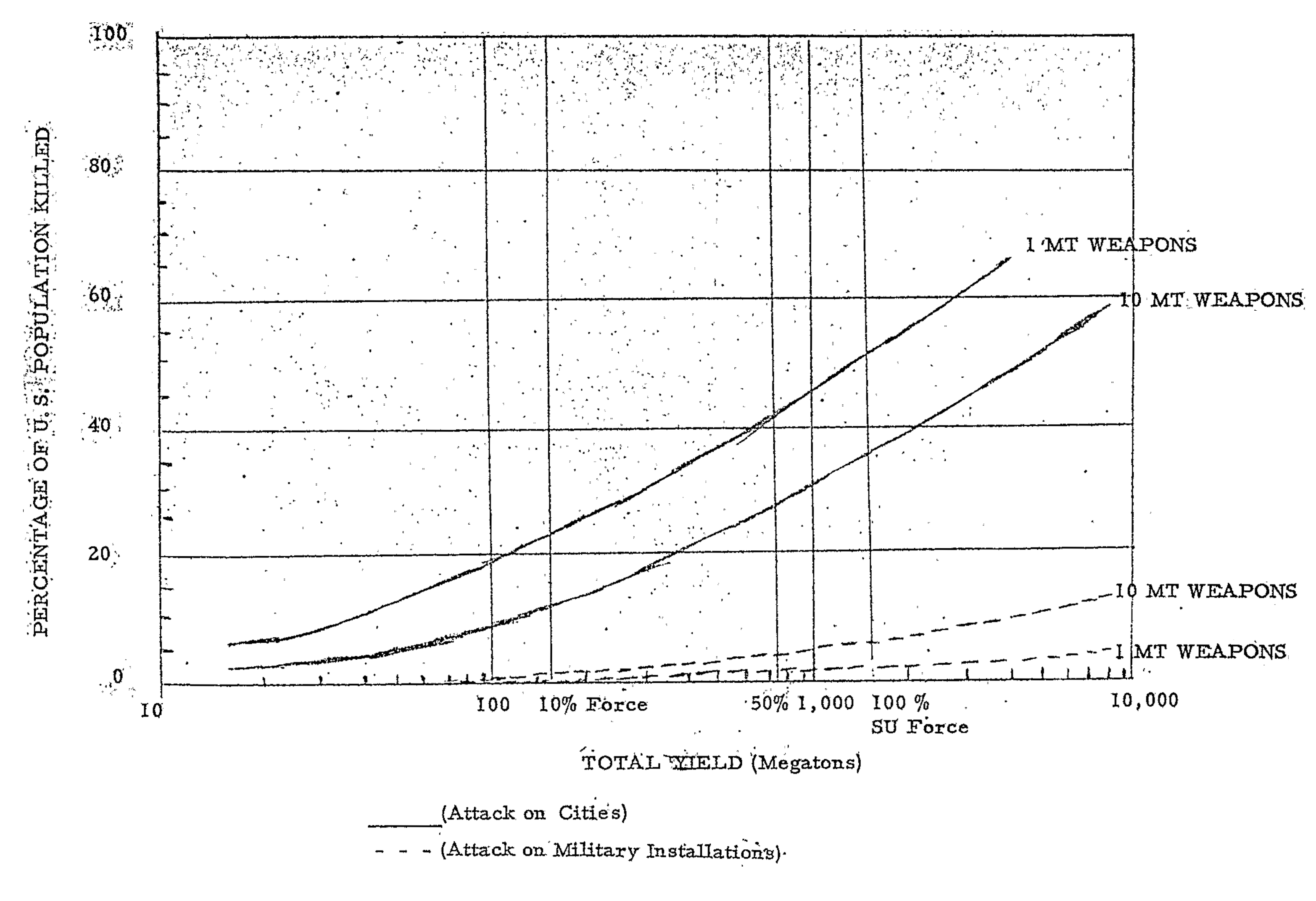
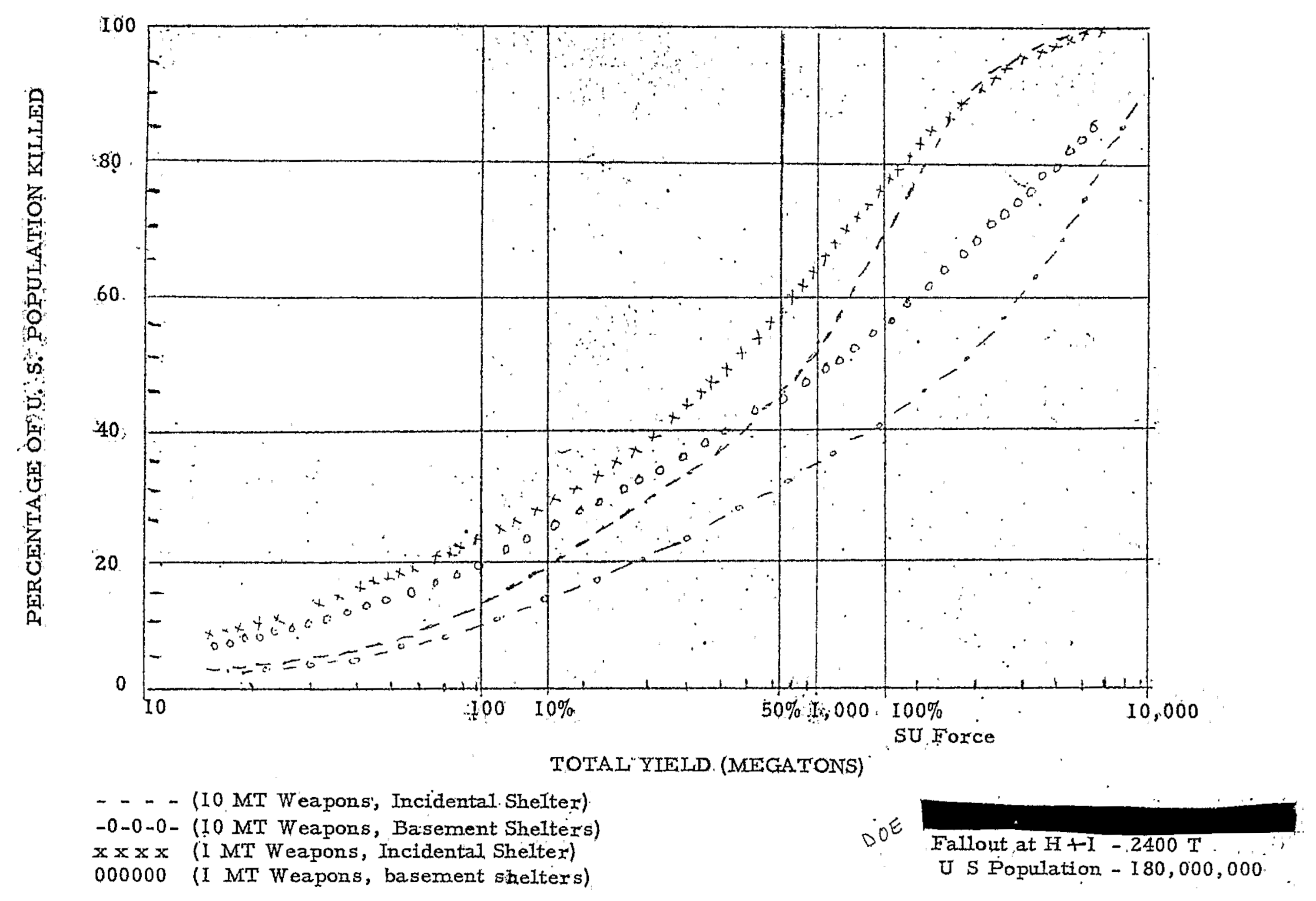
Charts I and II are intended to give a rough approximation of the range of mortalities that the U.S. might suffer from various weights and types of Soviet retaliation. Attention should be drawn to the lower end of the scale for the cases where the Soviets retaliate against cities. The number of mortalities that the U.S. suffers where only a few megatons are involved, while small percentage-wise--between three and seven per-cent--can range between 5,000,000 and 13,000,000. This is because New York and Chicago, with their great concentrations of people, can be virtually wiped out by a small number of high-yield weapons. In thermonuclear warfare, people are easy to kill.
The charts show ordinates corresponding to the full megatonnage calculated above, 50% and 10%, to give some indication of the results of the range of success or failure of the first attack.
CHART I
Prompt Deaths from Alternative Bombing Attacks
(Deaths due to Blast and Prompt Radiation)
CHART II
Deaths from Alternative Attacks on U.S. Cities
(Blast and Fallout, All Weapons Ground Burst)
– – – – – – – – – – – – – – – – – – – – – – – – – – – – – – – – – – – – – – – – – –
The Single Integrated Operational Plan is the war plan which directs the bulk of U.S. and Allied atomic strike forces in the event of general war with the Sino-Soviet Bloc. The origins of SIOP-62 lie in Study #2009 of the Net Evaluation Subcommittee. The study developed a single list of targets, known as the "optimum mix," and indicated what levels of damage could be accomplished against the target system with varying levels of assurance and capabilities. President Eisenhower approved of the target list and selected the damage and assurance criteria to be used in operational planning.
On 19 August 1960, the JCS issued the National Strategic Targeting and Attack Policy (NSTAP) as guidance for the planning staffs of the unified and specified commanders. Since NESC #2009 had considered the initial attack only, the NSTAP and SIOP-62 are similarly concerned and do not provide for follow-on attacks. The NSTAP laid down two objectives for the planners: (1) to destroy or neutralize the Sino-Soviet Bloc strategic nuclear capability and primary military and government controls of major importance; (2) to attack the major urban-industrial centers of the Sino-Soviet Bloc in order to achieve the general level of destruction selected by the President from NESC #2009.
With this guidance, the Director of Strategic Target Planning (DSTP), assisted by a joint staff in Omaha, established a National Strategic Target List (NSTL), determined the priorities to be given to these targets, and drew up a plan for a coordinated attack on the target system by major U.S. and Allied atomic strike forces. SIOP-62 resulted from this effort and became effective 1 April 1961. Unless changed, it will remain in effect until 1 July 1962 when SIOP-63 is scheduled to supersede it.
SIOP-62 starts from the premise that a single operational plan suffices for the atomic strike forces regardless of the circumstances in which a general war might be initiated. The target list is constant and the only question at issue is how much of the list can be destroyed with what degree of assurance. Consequently, the list is broken into two parts: a minimum NSTL containing 2220 primary objective targets, together with 835 active defense installations which must be hit in order to reach the primary objectives; and the full NSTL, which contains 3729 targets. Since many of these targets are co-located, and can be destroyed by a single weapon of sufficiently high yield, the actual number of Desired Ground Zeros (DGZ's) in SIOP-62 adds up to 1077.
The target list is assigned a total value of approximately 5,000,000 points; each target is allocated a certain number of points according to its importance; DGZ's are then "optimized" to destroy the maximum number of targets within a given complex; and finally, the most important DGZ's are assigned to those forces which have the highest probability of surviving and destroying the targets. [--SEVERAL SENTENCES DELETED--] In other words, the 'optimum mix' determines what targets should be attacked and when they should be attacked.
Table I
|
||
|
Type of Target |
Total Targets |
Alert Force Targets |
|---|---|---|
|
I. Nuclear Threat to the U.S. |
|
|
|
Airfields with nuclear storage and primary staging bases |
76 |
76 |
|
Nuclear storage sites |
68 |
68 |
|
Missile sites and storage; ICBM ** |
4 |
4 |
|
[DELETED LINE] |
218 |
166 |
|
Missile sites, MRBM ** |
6 |
6 |
|
Missile storage, MRBM |
1 |
1 |
|
Naval Bases |
29 |
26 |
|
[DELETED LINE] |
88 |
56 |
|
[DELETED LINE] |
5 |
5 |
|
[DELETED LINE] |
369 |
217 |
|
Naval Base, Surface |
11 |
11 |
|
[DELETED LINE] |
80 |
72 |
|
[DELETED LINE] |
29 |
26 |
|
V. Urban-Industrial Complexes at Risk |
|
|
|
USSR |
295 |
199 |
|
China |
78 |
49 |
|
VI. Government Control Centers |
|
|
|
USSR and China |
126 |
118 |
|
* Although this table is based on a JCS document, it does not represent the full target list. For example, 835 active defense installations are omitted. ** These numbers undoubtedly will change or already have changed: |
||
Table 1 illustrates in a rough way the targets that are attacked and the relative importance that is attached to them. The Alert Force is assigned 480 DGZ's; the Full Force, as noted, would cover 1077 DGZ's. All countries in the Sino-Soviet Bloc are represented on the target list, but the Soviet Union contains the bulk of the targets. As one example, General Power points out (in JCSM-406-61, Appendix A) that "four SAC alert sorties (11 weapons) are targeted in [--ONE SENTENCE DELETED--] However, he goes on to say that they "may be withheld at any time prior to launch of the SAC alert force on a calculated risk basis."
The requirement set by President Eisenhower, based on NESC Study #2009, was that the atomic strike forces have a capability to achieve a 75% assurance of inflicting [DELETED] severe damage to enemy nuclear delivery capabilities and military and government controls. Similarly, there was to be a 75% assurance of inflicting [DELETED] severe damage to the industrial floor space of the Soviet Union and China. A variety of techniques are used to achieve this amount of destruction with the requisite level of confidence. The maximum number of vehicles is launched consistent with the amount of warning received and the readiness of the force. Routes of all vehicles are coordinated, and time over target (TOT) is carefully controlled. The major tactics used to penetrate enemy defenses are:
[SEVERAL PARAGRAPHS DELETED]
In order to deliver the requisite damage to target with the desired assurance, a system of cross-targeting is employed. Different types of vehicles, launched from a variety of bases, are scheduled against a particular target. Thus, a Jupiter, an Atlas, a Titan, and 3 B-52's are programmed against [--SEVERAL PARAGRAPHS DELETED--]
A number of degradation factors are used in order to determine the probability that a weapon will reach a given bomb release line (BRL) and detonate on target. [--SEVERAL PARAGRAPHS DELETED--] Table II indicates some of the probabilities that have been obtained with respect to SIOP-62.
|
Table II |
|
|---|---|
|
Average Delivery Assurance |
Vehicles |
|
52.3% |
SIOP missiles (including cruise missiles) |
|
63.1% |
All-weather aircraft |
|
35.5% |
Non-all-weather aircraft |
|
56.8% |
All SIOP weapons |
|
87% |
Average DGZ Assurance (that one weapon will detonate on target) |
The delivery systems integrated into SIOP-62 total 2258 vehicles. They carry 3423 weapons with yields ranging from [DELETED] megatons. The Alert Force is programmed to deliver 1447 weapons with a total yield of [DELETED]. The Full Force, with 3423 weapons, would deliver 1433 weapons with a total yield of [DELETED]. The Full Force, with 3423 weapons, would deliver [DELETED] – assuming that the entire force got through to target. Tables III and IV show numbers and types of delivery vehicles, numbers and locations of bases from which they would be launched, and types of weapons to be employed.
|
Table III |
|
|
Type of Vehicle |
Number |
|
B-47 |
760 |
|
B-52 |
447 |
|
B-58 |
32 |
|
B-57 |
38 |
|
B-66 |
17 |
|
F-84F |
13 |
|
F-100 |
221 |
|
F-101 |
28 |
|
Valiant |
8 |
|
Canberra |
41 |
|
AD Skyraider |
69 |
|
A3D Skywarrior |
58 |
|
A4D Skyhawk |
168 |
|
Polaris |
80 |
|
Atlas |
58 |
|
Titan |
21 |
|
Jupiter |
30 |
|
Snark |
30 |
|
Regulus |
4 |
|
Mace |
54 |
|
Matador |
76 |
|
TOTAL |
2258 |
|
Location of Bases |
Number |
|
United States |
[DELETED] |
|
[DELETED] |
[DELETED] |
|
[DELETED] |
[DELETED] |
|
[DELETED] |
[DELETED] |
|
[DELETED] |
[DELETED] |
|
[DELETED] |
[DELETED] |
|
United Kingdom |
[DELETED] |
|
[DELETED] |
[DELETED] |
|
[DELETED] |
[DELETED] |
|
[DELETED] |
[DELETED] |
|
Germany |
[DELETED] |
|
[DELETED] |
[DELETED] |
|
[DELETED] |
[DELETED] |
|
[DELETED] |
[DELETED] |
|
[DELETED] |
[DELETED] |
|
[DELETED] |
[DELETED] |
|
Table IV |
|
|
Aircraft Delivery |
|
|
Type |
Yield |
|
Mark 41 |
[DELETED] |
|
Mark 39 |
[DELETED] |
|
Mark 43 |
[DELETED] |
|
Mark 28 |
[DELETED] |
|
Mark 5 |
[DELETED] |
|
Mark 7 |
[DELETED] |
|
Boar |
[DELETED] |
|
Mark 105 |
[DELETED] |
|
Missile Delivery |
|
|
Type |
Yield |
|
Titan |
[DELETED] |
|
Snark |
[DELETED] |
|
Atlas |
[DELETED] |
|
Jupiter |
[DELETED] |
|
Regulus |
[DELETED] |
|
Hound Dog |
[DELETED] |
|
Polaris |
[DELETED] |
|
Mace |
[DELETED] |
|
Matador |
[DELETED] |
SIOP-62 contains 16 options. However, these options do not refer to alternative strategies but to the number of delivery vehicles that can be generated for launch at specified times after A-Hour (time to begin force preparation). Thus, the alert force has zero generation time and represents Option 1. The full force can be generated with strategic warning of something over 28 hours. This represents Option 16. The alert force would be launched at an "optimum mix" of military and urban-industrial targets. Follow-on forces would attack additional targets together with the same targets scheduled for the alert force (in order to increase assurance of success). Table V shows the schedule of force generation.
|
Table V |
||||
|---|---|---|---|---|
|
Option |
Time |
Weapons |
Delivery Systems |
Total |
|
1 |
0000 |
[DELETED] |
874 |
874 |
|
2 |
0100 |
[DELETED] |
70 |
|
|
3 |
0200 |
[DELETED] |
57 |
|
|
4 |
0300 |
[DELETED] |
232 |
|
|
5 |
0400 |
[DELETED] |
46 |
|
|
6 |
0500 |
[DELETED] |
50 |
|
|
7 |
0600 |
[DELETED] |
65 |
1394 |
|
8 |
0700 |
[DELETED] |
54 |
|
|
9 |
0800 |
[DELETED] |
91 |
|
|
10 |
0900 |
[DELETED] |
51 |
|
|
11 |
1000 |
[DELETED] |
80 |
|
|
12 |
1200 |
[DELETED] |
97 |
|
|
13 |
1400 |
[DELETED] |
75 |
1842 |
|
14 |
2000 |
[DELETED] |
193 |
|
|
15 |
2800 |
[DELETED] |
209 |
|
|
16 |
Strategic Warning |
[DELETED] |
94 |
2338* |
|
* – This number is higher than the total shown in Table III. Although both numbers appear in the same paper, there is no explanation for the discrepancy. |
||||
The actual flexibility in SIOP-62 consists essentially of the ability to withhold certain strikes from preplanned targets.
[SEVERAL PARAGRAPHS DELETED]
The outcome to be expected from implementation of SIOP-62 has been calculated to a certain degree for two cases: where the alert force gets off; and where the full force gets off. It should be noted that casualties and damage to the United States and its Allies customarily are not presented, although casualties in the United States alone (resulting from Soviet attacks) are expected to be 16,000,000 at a minimum. Tables VI, VII, VIII, IX, and X show what might happen to the Sino-Soviet Bloc in the two cases mentioned above. Presumably the SIOP planning factors which provided the averages shown in Table II were used to obtain these results.
|
Table VI |
|||
|---|---|---|---|
|
Type of Target |
Total Targets |
Destroyed by Alert Force |
Full Force |
|
I. Nuclear Threat to the U.S. |
|||
|
Airfields with nuclear storage and primary staging bases |
76 |
76 |
76 |
|
Nuclear storage sites |
68 |
56 |
68 |
|
Missile sites and storage, ICBM |
4 |
4 |
4 |
|
[DELETED LINE] |
218 |
99 |
212 |
|
Missile sites, MRBM |
6 |
1 |
6 |
|
Missile storage, MRBM |
1 |
1 |
1 |
|
Naval Bases |
29 |
20 |
28 |
|
[DELETED LINE] |
369 |
91 |
276 |
|
Naval Base, Surface |
11 |
8 |
10 |
|
[DELETED LINE] |
80 |
15 |
56 |
|
[DELETED LINE] |
29 |
15 |
26 |
|
V. Urban-Industrial Complexes at Risk |
|||
|
USSR |
295 |
199 |
295 |
|
China |
78 |
49 |
78 |
|
VI. Government Control Centers |
|||
|
USSR and China |
126 |
85 |
121 |
|
Table VIII |
||
|
|
Caused by Alert Force |
Caused by Full Force |
|
[ DELETED // Bulgaria ] |
421,000 |
496,000 |
|
[ DEL. / Czechslovakia] |
258,000 |
308,000 |
|
[ DEL. / E. Germany ] |
197,000 |
292,000 |
|
[ DELETED / Hungary ] |
4,200 |
214,000 |
|
[ DELETED / Poland] |
497,000 |
2,636,000 |
|
[ DELETED / Rumania] |
1,300 |
58,000 |
|
[ DELETED ] |
1,378,500 [**] |
4,004,000 [***] |
|
* These casualties result from strikes by SIOP-committed forces only. ** One percent of the [ DELETED ] population. *** Four percent of the [ DELETED ] population. |
||
|
Table IX |
||
|---|---|---|
|
|
Destroyed** by Alert Force |
Destroyed** Full Force |
|
% Industrial floor space USSR |
65 |
74 |
|
% Total floor space USSR |
75 |
82 |
|
% Urban casualties*** USSR |
55 |
71 |
|
% Rural casualties USSR |
21 |
39 |
|
% Total casualties USSR |
37 |
54 |
|
% Industrial floor space China |
53 |
59 |
|
% Total floor space China |
61 |
62 |
|
% Urban casualties China |
41 |
53 |
|
% Rural casualties China |
4 |
9 |
|
% Total casualties China |
10 |
16 |
|
* – Estimates based on the arrival of at least one weapon at each DGZ. ** – Destroyed means damage to building or facilities which precludes production without essentially complete reconstruction of the installation. It connotes collapse or severe damage to all principal structures. A greater number of installations will receive lesser but significant damage which would require materials and effort before production could be resumed. *** Casualties include fallout effects during the first 72 hours, with a 60% shielding factor. |
||
The effort thus far has been to describe SIOP-62 and present official evaluations of the outcome of a general war should the SIOP be implemented. It may now be appropriate to underline several characteristics of the plan and briefly discuss the evaluations.
Although SIOP-62 possesses the potential of a limited amount of flexibility, it is actually an all-purpose plan designed for execution in its existing form regardless of the contingency that may arise. The rigidity of the plan, especially in respect of targeting, has a number of causes. Several of them are worth enumerating.
1. There is a widespread expectation among military planners that the Soviets, whether they strike first or second, will attack urban targets or some urban-military combination comparable to the 'optimum mix' upon which SIOP-62 is postulated. Consequently there is no need to be especially selective about targets or discriminating in the U.S. attack.
2. There is an equally widespread expectation that, regardless of the circumstances, the Soviets will manage to launch a number of weapons against the U.S. In other words, the U.S. will never be able to achieve the combination of surprise and complete destruction of the Soviet long-range nuclear capability; the Soviets will always execute either urban or optimum mix attacks; therefore the U.S. must always attack a composite target system as exemplified by SIOP-62. Nowhere is any real consideration given to the possibility that there may be an interaction between our targeting philosophy and that of the Soviet Union.
3. Accompanying these assumptions is the notion that prevailing in a general war means coming out relatively ahead of the enemy. As an example, if the U.S. has lost 20% of its industrial capacity and 30% of its people, but the Sino-Soviet Bloc has lost 40% of its industrial capacity and 60% of its people, then the U.S., somehow or other, has won the war. In somewhat oblique fashion, the JCS express this philosophy in JCSM-430-61. As they put it: Diversion of U.S. forces from other targets to military targets would reduce by relatively small percentage the effect on the Soviet civil society. If the diversion were highly pronounced, it could result in failure to damage the war-supporting economies of the USSR and China to the extent necessary to render them incapable of further support of the war effort. This latter condition was found by Study No. 2009 to be a shortcoming of attacking only military targets.
4. Finally, although this concern is rarely expressed, there is a growing fear that - owing to the vulnerability of U.S. strategic forces and our command-control - three consequences might flow from introducing any real flexibility into the SIOP. The first is that our offensive forces might be cut down to a very small fraction of their prewar size by a well-executed surprise attack; hence our retaliation would hurt the Soviets only if directed against an urban or composite target system. The second is that a surprise attack might knock out the U.S. command-control and leave our residual forces uncertain as to the plan they should execute. Existence of only one plan - SIOP-62 - together with the elaborate system of cross-targeting hopefully reduces the probability that the Soviets will escape unscathed from such an attack. A third consequence of great concern is that greater flexibility, introduced under these circumstances, will become widely known, will tempt the Soviets to attack, and thereby will weaken deterrence.
In addition to the rigidity inherent in SIOP-62, the plan depends very heavily for its success upon warning sufficient to launch the alert force. If sufficient warning is not received, it is conceivable that few, if any, U.S. delivery vehicles would get off. Such a contingency is within the bounds of possibility, especially with the growth of the Soviet ICBM force.
Finally, SIOP-62 is, to put it mildly, an extremely blunt instrument. Even in the case of strategic warning, the plan envisages using the force in such a way that the enemy has a high probability of receiving warning that a U.S. attack is on the way. Penetration techniques, as noted, call for mass, countermeasures, and the development of corridors through which subsequent bombers can pass. These are brute force tactics which, in turn, make for almost certain fulfillment of the prophecy that the enemy will be able to launch some of his weapons, regardless of the circumstances.
The evaluation of SIOP-62 contains a number of interesting features. The planning factors used to establish the assurance with which a weapon will reach the BRL are highly uncertain quantities. The averages, under some circumstances, could be much too high; under others, they may be much too low. Nowhere is a factor for base destruction in U.S. included. Consequently, however, detailed and refined the calculations about damage to the Sino-Soviet Bloc, no great weight of confidence can be placed in them. Similarly, there must be large uncertainties about the level of damage that the U.S. would suffer. In short, although the outcomes shown for SIOP-62 are of value, they are incomplete - not only because they play down the damage to the U.S., but also because they concentrate on one set of results rather than on a range.
– – – – – – – – – – – – – – – – – – – – – – – – – – – – – – – – – – – – – – – – – –
The Berlin crisis, rising international tension, and the possibility that the United States may become engaged in direct conflict with the Soviet Union make it imperative that we have general war plans-and particularly plans pertaining to the use of our strategic forces--which take account of the many ways in which general war may occur. One of the contingencies for which we must plan is the case where, as a result of major reverses to our conventional forces in Western Europe, the United States responds with a strategic attack against the Soviet Union itself. Review of SIOP-62 suggests that it need not be the only for such an attack. I therefore request, as a matter of the utmost urgency, that alternative plans be developed for a strategic attack upon the Soviet Union. I also request that such plans be evaluated for their effectiveness and that estimates be presented of the earliest date at which they could be instituted and implemented.
Certain objectives should be kept clearly in mind in the development of these plans. My desire is that the attack be concentrated on the smallest number of military targets compatible with the elimination of the Soviet intercontinental threat. The attack should be designed in such a way as to minimize damage to Soviet population, industry, and governmental authority. It should also be designed so as to enhance the probability of minimizing damage to the population, industry and governmental authority of the United States and its European Allies. Unless adequate justification can be given for the inclusion of targets in other countries, the attack should be directed solely against targets within the Soviet Union. Finally, the attack should ensure that substantial forces be available for follow-on attacks.
Emphasis should be given to a minimum-warning attack with the smallest number of vehicles compatible with the decisive reduction of the enemy's strategic offensive capabilities. Combined missile-bomber strikes and bomber-only strikes should be analyzed. All plans should be based on the assumption either that a state of extreme tension exists between the United States and the Soviet Union, or that a local conflict has started between them. It should be assumed further that the strategic forces of both sides have been placed on a high alert, with the further possibility that overflights may be occurring over one or both countries.
The plans that are developed should be detailed and explicit in character. In particular, they should describe:
1. The target system
2. The desired ground zeros
3. Weapons assignments
4. Expected results, including:
a. Expected accuracies of delivered weapons
b. Expected damage per DGZ
c. Variations in expected damage resulting from variations in yield and height-of-burst of assigned weapons
5. Mission characteristics
6. Follow-on forces
7. Measures to reduce warning
8. Enemy air defenses. In this connection, particular attention should be given to attacks which do not depend for their effectiveness on the destruction of enemy air defenses.
9. Optimum timing for execution of the plan
10. Pre-attack preparations
11. Overseas base requirements
12. U.S. warning systems, air defenses, and civil defense measures
I request that each plan be accompanied by an evaluation of its expected effectiveness. Such an evaluation should include:
1. Soviet force survival
a. Numbers and types of Soviet strategic forces expected to survive the attack.
b. Confidence levels and uncertainties associated with these estimates.
2. Damage in the Soviet Union
a. Casualties and damage in the Soviet Union resulting from the attack, with varying assumptions about the level of Soviet civil defenses and the ability of the Russian population to make effective use of available shelter.
3. Warning given to the Soviets
a. Degree of warning (measured in time) that the Soviets might expect to receive of the attack.
b. Confidence levels and uncertainties associated with these estimates.
4. Damage in the United States
a. Casualties and damage in the United States, given varying assumptions about the size of the Soviet response, the targets in the United States that be hit, and the attrition that U.S. defense could exact.
b. In this connection, consideration should be given to pre-attack and post-attack measures which might be taken in order to influence the nature of any Soviet reply.
5. Damage elsewhere
a. Casualties and damage in Allied countries resulting from the U.S. attack and from possible Soviet responses.
b. Casualties and damage within the Sino-Soviet Bloc (the USSR excluded).
6. U.S. follow-on forces
a. Estimates on numbers surviving
b. Readiness and ability to continue the attack
I request that, by 25 September 1961, a progress report on this project be presented to me, together with a preliminary estimate of the ability of U.S. strategic forces actually to execute such plans.