|
|
Cold War/World War III
(1945-1992)
|
|
|
Cold War/World War III
(1945-1992)
|
Anti-Ballistic Missile (ABM) Reading RoomChronology of the Development of Ballistic Missile Defense (1955 to Current FY) (14 July 1970) (2.3 MB PDF) – This document details the history of ABM from the NIKE-II study in 1955 to July 1970. Included in this rather lengthy document is a tabular list of all SPRINT and SPARTAN missile tests up to that date. ABM Research and Development at Bell Laboratories (October 1975) (21.7 MB PDF) – This rather thick document was written up by Bell Laboratories for the US Army in 1975, covering development from the initial NIKE-II concepts in 1955 up to 1975 and SAFEGUARD. Ballistic-Missile Defense Radars (November 1969 (7.12 MB PDF) – This paper was presented at the NEREM Conference[Boston, MA; November 5-7, 1969] by Charles M. Johnson, the scientific and technical director of the U.S. Army Safeguard System Office. It presents an unclassified technical overview of BMD radars as of late 1969. Ballistic Missile Defense: A Supercomputer Challenge (1980~) (11.5 MB PDF) – This article details the computing environment typical of the late 1970s/early 1980s for BMD. The money quote for this article is: "The algorithm that updates the state vector of an object requires about 3000 CPU instructions. This algorithm must be executed after each radar track pulse. For 300 targets, each tracked at 20 Hz, 18 million instructions per second of processor throughput would be required, plus the capability required to handle the other operations in the sequence." – – – – Third AICBM Panel Report (12 May 1958) (PDF) – This report by the AICBM Panel of PSAC covering NIKE-ZEUS was declassified in 1983; so there's a lot of redactions. Anti-Ballistic Missile Weapon System Program Report (Cover Letter Only) (10 Dec 1958) (8.4 MB PDF) – This is just a cover letter for a report I don't have yet but it has some thin details. Risks involved in the Nike-Zeus Program (Killian to McMillan) (3 Dec 1958) (PDF) – This memo details when NIKE-ZEUS could be plausibly bought to operational status to protect SAC bases. President's Science Advisory Committee -- AICBM Panel Meeting Report (17 Dec 1958) (PDF) – A rather thin report summarizing what's new in the ABM program. President's Science Advisory Committee -- AICBM Panel Meeting Report (21 May 1959) (PDF) – A rather thin report summarizing what's new in the ABM program. WSEG #45: Potential Contribution of NIKE-ZEUS to Defense of the U.S. Population and its Industrial Base and the U.S. Retaliatory System (25 Sep 1959) (5.3~ MB PDF) – This rather detailed report on NIKE-ZEUS goes into heavy detail in just how advanced the system actually was and rebuts many claims made about the system by others. Report of the AICBM Panel (4 November 1959) (PDF) – This report by the AICBM Panel of PSAC covering NIKE-ZEUS was declassified in 1991; so there's a lot of redactions. Anti-Ballistic Missile Weapon System Program Summary (23 Apr 1960) (PDF) – A rather thin report summarizing what's new in the ABM program. NSC Memorandum - U.S. Policy on Continental Defense (14 July 1960) (1.6~ MB PDF) – This includes some information on ABM efforts, and includes several tables that were censored in WSEG #45 on fallout shelter protection. President's Science Advisory Committe -- Memorandum for the Record: Nike-Zeus (18 Oct 1960) (PDF) – This memo by PSAC advises against the deployment of NIKE-ZEUS. ODDR&E Assessment of Ballistic Missile Defense Program (17 April 1961) (2 MB PDF) – This memorandum from DDR&E evaluates NIKE-ZEUS, ARPAT, Hard Point, BAMBI, Midcourse AICBM, and others with the knowledge of the time. Draft Appendix II to the Memorandum for the President re: Program for Deployment of NIKE ZEUS (30 September 1961) (PDF) – This version was declassified in 1979. Some portions of it are missing; due to the copy in FRUS not reprinting Sections II through VI. President's Science Advisory Committe (AICBM Panel): Memorandum on Limited Deployment, NIKE-ZEUS (21 Oct 1961) (PDF) – Once again, this memo by PSAC advises against NIKE-ZEUS' deployment. SPO-STG FBM Meeting #29 Excerpts (18 Jan 1962) (1.21 MB PDF) – This OCR excerpt has some ABM/Penetration stuff as well as Polaris weights. SPO-STG FBM Meeting #35 Excerpts (21 Mar 1963) (5.43 MB PDF) – This OCR excerpt has a large amount of documentation on early Polaris SSBNs, reliability, and some ABM/Penetration stuff. SPO-STG FBM Meeting #45 Excerpts (30 Sep 1964) (PDF) – I've excerpted the Re-Entry Body Committee Discussion, as it's got heavy details on what the USN's FBM people were thinking regarding ABM; and penetration aids. President's Science Advisory Committe (Strategic Military Panel): Report on the Proposed Army-BTL Ballistic Missile Defense System (Oct 1965) [Alternate Version OCR (1.98 MB Alternate PDF)] – Once again, this memo by PSAC advises against the deployment of NIKE-X, with the usual names signed off on the report. The two versions have slightly different redactions. JCSM-807-65 Nike-X Deployment Study (DEPEX)(6 Nov 1965) – This is the Joint Chiefs of Staff's formal reply to the Secretary of Defense regarding the October 1965 PSAC Report on NIKE-X. Defense Science Board Task Force Report on Ballistic Missile Defense (15 Sep 1966) (PDF) – This semi-sanitized report recommends the deployment of the NIKE-X system. Production and Deployment of the NIKE-X (Draft) (2 December 1966) (PDF) – This draft memorandum prepared by Robert McNamara's office for LBJ on NIKE-X is a very instructive look into how McNamara used his ability as SecDef to selectively release or withhold information to get the desired outcome in the ABM debate. This document is the source of the infamous "it costs the offense only $1 dollar to penetrate, against the defense's $4 dollars to defeat" cost ratio used to discredit ABM. But if you look at the declassified publication (originally TOP SECRET), you find that the 4:1 ratio in favor of the offense is for a light attack on the US (only 22M dead), which means that the whole cost for a nationwide buildout of NIKE-X (either $8.2B or $17.6B [in 1966 Dollars]) is charged against the Soviet cost in ICBMs to penetrate a few local city batteries.If the Soviets have to achive a successful nationwide attack resulting in 66M dead to deter the US, the cost ratio changes to $1.66 Soviet Cost to Penetrate against $1 US Cost to Defend as the entire NIKE-X system is placed into action. This document wasn't partially declassified until 2005, so for nearly forty years, the pro-ABM side couldn't rebut McNamara's claims. Production and Deployment of the NIKE-X (Draft) (10 December 1966) (1.3 MB PDF) – This "second" draft, written about a week (10 December) after the first draft of 2 December, is largely the same, but the censor has redacted the "fun" parts. The content is largely the same, but a few passages have changed their wording -- one of the reasons to deploy ABM is now "to protect our cities against a Chinese Communist missile attack in the 1975 to 1985 period." Notes on Meeting with the President in Austin, TX, with Secretary McNamara and the Joint Chiefs of Staff (6 December 1966) (PDF) – This memorandum, written by Walt Rostow (LBJ's National Security Advisor) summarizes the meeting at LBJ's ranch where the Joint Chiefs of Staff "ambushed" McNamara over ABM and forced him into supporting what became SENTINEL. Meeting with the President (4 January 1967) (PDF) – This is a follow-up to the earlier December meeting memorandum, describing more of how the JCS "wore down" McNamara over ABM. Status of the Development of the Antiballistic Missile Systems in the United States (16 February 1967) (4~ MB PDF) – this consists of Dr. John S. Foster's (DDR&E Director) statement before the Senate's Subcommittee on Disarmament regarding current US ABM development. He brings Congress up to date (re: SPARTAN replacing ZEUS, etc). NATO North Atlantic Council Briefing on ABM (9 March 1967) ([2.01 MB] PDF) – This paper contains the technical annex to the Briefing by Ambassador Cleveland; which contains the statements:
Army Research and Development Newsmagazine – "Sentinel Site Set for Boston Area" (October 1968) (PNG) – This excerpt from an Army magazine lays out the rough locations of where the Boston SENTINEL sites would be. "Why A Missile Defense?" - Statement by Representative Gerald Ford (R-MI) (1969) (33.4~ MB PDF) – This statement by then-Minority Leader Gerald Ford lays out the case for ABM/BMD. Sentinel ABM System Hearings, House of Representatives (Jan 1969) (33.4~ MB PDF) JCSM-111-69: SENTINEL Program Review (26 Feb 1969) (PDF) – This sanitized report which contains only the first few pages, is about Deployment Model 1-69 for the SENTINEL ABM system. Amendments to FY 1970 Defense Budget (NSSM 23) (Section A) (4 March 1969) (PDF) – This paper lays out the advantages that SENTINEL can offer at various protection levels; including the percentages of the US Bomber Force that would survive a Bolt out of the Blue from depressed trajectory SLBMs with and without SENTINEL. Memorandum for POTUS: Modified Sentinel System (5 March 1969) (1.3~ MB PDF) Minutes of NSC Meeting (5 March 1969) – This meeting contains a lot of technical details buried in it:
Nixon's Press Conference announcing SAFEGUARD (14 March 1969) (2.63 MB PDF) – This is the transcript of Nixon's press conference where he announced his decision on the SAFEGUARD program and also renamed it via this passage: "After long study of all of the options available, I have concluded that the SENTINEL program previously adopted should be substantially modified. The new program that I have recommended this morning to the leaders, and that I announce today, is one that perhaps best can be described as a safeguard program." President's "Safeguard" Is Not an Official Name (14 March 1969) (0.95 MB PDF) – This is the brief NYT article explaining that the Defense Department post-hoc changed the name of SENTINEL to SAFEGUARD after Nixon used that term in his announcement regarding the system. Memo to Deputy SecDef on Sentinel Deployment (14 May 1969) (PDF) – This memorandum advises that the SENTINEL program be delayed one year. Colonel Wood's ABM Study (22 May 1969) (PDF) – This study of ABM by (apparently) USAF Colonel Archie L. Wood of the Office of Secretary of Defense (SA) was found in the CIA's online reading room. PSAC Strategic Military Panel Comments on Minuteman ABM Defense (5 January 1970) (0.78 MB PDF) – This provides some hard numbers on the enemy threat to Minuteman in the mid-1970s:
Memorandum on the SAFEGUARD System (12 January 1970) (5.4 MB~ PDF) – This memorandum from SecDef Packard to Kissinger details SAFEGUARD as currently programmed. FY 71 Safeguard ABM Decision (16 January 1970) (1 MB~ PDF) – This memorandum from Kissinger to Nixon lays out the upcoming decision point on SAFEGUARD. Dep't of State Briefing Memorandum for NSC Discussion of SAFEGUARD (21 Jan 1970) (0.5 MB PDF) – In this document, State talks about two main issues that concern them -- the relationship of the area defense system to the credibility of our Far Eastern Diplomacy, and the relationship of SAFEGUARD to SALT talks. Telcon between Elliot Richardson and Kissinger on ABM (12 March 1970) (PDF) – This briefly mentions how Kissinger was briefed by SAC on what they assumed the SA-5 system was potentially capable of in an ABM mode. Contractor Doubts about SAFEGUARD (15 April 1970) (PDF) – This memorandum from Kissinger to Nixon and from Lynn to Kissinger lays out some of the internal "rumbling" by Bell Labs regarding SAFEGUARD; as Bell was quite "tired" of the controversy around the whole program. FY 73 Safeguard Program (Feb 1972) (1.6 MB PDF) – This is the FY1973 DOD review of the Safeguard program, as required by Nixon's direction that it be reviewed annually. Special SALT Briefing Notes (May 1972) (PDF) – This memorandum was apparently prepared by Kissinger's advisors in advance of the 1972 Moscow Summit where the ABM and SALT I Treaties were signed, to have talking points ready to forestall Congressional criticism of the agreement. It's very crucial for understanding why the US agreed to the ABM Treaty. MemCon - Discussion of UK SLBM, WH Situation Room (10 Aug 1972) (PDF) – This memorandum of a conference held in the White House situation room in 1972 between the UK Minister of Defence and several US national security personnel over US support for future British SSBN programs has this interesting line: "There has been, as you are aware, much discussion of the possibility of the Soviets upgrading their SAM’s to an ABM role. The Poseidon RV, being a beta RV, can go past any upgraded SAM. The Polaris A-3 RV could be vulnerable." by Dr Schlesinger. British SLBM Upgrade (18 April 1973) (PDF) – This memorandum and it's summary of discussions with the UK on the upgrade for the British SSBN force has a lot of rather interesting tidbits dropped in it, even if the most interesting tidbits are redacted by the censor. For one, SUPER ANTELOPE (Chevaline) can only reliably penetrate early "first generation" ABM systems with mechanically scanned radars (i.e. NIKE-ZEUS or ABM-1 GALOSH) due to traffic limitations. Simply adding a "modern" phased array radar with no traffic limits and discrimination capabilities reduces the effectiveness of SUPER ANTELOPE by 50%. SAFEGUARD Data-Processing System: Introduction and Overview (3 Jan 1975) (9.1~ MB PDF) – This manuscript details the SAFEGUARD computer system. SALT Implications of BMD Options (November 1979) – This short article reviews the options open to the US for the 1982, 1987 and 1992 ABM Treaty review periods. Soviet Missile System Designators (11 June 1982) (PDF) – This document gives a date as to when NATO officially assigned the SA-X-12 designator to the EMBA missile system (15 August 1980) and also lists the basic guidelines behind assignment of designators by the Weapon and Space Systems Intelligence Committee (WSSIC). Washington Post "Soviet Missile May Be Peril to U.S. Weapons" (5 April 1983) (PDF) – This 'selective leak' to the Washington Post on tests of the SA-X-12 on ballistic missiles (including the speculation it was a threat to Poseidon warheads) was captured by the CIA's own internal document system which reprinted the article for use in the "Early Bird". SA-X-12 Brief for PM Thatcher (19 April 1983) (PDF) – This paper was prepared for Thatcher's eyes, summarizing what the US and UK knew at the time in early 1983 about the S-300V (SA-12) system and its two missiles (SA-12A / SA-12B). NPIC Report: Initial Deployment of the SA-X-12 Missile System (10 February 1984) (PDF) – This report summarizes what the US knew about initial SA-12 [S-300V] deployment and testing; back when the SA-12A GLADIATOR [9M83] was known as EMBA-03 and the SA-12B GIANT [9M82] as EMBA-04. National Security Directive 119 - Strategic Defense Initative (6 Jan 1984) (PDF) – This document, signed by President Reagan, was the beginning of the SDI "Star Wars" program, which eventually led into our current ABM system. NPIC: SCALEBOARD Activity, probably associated with ATBM Testing (16 January 1984) (PDF) – This document details construction of two SS-12/SS-22 SRBM launch sites for testing of the EMBA-04 [designation for SA-12B GIANT] complex against ballistic missiles. National Intelligence Daily - Tuesday, 21 February 1984 (PDF) – This excerpt of the NID for that day covers the status of what we knew about the SA-X-12 deployment program at that time. U.S. detects new breach of arms treaty by Soviets - Washington Times Article (12 NOV 1985) (PDF) – This 'selective leak' to the Washington Times on Soviet Arms Control violations, including the Krasynoarsk radar, co-location of SA-X-12 units with SS-25 ICBM sites, etc was captured by the CIA's own internal document system which reprinted the article for use in the "Early Bird". Washington Times: "Further Cheating by Soviets on Arms Control Uncovered" (14 February 1986) (PDF) – This 'selective leak' to the Washington Times on Soviet Arms Control violations (including ABM Radars, SA-X-12 tests, joint tests of SAM radars on ICBM targets, massive increases in ICBM throw-weights, etc) was captured by the CIA's own internal document system which reprinted the article for use in the "Early Bird". Excerpts from "Sverdlovsk Guided Missile Production Plant 8" [RCA 09/0002/86] (May 1986) (2~ MB PDF) – This HTML page consists of excerpts from the larger report on GM Production Plant #8; focusing on SA-12/SH-08; with this tidbit found: "Developmental work on the SH-08 conical motor from the early 1970s through 1984 so closely paralleled that on the smaller GIANT conical booster that the two systems were confused at least once by the Soviets, when an order for a component part used on both systems was mistakenly identified with the GIANT rather than the SH-08. Also, [DELETED SENTENCE] The Soviets and SDI (25 Nov 1986) (PDF) – This speech was given by Robert M. Gates, Deputy Director of Central Intelligence to the World Affairs Council of Northern California in 1986 and lays out how the Soviets have been edging the ABM Treaty, thus its only proper that the US respond, etc. Technology speeds the Strategic Defense Initative Timetable (13 Jan 1987) (PDF) – This rather sparse press release includes some details on the program lineages of Exoatmospheric Reentry Vehicle Interceptor Subsystem (ERIS), High Endoatmospheric Interceptor (HEDI), Small Radar Homing Intercept Technology (SR-HIT), Flexible Lightweight Agile Guided Experiment (FLAGE) and Low Endoatmospheric Interceptor (LEDI). Response to Senator Helms' Soviet ABM Compliance Questions (14 August 1987) (PDF) – This represents the "conventional" CIA/State Department (through ACDA) view on Soviet ABM non-compliance in the mid-80s. Defense Science Board Task Force (Subgroup on Strategic Air Defense) - SDI Milestone Panel (May 1988) (18.7 MB PDF) – This rather disjointed document contains 800+ pages going back to the Defense Science Board Summer 1981 study on Strategic Defenses; most of which is redacted. Midcourse Discrimination for the Phase One Strategic Defense System (February 1989) (PDF) – This paper by the BMD Panel of the Army Science Board lays out their rough views of discrimination for the initial Phase of SDI. IDA Paper P-2429: DARPA Technical Accomplishments, Volume II (April 1991) (22.4 MB PDF) – This book contains details on DEFENDER-PRESS, DEFENDER-ARECIBO, DEFENDER-HIBEX and DEFENDER-PENAIDS. Only the portions relating to Project DEFENDER are OCRed in the HTML version; I've chosen not to OCR the rest of the book. MDA Comments on "Final Report of the Defense Science Board (DSB) Task Force on Science and Technology Issues of Early Intercept Ballistic Missile Defense Feasibility" (30 November 2011) (PDF) – This letter by the then-commander of MDA, LTG O'Reilly, sharply calls out the Defense Science Board (DSB) for errors in their report on the feasibility of Early Intercept (EI), with the big catch being: "However the [Terms of Reference] TOR clearly defines Early Intercept as that period 'from thrust termination to final [emphasis added] deployment of reentry vehicles and countermeasures.” The Task Force chose to reinterpret Early Intercept as the time from thrust termination to “a canonical time of 100 seconds post boost.' This is in direct contradiction to both the TOR and to the Task Force’s own data (Figure RMS-1), which shows the last release of objects occurs up to 500 seconds after boost termination." Research and Performance Analysis of the US KEI Missile (15 November 2023) (PDF) – This report by several Chinese engineers from the Beijing Institute of Electronic Engineering appeared in the October 2024 issue of "Modern Defense Technology". They concluded that KEI, within its known technical parameters:
|
Ballistic Missile Reading RoomNaval Warfare Analysis Group (NAVWAG) Study #1: Introduction of the Fleet Ballistic Missile into Service (30 Jan 1957) (PDF) – This study lays out the basic principles for the POLARIS FBM; and briefly covers the options for POLARIS deployment: SSG(N) [the SSBN designation had yet to be invented], Q-Ships disguised as Merchantmen, Surface Ships and Seaplanes. Also included is a costing rationale of POLARIS against ICBMs. Preliminary Views on POLARIS in Relation to Recent Events (24 Oct 1957) (PDF) – In this, the writer argues that other POLARIS concepts (on carriers, cruisers and merchantmen) be deferred in favor of the FBM (aka SSBN). ICBM Force Objectives (21 February 1958) (PDF) – This memo lays out the recommended force for FY63/64 to reach the Gaither Committee's recommendation of 600 ICBMs, while keeping in mind that first-generation ICBMs are "expensive and complex" and should be replaced with "simpler, less expensive" solid propellant ICBMs. Rationale for Concurrent Development of Titan ICC [ICBM] Force and Minuteman System (20 Mar 1958) (PDF) – This memo by the USAF's Ballistic Missile Division lays out why Titan should go ahead alongside Minuteman -- it's more conservative than Minuteman, has much greater growth potential as far as warhead weight or range goes; and can be used as a space booster. Cost Effectiveness of POLARIS vs. MINUTEMAN (Dec 1958) (PDF) – Another USN paper attacking Minuteman. Of note is that the USN claims that land-based ICBMs will: "Promote a spiralling arms race which the controlled Soviet economy can much better afford than ours.". General Operational Requirement for ACE IRBM Weapon Systems (9 Dec 1958) (PDF) – This GOR was issued by Lauris Norstad acting as Supreme Allied Commander Europe (SACEUR) in late 1958 for the development of a new generation of IRBMs to replace existing THOR/JUPITER systems no later than 1963. MINUTEMAN Information obtained from Rand Corporation and BMD, USAF (27 Mar 1959) (PDF) – This memorandum for the Chief of Naval Operations (CNO) lays out the data that a US Navy team gathered on Minuteman while at RAND and the USAF's Ballistic Missile Division; such as the fact that RAND expected that only 2/3rds of early Minutemen would fly "hot, straight and normal if [the] button were pushed", while the USAF specification of reliability was 0.905, but the USAF was willing to accept missiles with as low a reliability as 0.59(!). JCS 1620/248: Report by J-5 to the JCS on Concept of Employment and Command Structure for the Polaris Weapon System (27 Apr 1959) (PDF) – This memorandum sequence shows a small bit of the "food fight" that resulted when the USN formally submitted Polaris to JCS for employment as a strategic weapons system, with CINCSAC trying to get it assigned to SAC, and the Army trying to get it assigned to Unified Commands.. Operational Status of THORS (12 May 1959) (PDF) – This note describes a briefing given to a RAF General Officer at the Pentagon regarding the THOR deployment in the UK; the lede in this document is this rather classic British understatement: "What concerns them [the British] is that they cannot, under British regulations, ship nuclear warheads over British roads. Therefore, in a strict sense, the missiles could hardly ever be declared operational. According to General Moore, the RAF was trying to keep this bit of information from the Prime Minister." JCS 1620/266: Missile Firing Results (13 July 1959) (PDF) – This document lists test results (and miss distances) for Thor, Jupiter, Atlas and Mace missiles. Vulnerability of Atlas Missile Sites (3 Dec 1959) (PDF) – This short note lays out cost estimates (construction and annual costs afterwards) for an Atlas ICBM squadron, as well as a rough estimate of the number of enemy warheads required to destroy that squadron. What Reliability means to SAC (February 1960) (PDF) – This paper presented at the 6th Joint Military-Industry Guided Missile Reliability Symposium lays out some of the terms used within SAC in regards to missile reliability. [Excerpts from] ZW-7-366: Range and Guidance Accuracy Capability of the Atlas Missile System (6 June 1960) (5.9~ MB PDF) – This heavily excerpted report summarizes the accuracy of the Atlas D ICBM with either the radio-inertial (RIG) and all-inertial (AIG) guidance systems as of mid-1960. Trends and Feelings on Future Army, Navy and Air Force Programs (23 Dec 1960) (PDF) – This document was produced within the Chief of Naval Operation's office for distribution to flag officers within the Navy to provide the "party line" of the Navy at the time on various programs, amongst them: Nike-Zeus, B-52, Hound Dog, Skybolt, B-70, Atlas, Titan, Minuteman, Airborne Alert, Nuclear Powered Aircraft, Polaris, and MRBMs. BuNavWeps Special Projects Office Report #008800.1: A Comparison of the Polaris and Hardened and Dispersed Minuteman Weapons Systems (Jan 1961) (PDF) – This document by the USN costs out the 15-year lifecycle costs of Polaris versus Minuteman and makes many of the same arguments against ICBMs that are still used to this day (attacks on them would cover the US in fallout, etc). Missile Procurement [Hearings], Air Force (16 May 1961) (1.3~ MB PDF) – This is the complete [mostly] declassified copy of a Congressional Hearing on the Air Force missile program, with a lot of interesting data that normally is [REDACTED] in the public versions released by the GPO. SPO-STG FBM Meeting #29 Excerpts (18 Jan 1962) (1.21 MB PDF) – This OCR excerpt has some ABM/Penetration stuff as well as Polaris weights. Minuteman IOC Memorandum to Kennedy (26 October 1962) (PDF) – This brief memo from SecAF Zuckert to Kennedy at the height of the Cuban Missile Crisis, informs JFK that the first three Minuteman missiles have become operational; as well as the special measures taken to ensure nuclear surety for these initial Minutemen. SPO-STG FBM Meeting #35 Excerpts (21 Mar 1963) (5.43 MB PDF) – This OCR excerpt has a large amount of documentation on early Polaris SSBNs, reliability, and some ABM/Penetration stuff. SPO-STG FBM Meeting #45 Excerpts (30 Sep 1964) (PDF) – I've excerpted the Re-Entry Body Committee Discussion, as it's got heavy details on what the USN's FBM people were thinking regarding ABM; and penetration aids. CM-159-64 MINUTEMAN Missile Reliability (1 Oct 1964) (PDF) – This document contains the current (late 1964) interim MINUTEMAN A/B reliability factors for planning in the SIOP. DIA: Soviet Multiple Re-entry Vehicles (19 April 1965) (PDF) – This document contains DIA's estimates on Soviet MRVs, MIRVs as well as reliability estimates for SS-6 through SS-10 missiles. SAC ICBM Alert Status (3 May 1967) (PDF) – This brief one page excerpt shows that on one day in May 1967, 82.4% of all Minutemen and 91.2% of all Titan II were on alert; with the remainder in "Emergency Combat Capability". |
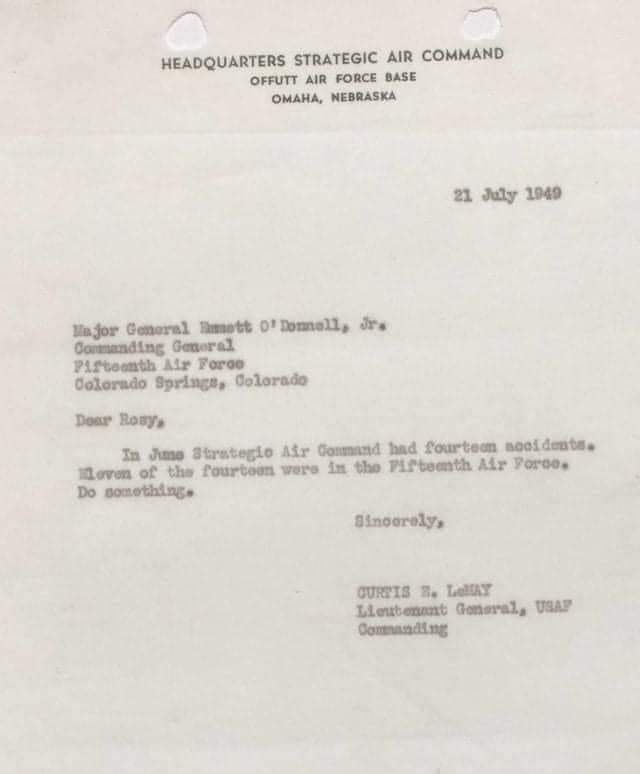
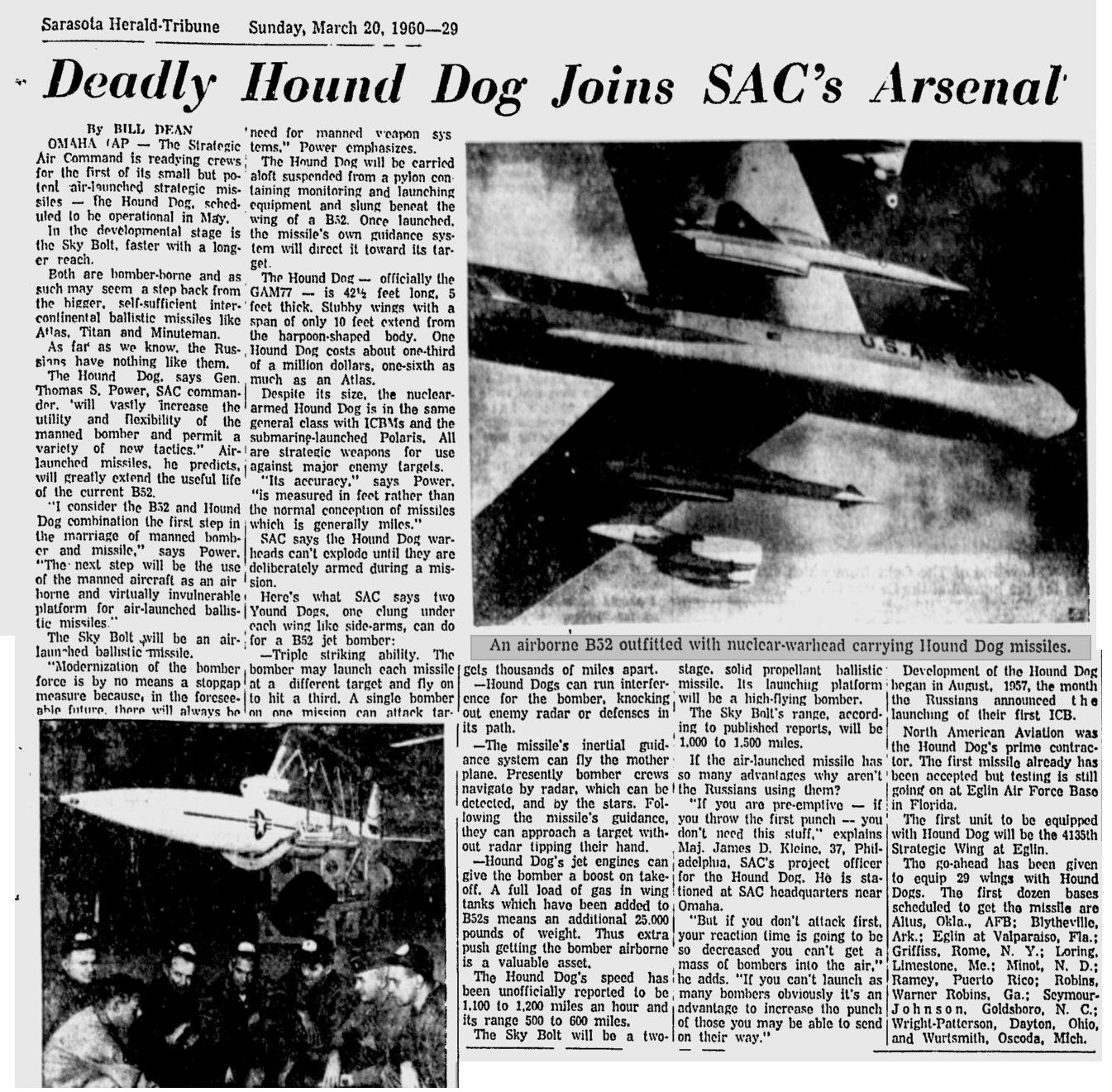
Aircraft Reading RoomLeMay's "Do Something" Memo (21 July 1949) (JPG) – This rather simple memo from CINCSAC LeMay to the Commanding General of 15AF points out that 78.5% of SAC's accidents for June 1949 were in 15AF and to fix this. Flash Report MiG-15 vs USAF Combat Systems (B-36) (Mar-Oct 1954) (PDF) – This excerpt (focusing only on the B-36) of a larger report is undated; but it appears to be preliminary results from the testing of North Korean Lieutenant No Kum-Sok's MiG-15bis (Red 2057) from March to October 1954 at Eglin AFB, FL against the B-36, B-47, F-84 and F-86 -- but only the B-36 portion is copied. Memo on B-47 Conventional Capability (1 November 1957) (PDF) – This memorandum from CINCSAC Thomas Power to Chief of Staff Thomas White, argues that retaining conventional capabilities on SAC bombers impairs SAC's nuclear deterrence mission. Weapons System Information (F-108 and MINUTEMAN) (24 Jul 1959) (PDF) – This article details some basic information about the F-108 and points out it's usefulness in conventional war (it can self-deploy to Formosa in 4.3~ hours). The Minuteman section points out how the Army PERSHING, Air Force MINUTEMAN and Navy POLARIS programs have a mutually integrated development program with personnel and knowledge migrating in all directions; and points out that POLARIS had to work with what was "state of the art" 2.5 years ago; while MINUTEMAN could take advantage of 18 months of further technical advances. [The] B-70 Weapons System (11 August 1959) (PDF) – This memorandum by Thomas Power, then-CINCSAC to the then-Chief of Staff of the USAF, presents the Air Force view on the requirements that can only be fulfilled by the B-70. NORAD View of the Bomber Threat by 1975 (c. 1960s?) (PDF) – This briefing given by NORAD sometime in the 1960s (the date is not given); was found in the online CIA reading room. It describes how NORAD viewed the Soviet Long Range Aviation (SLRA) threat to North America by 1975 roughly. Memorandum for the President: Problems of the B-70 Project (12 February 1960) (PDF) – This memorandum by Eisenhower's Science Advisor, George Kistiakowsky; represents the "conventional" view of the President's Science Advisory Committee (PSAC) at the time regarding the B-70. Deadly Hound Dog Joins SAC's Arsenal (20 March 1960) (JPG) – This newspaper article from the Sarasota Herald-Tribune on Sunday 20 March 1960 shows how the general public was introduced to the HOUND DOG. Missile Panel Report to President's Science Advisory Committee - Skybolt ALBM (20 Jul 1960) (PDF) – This paper says that "serious consideration" should be given to cancelling the Skybolt ALBM. Also includes CEP estimates for Skybolt. Concept for the B-70 Weapon System (19 Sep 1960) (PDF) – No real specifications; the juiciest tidbit is this: "The primary role of the B-70 is [...] to conduct initial strikes with high yield weapons against priority military targets of both known and uncertain locations, while concurrently observing and reporting the progress of the aerospace battle." Report of Project #13 - Comparison of Proposed B-70 Force With Alternatives (21 March 1961) (1.7 MB PDF) – This report to SecDef discusses the B-70 force in detail as well as various alternatives. Unfortunately, this was a horrifically badly-scanned copy with 1/3 or more of the left side of the scans cut off. I've tried my best to reconstruct it, but huge portions are [ILLEGIBLE]. Report of Project #41 - Skybolt (11 May 1961) (PDF) – Considers the status of the program in early 1961, as well as potential other carriers (KC-135, B-58, B-70, DROMEDARY) for Skybolt. GAM-87A Skybolt Revised Program (2 Dec 1961) (PDF) – This memorandum from McNamara to SecAF lays out the basic costs of the Skybolt program, and his opinion that: "It is not a good choice as a weapon for attacking high priority military targets because it takes hours to reach its targets and it is vulnerable on the ground." McNamara's Statement to Congress regarding the RS-70 Program (14 Mar 1962) (PDF) – This is the full, complete copy of McNamara's presentation to Congress in March 1962 on the B-70/RS-70, including assigned survival, reliability and penetration factors for many weapons systems (Atlas, Titan I/II, Minuteman Wing 1-5, Wing 6, Skybolt, and Hound Dog); along with assigned yields/CEP used in planning. AFA - 1963: Manned Aircraft Requirements in the 1970s Symposium (12 Sep 1963) – At this symposium, General Power made the following statement: "I think the B-47 fleet in the hands of professionals could deliver weapons in the year 2000. I am not saying that you will not get kicked around. There is no easy way to fight a war. We will deliver the weapons, however much it costs us to deliver them. But why do it the hard way if you can do it the easy way." 1964: Year of Decision for the Strategic Force of the 1970s (December 1963) – This old Air Force Magazine article from 1963 is posted here because it explains clearly the VTOL fervour of the 1960s; and why Dean McLaughlin's "Hawk Among the Sparrows" sci-fi novella used a VTOL supersonic fighter to be thrown back to 1915; because of the optimistic estimates of T/W for lift only engines; meaning that the "cost" of VTOL would be at best a couple hundred pounds. CSAFM 6-64 [for JCS] Improved Manned Strategic Aircraft (4 Jan 1964) – In this letter to the JCS, Chief of Staff LeMay lays out the rationale for procuring an Improved Manned Strategic Aircraft (IMSA), which would eventually evolve into the B-1 program, with a few juicy bits, such as: "Last year [1963], for example, all Wing I Minuteman missiles were determined to be unreliable for a period due to difficulties with the re-entry vehicle. Concurrently, all Wing II Minuteman missiles, comprising the remainder of the force, were considered unreliable by the Atomic Energy Commission as a result of warhead deficiencies. Finally, the reliability of the Polaris A-1 fleet, during a period in 1963, was suspect in its entirety due to bonding problems with the propellant." Strategic Force Capability (6 April 1964) (PDF) – This memo lays out the case for delaying B-47 phase out and paying for that through cancelling or curtailing early ICBMs: "Our examination of the current and projected contributions of the early liquid fueled missiles indicates these systems will give a marginal return for the money to be expended. Specifically, in a comparison of the relative cost per weapon on target, the B-47 offered a marked advantage over the Atlas E and Titan I under the three attack conditions in the current SIOP." Third Report of the Defense Science Board Task Force on Penetration (15 Sep 1967) (PDF) – This paper is the first Penetration report to deal with the Manned Bomber force and includes rough characteristics of AMSA (eventually to become the B-1). Opposition is considered be the F-12/AWACS combination as well as nuclear-tipped SAMs. It also includes one of the first mentions of the air launched cruise missile (ALCM) concept as an alternative to SRAM. A Case for the Manned Penetrating Bomber (July-August 1977) – This article from Air University Review lays out the case for the B-1 and has this tidbit buried in the document: "[The] B-1 has room to grow and will be fully capable of accepting advanced systems such as the short-range ballistic defense missile (SRBDM) and the advanced strategic air-launched missile (ASALM). The former would be used to protect the bomber from air-to-air missiles; the latter will be capable of nuclear engagement against air or land-based targets and will combine SRAM speed (Mach 2.5 – 3.0) with ALCM range (650 NM)" |
Nuclear War Plans Reading Room(This reading room's collection is centered around documents relating to war planning, the plans themselves, or documents that explain why the plans were the way they were) Atomic Bomb Production (15 Sep 1945) (53.5 MB PDF) – This appears to be the very first Atomic War Plan developed by the United States against the Soviet Union. The planners concluded that several hundred atomic bombs would be needed on "M-Day". "Strategy Must Change" by General Tomoyuki Yamashita (April 1946 Inf. Journal) (PDF) – This document was dictated by General Yamashita in his cell before his execution and it lays out his thoughts on what the atomic bomb means from a strategic point of view. One of the interesting passages is: "The [atomic] war will be over, to all intents and purposes, even if enemy [ground] forces are still in existence, still unengaged and still undefeated. They will be dependent on supplies which they can never receive [from their destroyed homeland]. And the employment of our own ground forces will be necessary only if those doomed enemy combat forces continue to wage their hopeless fight to the end." Army Air Forces Chemical Warfare Policy (1946) (4.3~ MB PDF) – This memoranda - written about 1946 - is the Chemical Warfare Service's attempt to stay important after the Atomic Bomb in the post-war era. Notable is their claim that five B-29 bombloads of CG (phosgene) gas bombs would have greater effect on enemy personnel on a half mile front than an atomic bomb at the same blast radius. They also mention the "newer agents" which are 25 times more effective than phosgene. MEMCON of Dinner conversation with General LeMay at Secretary Forrestal's house by RADM W.S. Parsons (8 Nov 1948) (PDF) – This memorandum was written by "Deak" Parsons after attended a dinner with General LeMay; it is notable for LeMay's view(s) on how a possible war would go in the "early" era of Strategic Air Command as well as Parson's own views of how an Atomic Offensive would be conducted. The "Harmon Report" (12 May 1949) (9.2 MB PDF | 18.1 MB Alternate PDF) – The "Harmon Report" was an evaluation of the then-current war plan (TROJAN) which contemplated dropping atomic bombs onto 70 Soviet cities over 30 days. It's been heavily excised, but enough remains to let you figure out some of the assumptions the planners used. SAC Presentation (Prepared) - USAF Commander's Conference (25 Apr 1950) (PDF) – This was the (prepared) presentation by SAC at the USAF's Commander's Conference at Ramey AFB from 25 to 27 April 1950. It's a basic rundown of SAC's war plans to execute War Plan OFF-TACKLE, the overall US general war plan at the time. Over 120 target areas would begin to be struck by SAC some six days after the order was given, with strikes continuing for up to thirty days, if USAF bases in the UK "remain[ed] tenable". SAC Presentation (Actual) - USAF Commander's Conference plus post-briefing Transcripts (25 Apr 1950) (PDF) – This was the (actual) presentation by SAC at the USAF's Commander's Conference at Ramey AFB on 26 April 1950. Also preserved is the post-briefing discussion in transcripts, where LeMay laments the lack of the XF-12 Rainbow "we had the reconnaissance airplane – the F-12; it wasn’t perfect; it was pretty expensive for the times, too; but if we had bought it, then we would have something now. We could have used that airplane." Excerpt of General LeMay's Diary (22 Jan 1951) (PDF) – General LeMay arrived in Washington DC in January 1951 for a commander's conference on establishing ground rules for targeting. LeMay pointed out that given the power of an atomic bomb, even if the bomb missed it's target, there would still be significant "bonus" damage which would go a long way towards meeting the original objective, citing his experience in WWII with the Tokyo Fire Raids. General LeMay's Lecture to the National War College (28 January 1954) (PDF) – General LeMay gave this presentation to the NWC and it contains a decent amount of "interesting" tidbits, such as: "Notice that while the MiG-15 can make a complete circle at an altitude of 30,000 feet in a radius of 4800 feet in 42 seconds, it requires a radius of over 30,000 feet and takes 6 minutes to complete a turn at 50,000 feet. By contrast, our heavy bombers can turn well within the fighter's capability. The B-36 can turn inside of 17,500 feet and in 2 minutes and 54 seconds. The B-52 can turn in 23,000 feet in 3 minutes 10 seconds. I don't mean to imply by this illustration we are going to stop to dogfight with the MiGs, but you can see a MiG will have a hard time maneuvering to make a good attack if we take a little bit of creative action." Briefing on SAC given at Offutt AFB (18 Mar 1954) (PDF) – This briefing was given at SAC HQ about the then-current war plans (c.1954) and attended by General LeMay who did a short Q&A period after the briefing. This document is the source of the line "virtually all of Russia would be nothing but a smoking, radiating ruin at the end of two hours." There is a lot of specific details here, such as the number of DGZs (1700) and the number of bombers to be used (150 x B-36s plus 585 x B-47s). Briefing of WSEG Report No 12 (1955) – This briefing document was written circa 1955 by a USN officer to brief other USN officers on the just-released WSEG #12 "Evaluation of an Atomic Offensive in Support of the Joint Strategic Capabilities Plan". Notable tidbits: 175 weapons in Europe are used against troop targets, the USSR loses 118 out of 134 cities and suffers 77 million casualties. Capabilities of Entire USAF Considering Atomic vs H.E. Weapons - Specific Inference to Matsu and Quemoy Applications (31 Mar 1955) (PDF) – This document points out that its significantly more efficient to use nuclear weapons than conventional for war-fighting tasks. For the early phase of deterring an invasion of Taiwan, 70 targets would have to be struck (60 gun emplacements, 4 ports and 6 airfields). Destroying these conventionally would require 19,580 tons of bombs and 19,580 conventional sorties by six Fighter-Bomber Wings (450 a/c) over 30 days. By contrast, just two medium bomb wings equipped with B-47s (90 a/c) could destroy all 70 aimpoints in a single night's operation utilizing 70 atomic bombs. Memorandum for General Twining on the ability of Aircraft Carriers to contribute to the SAC Offensive (6 Jun 1955) (PDF) – This document points out that the ability of the USN to contribute to any General Nuclear War plan is limited by the small numbers (less than 100 heavy attack craft that can carry 70> KT weapons) and short ranges (800~ mile penetration) of the US Navy's aircraft force. LeMay to Twining on FY56 Weapons Allocation (6 Jun 1955) (PDF) – In this memo, CINCSAC LeMay argues for priority in nuclear weapons allocation to SAC; and that no tactical aircraft be given nukes until SAC's bomber force has been allocated weapons. LeMay to Armstrong on the B-47 Force (26 July 1955) (PDF) – In this document, LeMay expresses doubt in the capability of [European] TAC to carry out war plans - "I consider SAC to be a backup force for the limited [European] theater capability with the probability SAC will conduct a great majority of the active operations in winning the air battle." and as well in the concept of forward deployment of the B-47 force to North African bases, expressing a preference to keep the units in CONUS, as one years' deployment to North Africa degrades the quality of the units sent there. CSAFM-72-58: Launching of the Strategic Air Command Alert Force (10 Mar 1956) (PDF) – This was the formal notification to the Joint Chiefs of Staff by CSAF Thomas D. White of SAC implementing the "Alert Force" concept, where SAC aircraft would be pre-armed and pre-briefed and launched under a "Fail Safe" concept to return to base if not given a positive command to proceed to their targets. SM 129-56: SAC - Atomic Weapons Requirements Study for 1959 (15 Jun 1956) – This rather thick spreadsheet was partially declassified about ten years ago; and it includes a significant amount of detail on how SAC planned out its war. For one, enemy airfields would all receive surface bursts to ensure they were 100% inoperational during a General War. This also includes an attempt by the Future of Life group to transcribe all the DGZs available. It's not 100% there, but it's better than nothing. Another point of note is that it describes a "constrained" scenario where "only" 69,000 kg of Oralloy Equivalent is available for US Nuclear Weapons. With the W47 warhead consuming 60~ kg, this works out to about 1,150 US Nuclear weapons. Net Evaluation Subcomittee's Report for 1956 (1 Nov 1956) (PDF) – This summarizes the "Net Evaluation Subcommittee's 1956 report, which centered around studying two potential nuclear wars -- one in which the Soviets suddenly launch a first strike under "strategic surprise"; and the other in which the US was on "full alert" due to a lengthy period of international tension preceding the attacks. In both cases, the Soviets are able to put 5000+ MT on CONUS, and about 1500+ MT onto Europe/Asia. A rather unique detail of these hypothetical war (s) is that the US utilizes about 40 x SNARK ICCMs. An Air Force Concept for an Optimum Military Strategy (7 May 1957) (PDF) – This appears to be a briefing of one proposed USAF overall strategic plan to the other services, as shown by the statement: "It undoubtedly differs in certain respects to the strategies presented by the Army and Navy." General Power describes SAC's Alert Force to USAF Chief of Staff Thomas White (21 Oct 1957) (PDF) – In this memorandum, Power goes into specific details for SAC's Alert Force on 1 October 1957 and some details on the planned January 1958 Alert Force. Commanders' Conference 4-7 November 1957 (19 Nov 1957) (PDF) – On 14 October 1957 the USAF Chief of Staff summoned certain Major Commanders and retired officers to a HQ USAF Conference to run from 4 November to 7 November 1957. This is a brief precis of what was discussed; from a condensed SAC Briefing to a very condensed summary of the wrapup discussion between the commanders on 7 November 1957. Briefing for POTUS on SAC Operations with Sealed-Pit Weapons (1958) (PDF) – Sometime in mid-1958-ish, Eisenhower was briefed on SAC's concept of operations utilizing Sealed-Pit nuclear weapons. This was a briefing intended to convince Ike to approve them: "Completely assembled or war-ready weapons have never been flown before. This was due to the substantial hazards which would have been involved in flying the older completely assembled capsule-type weapons. However, the new war-ready, sealed-pit weapons can be flown within acceptable safety tolerances as will be explained during this presentation." British Aide Memoire on the Launching of Nuclear Reprisal (14 May 1958) (PDF) – This agreement details some of the agreed understandings on how the US/UK "joint" strategic force composed of SAC + Bomber Command would be launched. Report to the President and Prime Minister: Procedures for the Committing to the Attack of Nuclear Retaliatory Forces in the United Kingdom (7 June 1958) (PDF) – This agreement (released a few months after the earlier Aide Memoire of April 1959, goes into some more details on the agreed understandings on how the US/UK "joint" strategic force composed of SAC + Bomber Command would be launched. JCSM-22-59: Weapons Systems for Strategic Delivery (20 Jan 1959) (PDF) – This memorandum, dated 20 January 1959, gives the planned strategic delivery forces for the following dates: 30 June 1959, 30 June 1960, 30 June 1961, 30 June 1962 and 30 June 1963. It's interesting to note that the MACE GLCM isn't in the list; indicating that it was assigned on the same basis as REDSTONE/PERSHING. Vulnerability of SAC Bombers in Early 1960's (18 Feb 1959) (PDF) – This memorandum covers the options available to reduce the vulnerability of SAC's bomber fleet in the 1960s, ranging from increased dispersal, early warning, airborne alert, active missile defenses, increasing force sizes, or building hardened shelters, with estimated costs (initial and annual) for each option. Memorandum on SAC Dispersal (7 Apr 1959) (PDF) – This memorandum is part of the beginning of the SAC dispersal program, where bombers would be dispersed to nearby civilian airfields in times of crisis. SAC Historical Study #73A: SAC Targeting Concepts (c. April 1959) (PDF) – This somewhat redacted document lays out the general concepts involved in SAC targeting during the late bomber era from 1956-1959-ish.. Army participation in the NSTL/SIOP (1 Nov 1960) (PDF) – Written by a US Navy officer, this document argues an aggressive Army presence is needed on JSTPS. The big tidbit in this one is that the damage criteria on some 200 DGZs in the current SIOP are as high as 97% in some cases. An Evaluation of Some Feasible 1969 U.S. Strategic Force Compositions (16 Mar 1961) (PDF) – This document involves some evaluations of the B-70 in a hypothetical future war, and provides some meaty details on said future war. It does, however severely overstate the capabilities of Soviet Air Defenses (SA-2 Improved to counter B-70) when we know (from SR-71 experience) that even SA-5's are challenged by Mach 3.0 aircraft CINCPAC Operation Plan 1-61 (General War Plan) (26 Jan 1961) (PDF) – This is a extremely brief copy of CINCPAC's SIOP-62 supporting plan. A significant amount of attachments have been excised, but there are a few interesting tidbits: The number of execution options for the SIOP and constraints on surface bursts -- for example, Japan and South Korea cannot get more than 150R (per hour? or total?) of radiation fallout. Memorandum for DDI, Briefing Notes re: Soviet Capabilities for Long Range Attack (8 May 1961) (1~ MB PDF) – This briefing is the quick bulletpointed estimates by the Intelligence Community (IC) on what the Soviets could do (ICBMs, MRBMs/IRBMs, SLBMs, Bombers) in the range of 1961-1965 ish. Memorandum to General Taylor Summarizing the Kayser Report (7 Sep 1961) (PDF) – This memo summarizes the full Kayser Report under the title of "Strategic Air Planning and Berlin" and has tidbits like:
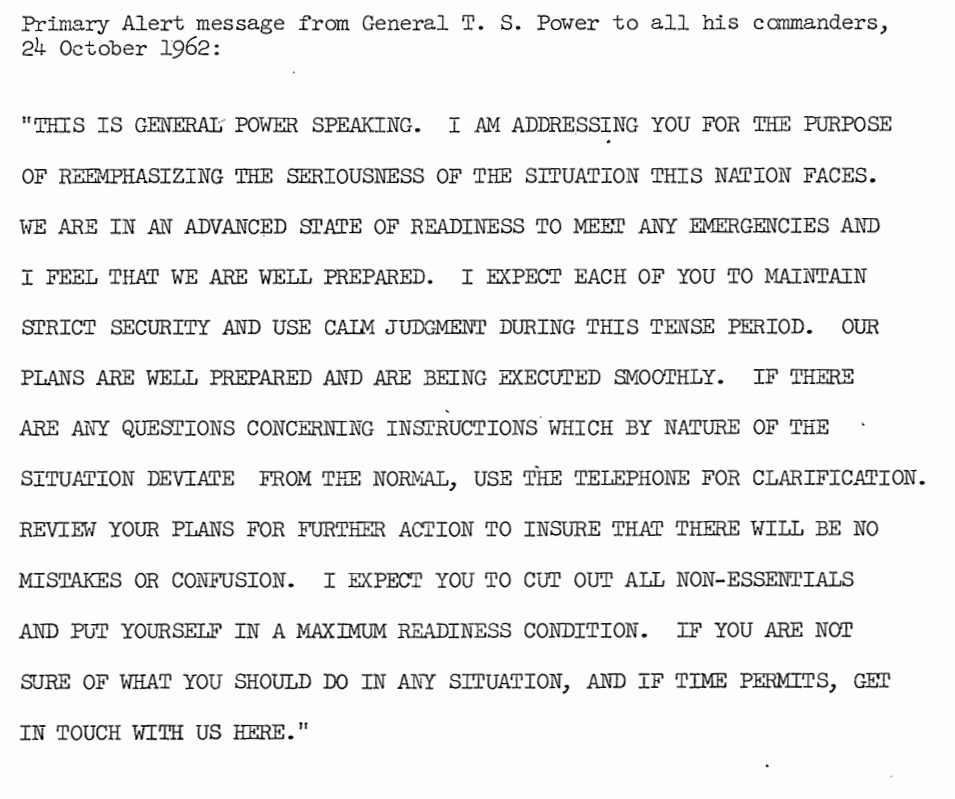
"The Kayser Report" (5 Sep 1961) (1.8 MB PDF) – This is roughly the full Kayser Report, with heavy redactions. JCS 2056/281 - The JCS Single Integrated Operational Plan - 1962 (SIOP-62) (13 Sep 1961) – This is a summary of the briefing of the SIOP that was given to President Kennedy in September 1961. At the time, SIOP-62 contained 3,729 installations over 1,060 Designated Ground Zeroes. The SIOP was broken down into 14 "execution options" based on the amount of warning; from none at all to 14+ hours with varying levels of weapons available for each execution option. Commander's Conference with Kennedy regarding Reconnaissance Operations (20 Sep 1961) (PDF) – Generals Lemnitzer (JCS Chief), Power (SAC), Taylor (Kennedy's unofficial military advisor) and Clifton met with Kennedy to discuss resumption of reconnaissance operations (U-2s) over the Soviet Union. This meeeting is notable for it containing Power's belief that: "General Power expressed great concern over the lack of information on Soviet ICBM sites, stating that we had only 10% usable photographic coverage of the USSR. Since in the photographed area 20 ICBM pads had been found, there might be many times more in the un-photographed area." Consequences of Thermonuclear War Under Various Conditions of Outbreak (Draft) (28 Oct 1961) (PDF) – This draft document is incomplete as it's missing it's Appendixes, but there's a significant amount of details on casualties expected and how many Soviet retaliatory forces would survive to be used against the US/NATO. JCS memorandum on General Format for SIOP-63 (17 Apr 1962) (PDF) – This details how SIOP-63 (the plan in operation during the Cuban Missile Crisis) would have been laid out. Even though it's nothing but a table of contents, the titles of each section can tell you much; like the fact there are only up to five attack options (the previous SIOP-62 had fourteen options). Primary Alert message from General Power (24 October 1962) (PNG) – During the height of the Cuban Missile Crisis in 1962, General Thomas Power, CINCSAC; sent out an open in the clear message to all SAC units. For decades, it has been used to malign General Power as a loose cannon; but now that you can look at the actual text of what he said, it turns out he was much more calm than they said he was. Recommended FY 1964-FY 1968 Strategic Retaliatory Forces [Draft] (21 Nov 1962) (1.5 MB PDF) – In this, McNamara recommends killing Skybolt; and it includes a very detailed data table of: "Readiness, Survival, Reliability and Penetration Factors by Weapons System (End-FY 1968)". Recommended FY 1967-FY 1971 Strategic Retaliatory Forces [Draft] (1 Nov 1965) (1.4 MB PDF) – In this, rough specifications for the proposed FB-111A+, FB-111M-3 and AMSA appear alongside that of the B-52C, B-52H and B-58A. It also reveals that the JCS wanted 2,448+ SAM-D (PATRIOT) missiles by FY74 -- a force level about equal to the Army's NIKE-HERCULES force circa FY61. JCSM-12-63: Withdrawal of Italian and Turkish JUPITERs (10 Jan 1963) (2.5 MB PDF) – This letter details the comments that CINCLANT, USCINCEUR and the Director, Strategic Target Planning (DSTP) forwarded to the JCS regarding the loss of NATO IRBMs in the Mediterranean area. History of the Joint Strategic Target Planning Staff: Preparation of SIOP-63 (January 1964) - There are multiple versions of this document available through the National Security Archive - (2.8 MB Redacted Version | 4 MB Mostly Unredacted Version (alt version) – This is the SIOP that went "hot" in August 1962 and was active during the Cuban Missile Crisis. Summary of Population Fatalities from Nuclear War in 1966 (17 Feb 1962) (PDF) – This rather thin document details the estimated population fatalities in 1966 with an attached appendix providing the number of Soviet Bloc targets for mid-1967 and the assigned warheads for each target -- 467 aim points for ICBMs with 1,501 warheads (3.21 per) assigned. CM-858-63: Attack of Hardened Targets In FY 1966 (Undated) (PDF) – This letter from the Chairman of the JCS (Maxwell Taylor) to the Director of the Joint Staff, talks very elliptically about the requirements for FY1966 to attack hardened targets; and lists the following targeteering choices:
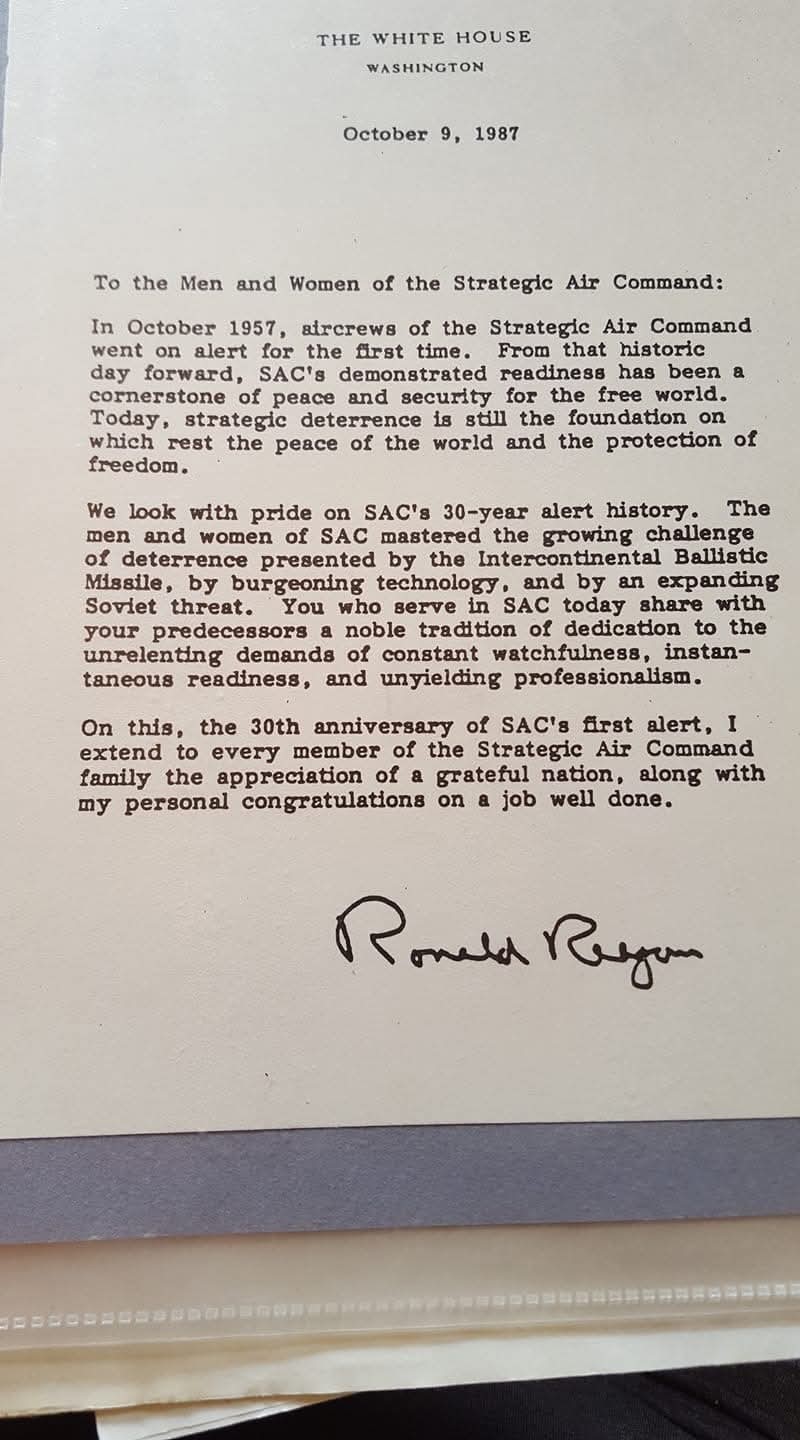
Notes of President Johnson's Meeting with the JCS over Project FUTHERANCE (14 Oct 1968) (PDF) – This rather prosaic minute reveals that up until October 1968, the US plan (FUTHERANCE) in the event POTUS was killed or missing after a nuclear attack (presumably against Washington DC) was to immediately order a full retaliatory response onto both the Soviet Union and China. An even more interesting note is the deliberate misspelling (FUTHERANCE) in the code name (it should be FURTHERANCE). Presumably this was a "barium meal" to find/locate leakers. Washington Special Action Group Review of North Korean Contingency Plans (25 Jun 1969) (PDF) – This review of contingency plans for North Korea ranges from a simple seizure of a North Korean Factory Ship (FRINGE SWOOP) to Tactical Nuclear Strikes on North Korean Targets (FREEDOM DROP). CORONA Intelligence Value Statement for CIA Backup to the NRO Budget Book (9 Apr 1970) (PDF) – In this statement, the CIA provides backup to the National Reconnaissance Office (NRO)'s budgetary requests by pointing out that from March 1969 to March 1970, spy satellites imaged 215 new Soviet ICBM silos. DOD Strategic Targeting Study Briefing [for Kissinger] (27 Jul 1972) (PDF) – This gives some details of how SIOP-4 Revision K (January 1972 to 30 June 1972) was targeted. There are now four Major Attack Options and twelve Selected Attack Options. But the biggest takeaway from this document is this phrase: "Its only objective is to win the nuclear war by destroying the enemy. There is no effort to control escalation or plan for limited options." Memorandum to POTUS: Impact of the Mideast War (1 Nov 1973) (PDF) – This memorandum from SecDef Schlesinger to Nixon lays out the impact of Israeli requests for aid during the 1973 Yom Kippur War on overall US conventional readiness. Report of the President's Commission on Strategic Forces (6 April 1983) (2 ~ MB PDF) – This short 29 page document lists in brief the major issues facing the US in the early 1980s in regards to strategic forces. Presidential Message to the Men and Women of Strategic Air Command (9 October 1987) (JPG) – In this short letter, President Reagan congratulates the personnel of SAC on the 30th anniversary of SAC's first alert. SIOP Stand-Down Message(s) (September 1991) (PDF) – These are copies of the messages sent to SAC directing that bombers and Minuteman II missiles be removed from SIOP alert durty. |
 (Click HERE for a full size image of the Oozlefinch) Air Defense Reading RoomADC Historical Study #12: Aircraft in Air Defense 1946-1960 (37.5~ MB PDF) – Contains tables listing the # of interceptors by year. ADC Historical Study #14: History of Air Defense Weapons 1946-1962 (38.6~ MB PDF) – Covers interceptors as well as BOMARC. ADC Historical Study #16: Air Defense in Theory and Practice 1918-1945 (Incomplete) (1~ MB PDF) – This is an incomplete copy; it only goes up to page 26 and is missing page 1; whereas OCLC information on this document indicates it is 46 pages in total. NIKE-HERCULES Blue Book (10~ MB PDF) – This "blue book" contains a useful chronology of the NIKE-HERCULES system, as well as uncommon technical specifications. Historical Reference Paper #6: NORAD's Quest for Nike Zeus and a Long-Range Interceptor (1 July 1962) (36.8~ MB PDF) – This is a study of NORAD's efforts to get two weapons systems: Nike Zeus and a long-range interceptor. Both were considered by NORAD to be vital to the defense of the continent. Historical Overview of the NIKE Missile System (December 1984) (3.8~ MB PDF) – This document provides a simple high level overview of NIKE-AJAX and NIKE-HERCULES, with a listing of sites as well as of maps of sites. – – – – Defence of the North American Continent (30 Nov 1953) (PDF) – This speech was given to the Defence Research Board of Canada by Ellis A. Johnson, the Director of the Operations Research Office at Johns Hopkins University. Message from USAF HQ Authorizing Atomic Weapons use for defense of CONUS (11 Dec 1956) (PDF) – This memo passes along Presidential authorization to use nuclear weapons in defense of CONUS. Chronological Histories of Army Surface-to-Air Missiles as of 1 March 1958 (PDF) – This (incomplete) chronology covers: HAWK, Land-Based TALOS, NIKE-AJAX, NIKE-ZEUS and NIKE-HERCULES. US Atomic Weapons for UK Interceptors (17 June 1959) (PDF) – Draft authorization letter for SecDef to authorize the transfer of US nuclear weapons to the UK, with potential provisions for expenditure without formal transfer of ownership. Request for Authority to Provide Atomic Weapons for U.K. Air Defense Forces (15 October 1959) (PDF) – Draft memorandum for POTUS to authorize the transfer of US nuclear weapons to UK forces under conditions suitable for air defense use. Statement Concerning the Army's Role in Air Defense by General Maxwell Taylor (22 May 1959) (PDF) – This public statement by then-Chief of Staff Maxwell Taylor in 1959 shows the view of the US Army at the time concerning Air Defense. ADC Aerospace Objectives 1965 – 1975 (21 December 1960) (PDF) – This memorandum by the then current ADC Commander, gives his opinion of current and projected future weapons systems for ADC use. Interesting tidbits:
US Warning Systems (3 November 1961) (1.1~ MB PDF) – This lengthy paper by the Office of the Secretary of Defense (OSD) was given to Senator Stennis by SecDef McNamara in response to Stennis' Preparedness Investigating Subcommittee's questions on U.S. early warning systems, more specifically their geographic coverage, how reliable they were, their survivability under attack, etc. Schriever's Comments on MIDAS (13 August 1962) (PDF) – This memorandum was submitted by General Bernard A. Schriever to SecAF Zuckert laying out the needs/requirements for MIDAS and has the following tidbits:
NORAD/CONAD Historical Summary (July - December 1965) [EXCERPTS] (14.4~ MB PDF) – This page contains excerpted passages from the official NORAD/CONAD history that are of interest; because the full document (200+ pages) is too long to OCR exhaustively. NORAD/CONAD Historical Summary (January - December 1966) [EXCERPTS] (6.8~ MB PDF) – This page contains excerpted passages from the official NORAD/CONAD history that are of interest; because the full document (200+ pages) is too long to OCR exhaustively. |
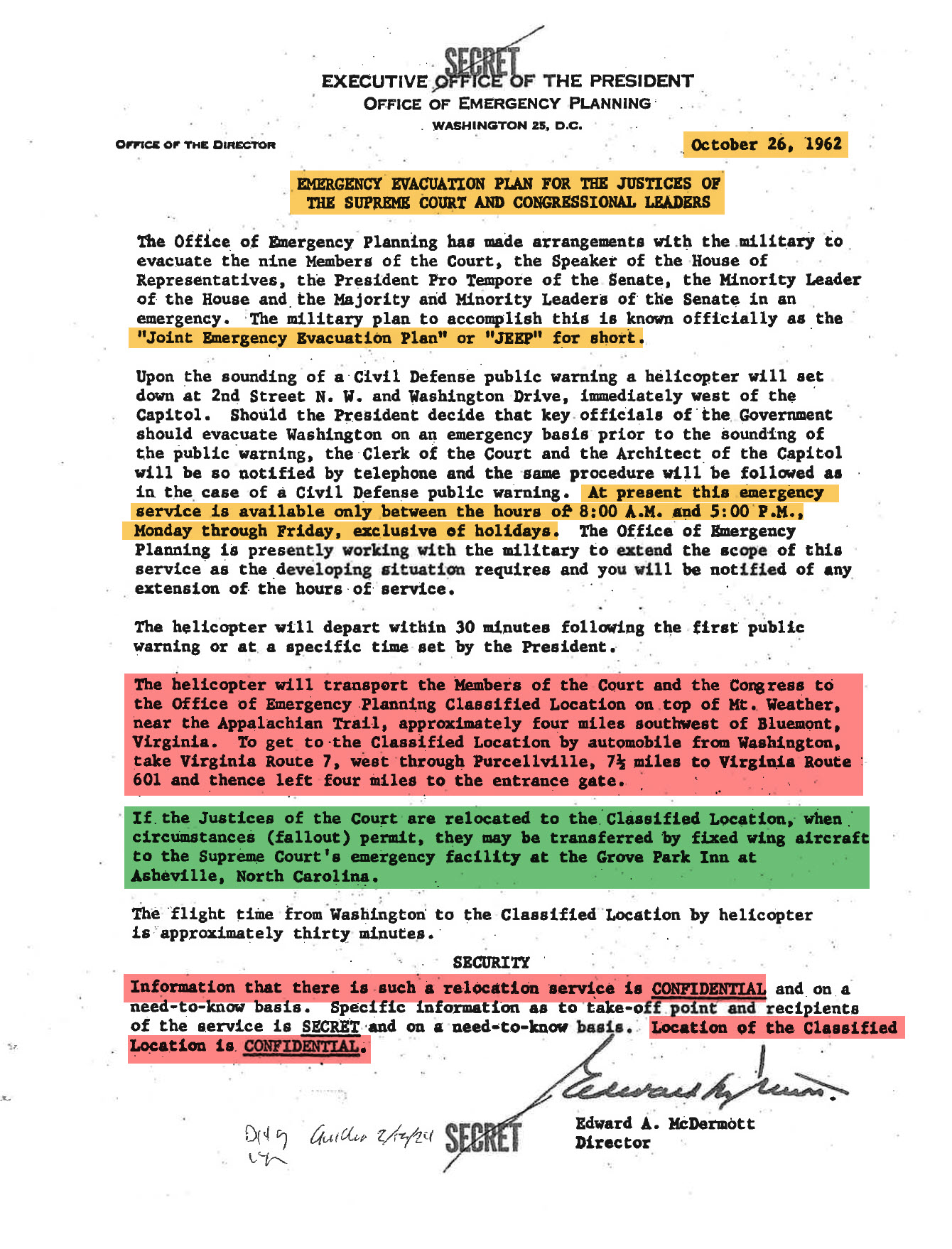
 Civil Defense Reading RoomFire Effects of Bombing Attacks (1950) (2.6 MB PDF) – This pamphlet from 1950 gathers up and summarizes information that was publicly unclassified (but of some difficulty to obtain) in 1950 on conventional bombing raids on Germany and Japan as well as the two atomic attacks during World War II. Emergency Evacuation Plan for the Justices of the Supreme Court and Congressional Leaders (26 Oct 1962) (JPG) – This speaks in vague terms about how specific Congressmen and SCOTUS justices would be evacuated to the "Office of Emergency Planning Classified Location on top of Mt. Weather", and also details how once fallout abates, SCOTUS may be transferred to the "Supreme Court's emergency facility at the Grove Park Inn at Asheville, North Carolina." JCSM-4-64: Memo from JCS to SecDef, regarding Deep Underground Command Center (DUCC) (10 Jan 1964) – In this memo, the JCS inform McNamara that "it is the opinion of the Joint Chiefs of Staff that a DUCC as a military command center cannot be justified." ORNL 5041: Survival of the Relocated Population of the US After a Nuclear Attack (June 1976) (16.4 MB PDF / 12.2 MB PDF) – This rather detailed study looks into the likely effects of a 6,559 MT attack on CONUS at 1,444 designated ground zeroes broken down as:
|
|

CIA Reading RoomThis section deals with specific CIA estimates, which represent the "consensus" of the National Intelligence Community on certain subjects. ORE 77-48: Chinese Communist Capabilities for Control of all China (10 Dec 1948) (Ver 1 PDF | Ver 2 PDF | Ver 3 PDF [4.5MB] | Ver 4 ZIP [Truman's Copy]) NIE-29/1: Review of the Conclusions of NIE-29 "PROBABILITY OF AN INVASION OF YUGOSLAVIA IN 1951" (4 May 1951) (2.4 MB PDF) NIE 11-3-61: Sino-Soviet Air Defense Capabilities through Mid-1966 (11 July 1961) (5 MB PDF | 13.9 MB PDF [CIA Copy]) |
State Reading Room

This section deals with high-level foreign policy issues. MacArthur's "Bread or Bullets" Message to Congress regarding Japan (20 February 1947) (0.59 MB PDF) – This is the famous "give me bread or give me bullets" response that MacArthur gave to Congress over the cost of sending food to Japan post-war. Unfortunately for us historians, he didn't actually quite say that – you have to read "between the lines" in his statement. |
|


AEC / DOE Reading RoomThis section deals with nuclear weapons/energy, as the AEC/DOE managed them in response to Service requests/specifications as well as managing nuclear weapons custody from the 1940s into the 1950s. Proposed Plan for Atomic Bomb Test Against Naval Vessels (PDF) – This memorandum lays out a proposed plan to carry out A-Bomb testing against naval ships, which would become Operation CROSSROADS. Atomic Weapons Custody Memo from SecDef to POTUS (23 Mar 1956) (PDF) – This memorandum lays out the proposed (at the time) methods and conditions for the transfer of custody of nuclear weapons from AEC control to DOD hands for Eisenhower to comment on. AEC-DOD Memorandum of Understanding for the Transfer of Atomic Weapons (4 May 1956) (138~ kb PDF) – This memorandum details the terms and conditions under which the AEC would transfer nuclear weapons into the custody of DOD combatant commanders, circa 1956. Address by Herbert Loper, Assistant to SecDef (Atomic Energy) before the Air War College on current U.S. Nuclear Energy Programs 1956-1959 (19 November 1956) (488~ kb PDF) – In this speech, Mr. Loper states the theoretical energies available from U235, Pu239 as well as Lithium-6 Deuteride as well as the current "burn rates" of nuclear weapons. In closing, he gives a list of potential nuclear weapon weights and weight/yield ratios from 10 kT to 4 MT that seem achievable by 1965. DCI Briefing to Joint Chiefs of Staff (30 July 1963 @ 1000 Hrs) (12~ MB PDF) – This briefing by the Director of Central Intelligence (DCI) to the JCS in mid-1963 lays out what people expected in kT/lb from different warheads as well as providing known/estimated ranges as well as warhead yields/weights for a variety of tactical and strategic weapons systems. Narrative Summaries of Accidents involving U.S. Nuclear Weapons 1950-1980 (Apr 1981) (138~ kb PDF) – This document lays out all the officially acknowledged incidents involving US Nuclear Weapons at the time of press in 1981-82. DOE/ES-0005: The United States Nuclear Weapon Program: A Summary History (March 1983) DOE Fact Sheet: Increasing Transparency in the U.S. Nuclear Weapons Stockpile (3 May 2010) |
 Naval Forces Reading RoomU.S. Navy Estimated Shipbuilding Costs (14 August 1947) – This page contains the USN's estimates for immediate post-war combatant construction times and costs. A gold mine for designing Cost Estimation Relationships (CERs). The Tenets of Naval War Planning by RADM W.F. Boone (18 April 1949) (774~ kb PDF) – This speech was given at the Air University at Maxwell AFB in 1949, and provides us with the USN's immediate post-WW2 views on strategic planning, and has this lede which shows the USN's views on strategic air warfare at the time: "The explosive equivalent of over 500 A-bombs was dropped on Germany and she still produced vast quantities of war equipment." TANG-Class (SS-563/564) Cost Hearings (12 May 1949) (1.8 MB PDF) – In 1949, Congress held short hearings on the cost-escalations since 1947 on the new TANG-class Submarines. Awards for USS Nautilus (SSN-571) crew for North Pole Crossing (8 August 1956) (176~ kb PDF) – These are the citations for the Legion of Merit for Commander Anderson and the Presidential Unit Citation for the crew of the Nautilus, following her North Pole crossing in the summer of 1958. The Development of Nuclear Propulsion in the Navy (29 March 1960) (176~ kb PDF) – This paper is a summary of the Navy's early interest in Nuclear Power over ten years from early investigations in 1939 to the CNO issuing a formal operational requirement for a nuclear-powered submarine in August 1949. DOD Appropriations for 1970: Hearings -- Excerpt on Nuclear Submarine Cores (1969) (PDF) – A considerable amount of detailed information on reactor core life was revealed in 1969 during Congressional hearings on the FY70 DOD budget. Nuclear Warships and the Navy's Future: A Speech by Admiral Rickover (8 March 1974) (1.5MB PDF) – This speech by Admiral Rickover lays out his rationale for converting as much of the Navy's fleet to Nuclear power as possible. GAO/NSIAD-98-1: NAVY AIRCRAFT CARRIERS: Cost-Effectiveness of Conventionally and Nuclear-Powered Carriers (August 1998) (ASCII Conversion) (1.8~ MB PDF) – This GAO document, done in the 1990s covers many of the issues related to the extra performance of CVNs over CVs and their associated costs. |
 Ground Forces Reading RoomNSIAD-95-89 – Industrial Base: Inventory and Requirements for Artillery Projectiles (March 1995) (1.1 MB PDF) – This document details the US Military's shell inventory as of roughly November 1994; which gives you a general idea of how big the U.S. munitions base was in the final years of the Cold War. |
 RAND Corporation Reading Room"Founded" in October 1945 when the Army Air Forces gave the 'Project RAND' (Research ANd Development) contract to Douglas Aircraft; Douglas/Project RAND released Preliminary Design of an Experimental World-Circling Spaceship in May 1946. Due to concerns over conflicts of interest in obtaining future hardware contracts, Douglas in late 1947 requested that RAND be spun off into an independent non-profit corporation, which was accomplished by November 1948. RM-868: Implications of Potential Weapon Developments for Strategic Bombing and Air Defense - A Preliminary Study (10 July 1952) (1.39 MB PDF) – Late in 1951, Los Alamos informed RAND that weapons of yields ranging from 1 to 25 MT would be available in a few years. RAND reported the results of its studies to the Government in March 1952 and then reprinted several of their studies as Research Memorandums (RMs), of which this is one.
R-237: Implications of Large-Yield Nuclear Weapons (10 July 1952) (578 kb PDF) – Late in 1951, Los Alamos informed RAND that weapons of yields ranging from 1 to 25 MT would be available in a few years. RAND reported the results of its studies to the Government in March 1952 before ultimately printing a summary of their findings in this report. D-2270: Defending a Strategic Force after 1960 (1 February 1954) (PDF) – This paper by Wohlstetter and Hoffman presents the first findings of an early study done in late 1953 on how to defend Strategic Air Command against the ICBM threat, referred to here as "IBMs" since terminology was not yet canonical.
D-4659: Some Comments on The Capability of SAC in Non-Atomic, Limited War (21 Oct 1957) (PDF) – This paper by William M. Jones analyzes the capabilities of SAC if it was called upon to do "non-atomic, limited war" missions.
R-1754-PR: The U.S. ICBM Force: Current Issues and Future Options (October 1975) (4.7 MB PDF) – This remarkable document contains a large amount of information on the “second generation” of US ICBMs (Minuteman I/II/III and Titan II) during the early 1970s; as well as a large amount of highly useful data otherwise. |
These are various General Orders issued by the US Army for specific newsworthy events during the Cold War period.
General Order 50 of November 23,
1963 (Death of John F Kennedy) (PDF)
General
Order 19 of March 28, 1969 (Death of Dwight Eisenhower)
(PDF)
General
Order 34 of June 8, 1970 (Sergeant Major of the Army
Position/Duties) (PDF)
General
Order 32 of September 4, 1974 (Death of Creighton Abrams)
(PDF)
General
Order 15 of June 14, 1975 (U.S. Army Bicentennial) (PDF)
General
Order 19 of October 31, 1978 (Branch Anniversary Dates)
(PDF)
General
Order 11 of April 27, 1981 (Death of Omar Bradley) (PDF)
General
Order 24 of June 4, 1984 (40th Anniversary of D-Day Landings)
(PDF)